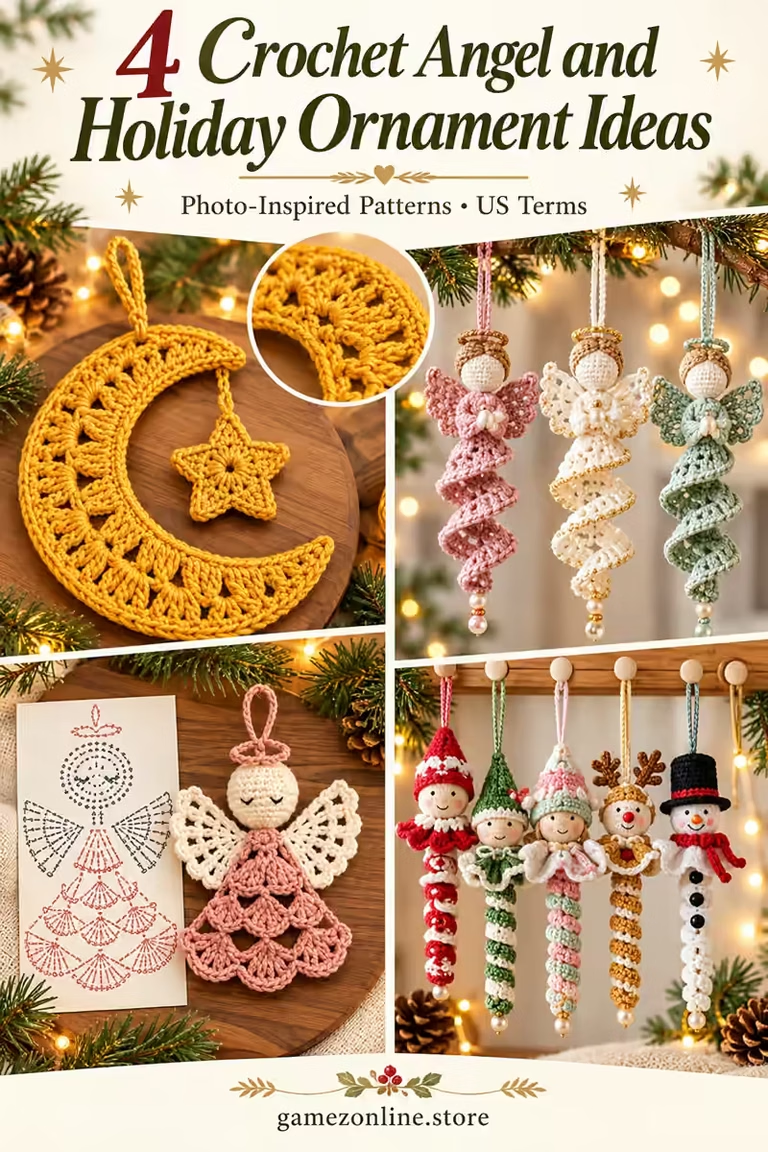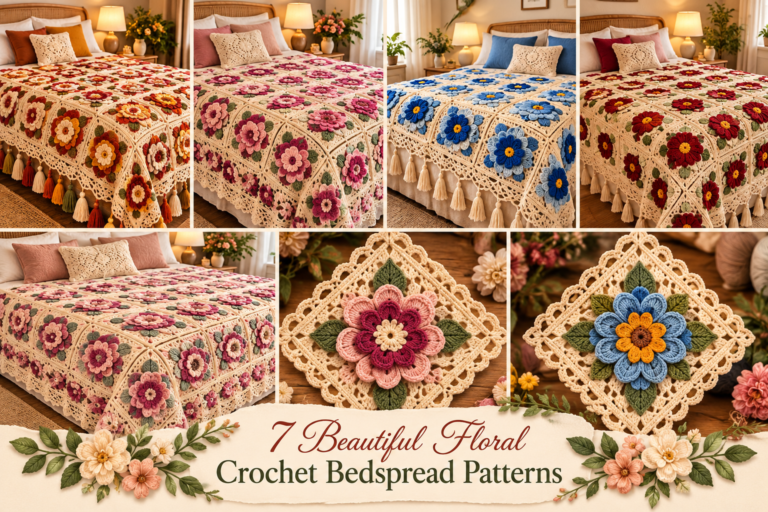
4 Crochet Butterfly Motif Ideas
Explore four crochet butterfly motif ideas with original US-term patterns for gold lace trim, lavender appliques and a burgundy floral butterfly. Each photo is paired with an original construction, materials, counted steps and finishing notes.
US crochet terms and working rules
ch = chain; sl st = slip stitch; sc = single crochet; hdc = half double crochet; dc = double crochet; inc = 2 stitches in one stitch; sc2tog = single crochet two stitches together; st(s) = stitch(es); sp = space; RS = right side. A magic ring is an adjustable yarn loop. Numbers in brackets give end-of-round or end-of-row counts. Repeat instructions between parentheses the stated number of times.
Unless a step explicitly says otherwise, beginning chains do not count as stitches. For dc rounds, ch 2 to reach height, then work the first dc into the first stitch; join to the first real dc. For sc rounds, ch 1 and join to the first sc. For flat sc rows, ch 1 and turn. Flat dc rows explicitly use ch 3 as the first counted dc. Do not work into joining slip stitches. Change color by completing the last yarn-over of the preceding stitch with the new yarn.
To work sc2tog: insert hook into the next stitch and draw up a loop, repeat in the following stitch, yarn over and draw through all three loops. For a surface slip stitch, bring the yarn up from behind the fabric, insert the hook into the next chosen gap and pull the new loop through the loop already on the hook. Keep these stitches loose.
US terms: inc = 2 stitches of the stated type in one stitch; sc2tog/dc2tog/dc3tog = work two or three stitches together as named; BLO = back loop only; FPdc = front-post double crochet; tr = treble crochet. Ch 3 counts as a dc unless stated otherwise; ch 1 for turning never counts. Joined rounds close with sl st unless continuous rounds are specified. The printed charts in some photographs are reference content, not instructions verified or transcribed here.
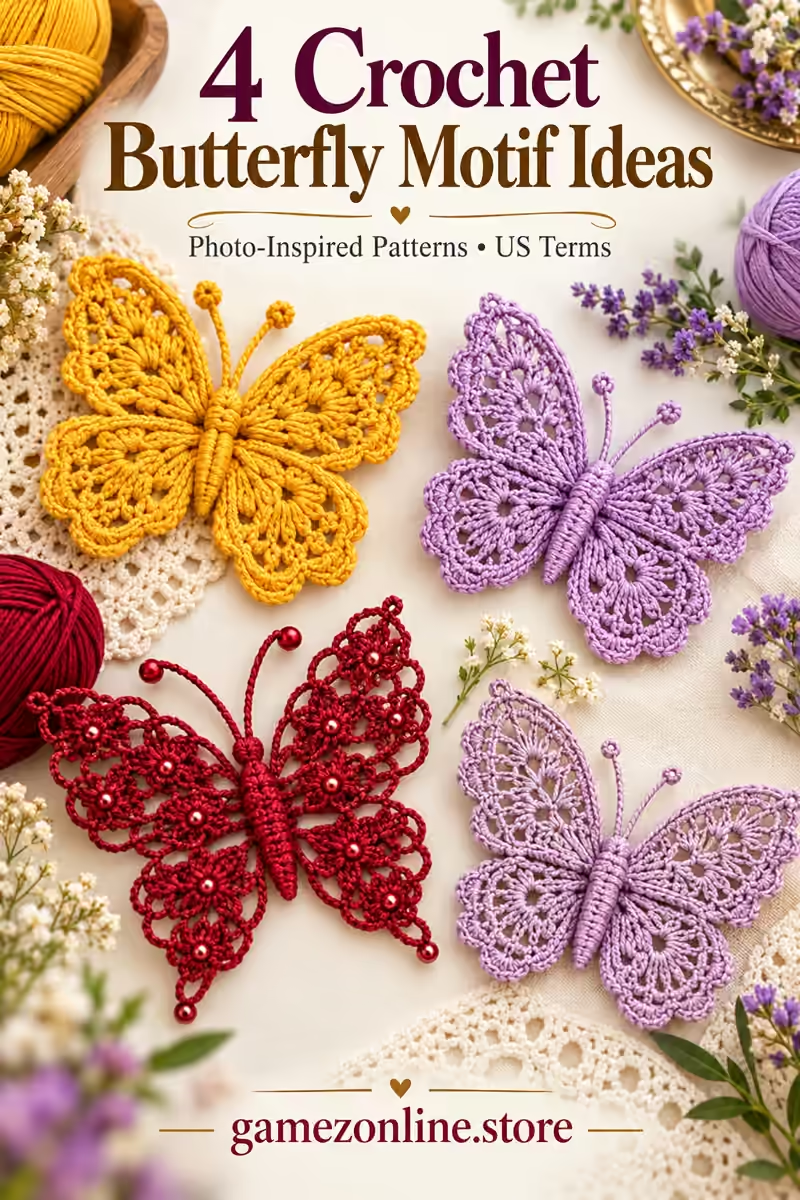
1. Golden Butterfly Lace Band
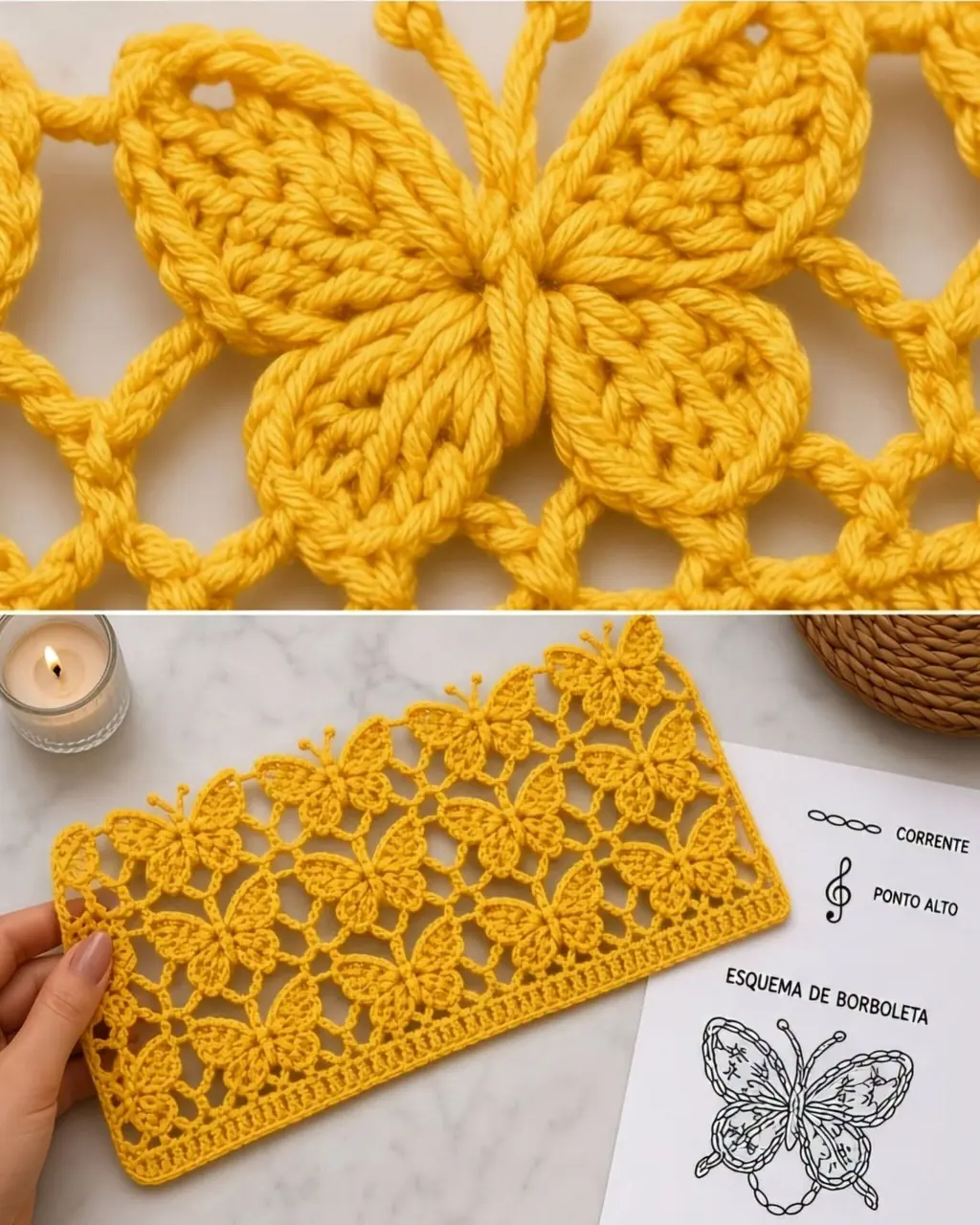
This golden butterfly lace band highlights gold. The written version explains a complete original construction while simplifying details that cannot be recovered reliably from the photograph.
Materials, gauge and size
Sport cotton, approximately 15–35 g per butterfly, or 100–200 g for a five-motif band. Colors: gold. Hook: 2–3 mm. Quantities are estimates; weigh a sample and add 15–20% for assembly, edging and adjustments.
Also use a yarn needle, scissors, markers, measuring tape and blocking pins.
Gauge and size: Make one motif and measure its blocked wingspan. Different yarn/hook combinations change size; the photographed chart is not a verified pattern source.
Four-wing butterfly motif
- Ch 5 and join to form a ring. Round 1: (sc in ring, ch 7) four times; join to first sc [4 anchors, 4 loops]. Mark the first two loops as upper wings and the next two as lower wings.
- Round 2: in each of the two upper loops work (sc, hdc, 4 dc, 3 tr, 4 dc, hdc, sc); sl st in the following anchor [15 stitches per upper wing]. In each lower loop work (sc, hdc, 5 dc, hdc, sc); sl st in its following anchor [9 stitches per lower wing]. Fasten off [48 wing stitches plus 4 anchor sl sts].
- Round 3: join at an upper wing base. Sc in each of that wing’s 15 stitches, adding a ch-3 picot after its eighth stitch (ch 3, sl st in first of these chains). Repeat for the other upper wing. Sc in each lower wing’s nine stitches, adding a picot after its fifth stitch. Sl st across the four old anchor joins as you reach them; no extra stitches in those joins [48 sc, 4 picots and 4 anchor sl sts].
- Body: ch 13. Row 1: sc in second chain and across [12]. Row 2: sc across [12]. Fold the strip lengthwise, sew the long edges together without stuffing, and stitch it down the motif center. Arrange upper wings above lower wings before fixing it. Antennae: join at body top, ch 9, sl st along 8 chains, sl st in body; repeat once [two antennae]. Embroider a small knot at each tip.
Project variation and assembly
- Make five gold butterflies. Block them to equal height, then sew neighboring side wing tips together at two points. For top and bottom rails, join at the first outer wing tip, ch 7 to the next corresponding tip, sl st to attach and repeat across. Change the bridge length equally across the band if the blocked tips are farther apart.
- Work one sc per rail chain and attachment, then one dc row in every sc. Add one sc row along each short end. A 2 × 5 panel uses ten motifs joined at all touching points. The separate-motif band interprets the reference rather than transcribing its chart.
Assembly and finishing
- Check all counts before joining. Weave ends through several stitches in three directions. Sew point joins more than once and distribute tension evenly.
- Wash a sample using the yarn care instructions, block gently and allow it to dry completely. Recheck fit or motif size after washing. These original patterns are photo-inspired and physically untested; they do not reproduce a verified photographed chart.
2. Lavender Butterfly Appliques in Two Sizes
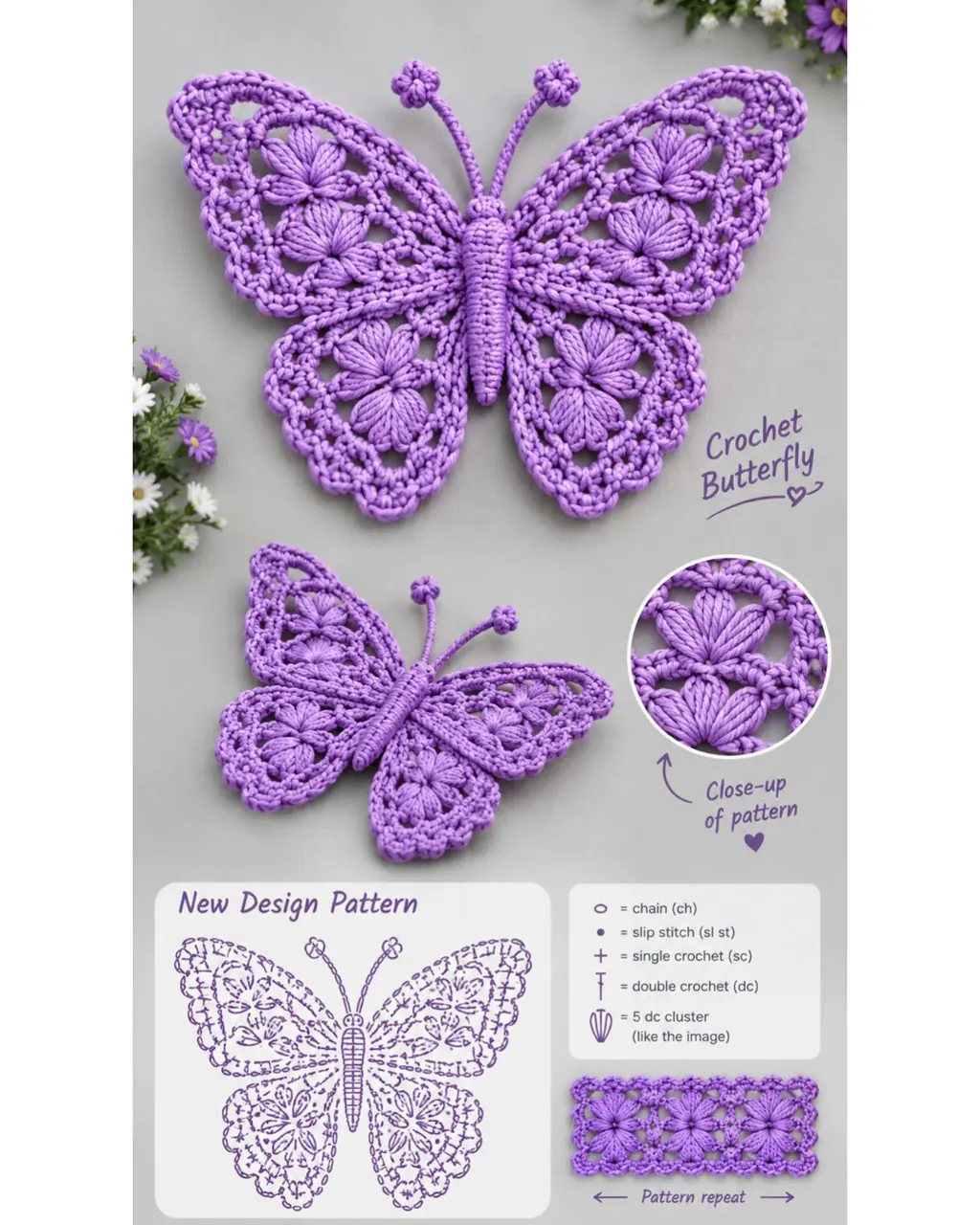
This lavender butterfly appliques in two sizes highlights lavender. The written version explains a complete original construction while simplifying details that cannot be recovered reliably from the photograph.
Materials, gauge and size
Sport cotton, approximately 15–35 g per butterfly, or 100–200 g for a five-motif band. Colors: lavender. Hook: 2–3 mm. Quantities are estimates; weigh a sample and add 15–20% for assembly, edging and adjustments.
Also use a yarn needle, scissors, markers, measuring tape and blocking pins.
Gauge and size: Make one motif and measure its blocked wingspan. Different yarn/hook combinations change size; the photographed chart is not a verified pattern source.
Four-wing butterfly motif
- Ch 5 and join to form a ring. Round 1: (sc in ring, ch 7) four times; join to first sc [4 anchors, 4 loops]. Mark the first two loops as upper wings and the next two as lower wings.
- Round 2: in each of the two upper loops work (sc, hdc, 4 dc, 3 tr, 4 dc, hdc, sc); sl st in the following anchor [15 stitches per upper wing]. In each lower loop work (sc, hdc, 5 dc, hdc, sc); sl st in its following anchor [9 stitches per lower wing]. Fasten off [48 wing stitches plus 4 anchor sl sts].
- Round 3: join at an upper wing base. Sc in each of that wing’s 15 stitches, adding a ch-3 picot after its eighth stitch (ch 3, sl st in first of these chains). Repeat for the other upper wing. Sc in each lower wing’s nine stitches, adding a picot after its fifth stitch. Sl st across the four old anchor joins as you reach them; no extra stitches in those joins [48 sc, 4 picots and 4 anchor sl sts].
- Body: ch 13. Row 1: sc in second chain and across [12]. Row 2: sc across [12]. Fold the strip lengthwise, sew the long edges together without stuffing, and stitch it down the motif center. Arrange upper wings above lower wings before fixing it. Antennae: join at body top, ch 9, sl st along 8 chains, sl st in body; repeat once [two antennae]. Embroider a small knot at each tip.
Project variation and assembly
- Make one motif in sport cotton with a 2.5 mm hook and another in fine crochet thread with a 1.5 mm hook. Keep all counts unchanged; the yarn and washed gauge create the two sizes. Measure and record each wingspan instead of assuming the photograph’s scale.
- Use each as a flat applique: sew the body and four wing tips to the receiving fabric with matching thread. Optional trim sample: arrange four small motifs in a row and connect corresponding wing tips with reinforced sewing stitches.
Assembly and finishing
- Check all counts before joining. Weave ends through several stitches in three directions. Sew point joins more than once and distribute tension evenly.
- Wash a sample using the yarn care instructions, block gently and allow it to dry completely. Recheck fit or motif size after washing. These original patterns are photo-inspired and physically untested; they do not reproduce a verified photographed chart.
3. Burgundy Floral Lace Butterfly
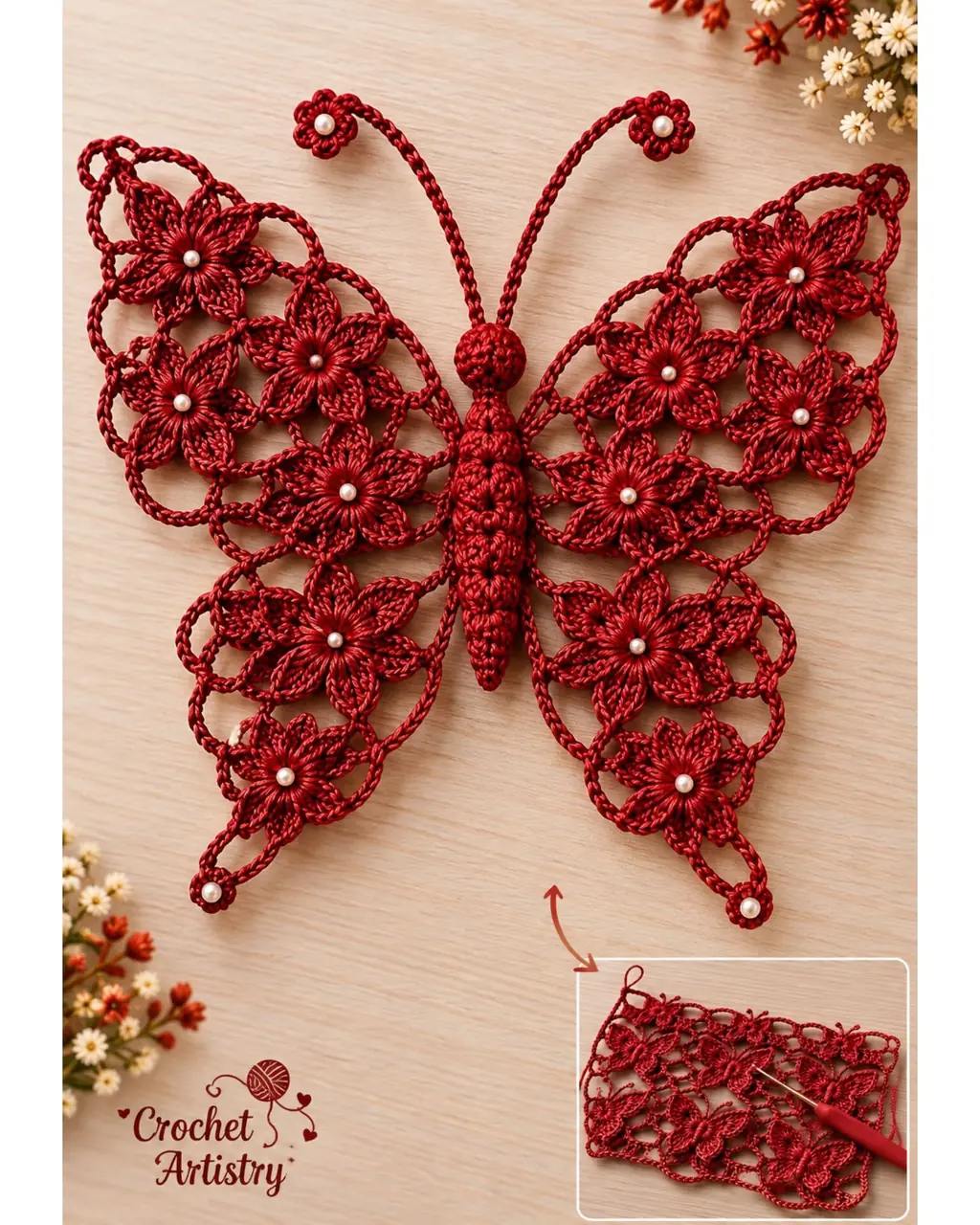
This burgundy floral lace butterfly highlights burgundy. The written version explains a complete original construction while simplifying details that cannot be recovered reliably from the photograph.
Materials, gauge and size
Sport cotton, approximately 15–35 g per butterfly, or 100–200 g for a five-motif band. Colors: burgundy. Hook: 2–3 mm. Quantities are estimates; weigh a sample and add 15–20% for assembly, edging and adjustments.
Also use a yarn needle, scissors, markers, measuring tape and blocking pins.
Gauge and size: Make one motif and measure its blocked wingspan. Different yarn/hook combinations change size; the photographed chart is not a verified pattern source.
Four-wing butterfly motif
- Ch 5 and join to form a ring. Round 1: (sc in ring, ch 7) four times; join to first sc [4 anchors, 4 loops]. Mark the first two loops as upper wings and the next two as lower wings.
- Round 2: in each of the two upper loops work (sc, hdc, 4 dc, 3 tr, 4 dc, hdc, sc); sl st in the following anchor [15 stitches per upper wing]. In each lower loop work (sc, hdc, 5 dc, hdc, sc); sl st in its following anchor [9 stitches per lower wing]. Fasten off [48 wing stitches plus 4 anchor sl sts].
- Round 3: join at an upper wing base. Sc in each of that wing’s 15 stitches, adding a ch-3 picot after its eighth stitch (ch 3, sl st in first of these chains). Repeat for the other upper wing. Sc in each lower wing’s nine stitches, adding a picot after its fifth stitch. Sl st across the four old anchor joins as you reach them; no extra stitches in those joins [48 sc, 4 picots and 4 anchor sl sts].
- Body: ch 13. Row 1: sc in second chain and across [12]. Row 2: sc across [12]. Fold the strip lengthwise, sew the long edges together without stuffing, and stitch it down the motif center. Arrange upper wings above lower wings before fixing it. Antennae: join at body top, ch 9, sl st along 8 chains, sl st in body; repeat once [two antennae]. Embroider a small knot at each tip.
Project variation and assembly
- Make one burgundy butterfly and six tiny flowers using the five-petal motif below. Sew two flowers on each upper wing and one on each lower wing, catching both the center and two petal tips. Use a slightly finer thread for flowers so the wing outline remains visible.
- Embroider gold knots at the flower centers rather than attaching loose beads. For a brooch, sew a purchased brooch finding to a felt backing and stitch the backing to the body; the finding is a supply, not a crocheted component.
- With the center color work 10 sc into a magic ring; join [10]. With the petal color repeat (sl st in next sc, 5 dc in next sc) five times. [Five petals] Fasten off with a sewing tail; weave or sew both ends securely.
Assembly and finishing
- Check all counts before joining. Weave ends through several stitches in three directions. Sew point joins more than once and distribute tension evenly.
- Wash a sample using the yarn care instructions, block gently and allow it to dry completely. Recheck fit or motif size after washing. These original patterns are photo-inspired and physically untested; they do not reproduce a verified photographed chart.
4. Lilac Openwork Butterfly
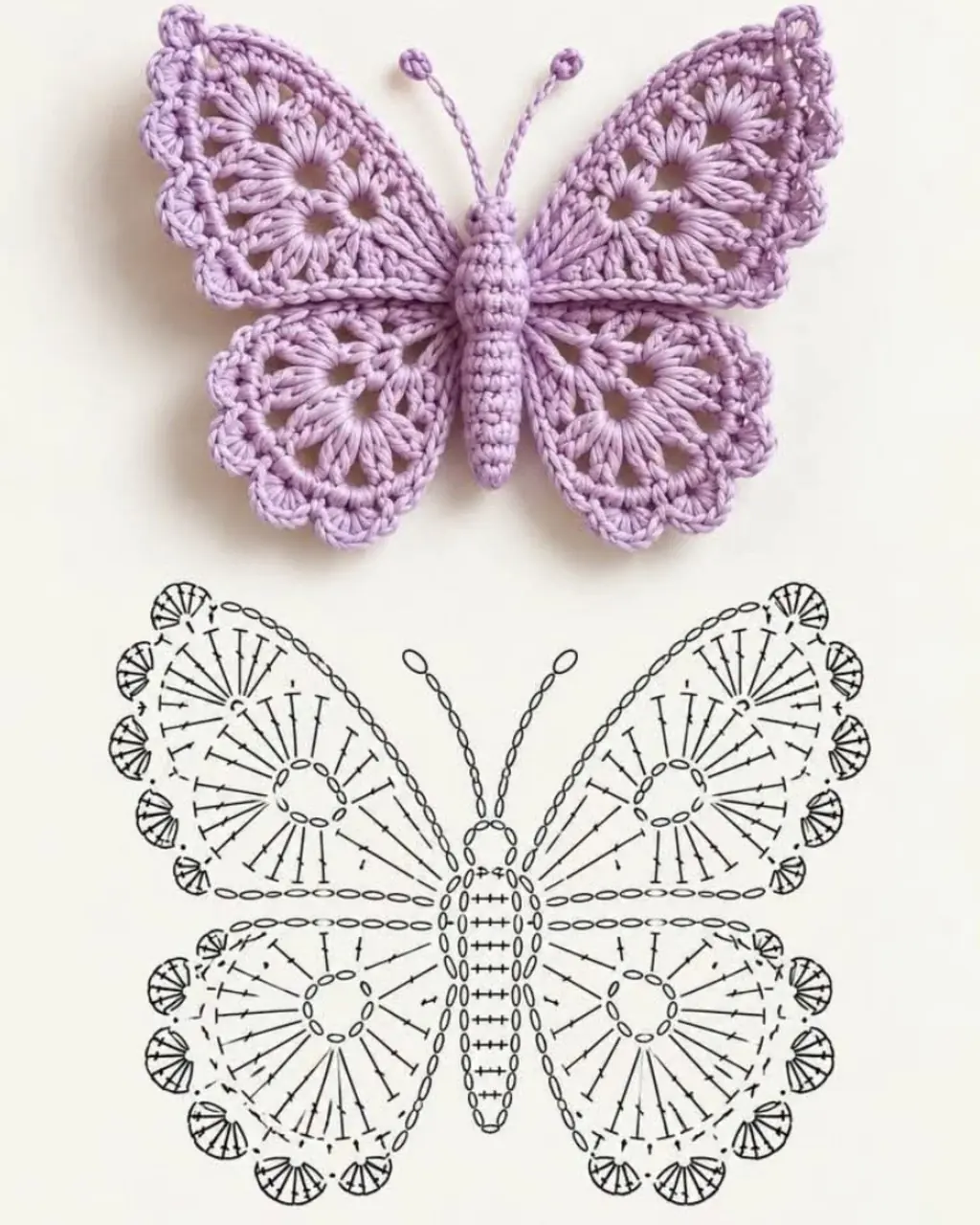
This lilac openwork butterfly highlights lilac. The written version explains a complete original construction while simplifying details that cannot be recovered reliably from the photograph.
Materials, gauge and size
Sport cotton, approximately 15–35 g per butterfly, or 100–200 g for a five-motif band. Colors: lilac. Hook: 2–3 mm. Quantities are estimates; weigh a sample and add 15–20% for assembly, edging and adjustments.
Also use a yarn needle, scissors, markers, measuring tape and blocking pins.
Gauge and size: Make one motif and measure its blocked wingspan. Different yarn/hook combinations change size; the photographed chart is not a verified pattern source.
Four-wing butterfly motif
- Ch 5 and join to form a ring. Round 1: (sc in ring, ch 7) four times; join to first sc [4 anchors, 4 loops]. Mark the first two loops as upper wings and the next two as lower wings.
- Round 2: in each of the two upper loops work (sc, hdc, 4 dc, 3 tr, 4 dc, hdc, sc); sl st in the following anchor [15 stitches per upper wing]. In each lower loop work (sc, hdc, 5 dc, hdc, sc); sl st in its following anchor [9 stitches per lower wing]. Fasten off [48 wing stitches plus 4 anchor sl sts].
- Round 3: join at an upper wing base. Sc in each of that wing’s 15 stitches, adding a ch-3 picot after its eighth stitch (ch 3, sl st in first of these chains). Repeat for the other upper wing. Sc in each lower wing’s nine stitches, adding a picot after its fifth stitch. Sl st across the four old anchor joins as you reach them; no extra stitches in those joins [48 sc, 4 picots and 4 anchor sl sts].
- Body: ch 13. Row 1: sc in second chain and across [12]. Row 2: sc across [12]. Fold the strip lengthwise, sew the long edges together without stuffing, and stitch it down the motif center. Arrange upper wings above lower wings before fixing it. Antennae: join at body top, ch 9, sl st along 8 chains, sl st in body; repeat once [two antennae]. Embroider a small knot at each tip.
Project variation and assembly
- Make one lilac motif. For a lighter second example use ch 9 for each wing loop but keep the Round-2 stitches unchanged, spreading them evenly. This enlarges the openings rather than producing an exact alternate-size pattern.
- Block with the two upper wings slightly higher than the body top and lower wings angled down. Sew onto fabric through the body and wing tips, or reinforce two tip connections per neighboring motif for a lace strip.
Assembly and finishing
- Check all counts before joining. Weave ends through several stitches in three directions. Sew point joins more than once and distribute tension evenly.
- Wash a sample using the yarn care instructions, block gently and allow it to dry completely. Recheck fit or motif size after washing. These original patterns are photo-inspired and physically untested; they do not reproduce a verified photographed chart.