
12 Crochet Blanket and Bedspread Ideas
Explore 12 crochet blanket and bedspread ideas, with original US-term patterns for floral squares, butterfly motifs, spiral medallions and sofa covers. Each reference below has its own materials, counted construction, assembly and finishing instructions.
US crochet terms and working rules
ch = chain; sl st = slip stitch; sc = single crochet; hdc = half double crochet; dc = double crochet; inc = 2 stitches in one stitch; sc2tog = single crochet two stitches together; st(s) = stitch(es); sp = space; RS = right side. A magic ring is an adjustable yarn loop. Numbers in brackets give end-of-round or end-of-row counts. Repeat instructions between parentheses the stated number of times.
Unless a step explicitly says otherwise, beginning chains do not count as stitches. For dc rounds, ch 2 to reach height, then work the first dc into the first stitch; join to the first real dc. For sc rounds, ch 1 and join to the first sc. For flat sc rows, ch 1 and turn. Flat dc rows explicitly use ch 3 as the first counted dc. Do not work into joining slip stitches. Change color by completing the last yarn-over of the preceding stitch with the new yarn.
To work sc2tog: insert hook into the next stitch and draw up a loop, repeat in the following stitch, yarn over and draw through all three loops. For a surface slip stitch, bring the yarn up from behind the fabric, insert the hook into the next chosen gap and pull the new loop through the loop already on the hook. Keep these stitches loose.
Additional US terms used here: inc = 2 stitches of the stated type in one stitch; dec/sc2tog = single crochet two together; dc2tog = double crochet two together; sc3tog = single crochet three together; tr = treble crochet; BLO = back loop only; front-post dc = work a dc around the post from front to back to front. A ch-3 turning chain counts as one dc unless a step explicitly states otherwise; a ch-1 turn never counts as a stitch.
1. Gray Petal-Lace Bedspread
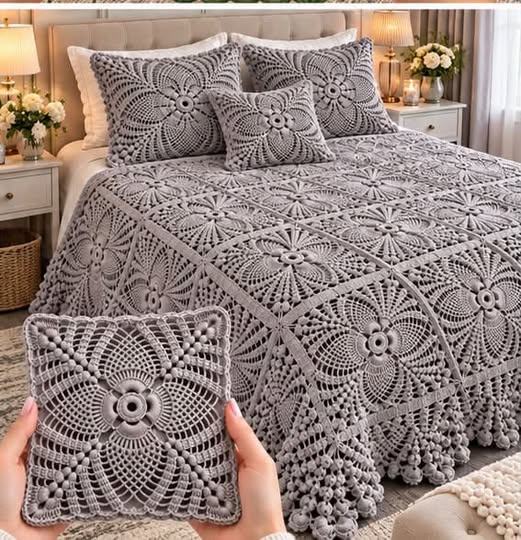
The reference highlights gray in a gray petal-lace bedspread. The written construction preserves the overall idea while simplifying details that cannot be reliably recovered from a photograph.
Materials, gauge and size
Smooth DK yarn, approximately 1,500–3,500 g for a full cover, or 800–1,800 g for a measured sofa set; 3.5–4.5 mm hook. Colors: gray. These are estimates: weigh a sample, multiply by the planned component count and add 15–20% for assembly and adjustments.
Also use a yarn needle, scissors, stitch markers and a measuring tape. Make and wash one complete motif. Measure width W, calculate motif count from the actual bed or sofa, and weigh the sample before buying all yarn. No photographic scale is assumed.
Eight-petal lace medallion
- Joined rounds: ch 4 and join to form a ring. Round 1: 16 sc into ring [16]. Round 2: (sc in next stitch, ch 7, skip next stitch) eight times; join [8 anchors and 8 loops].
- Round 3: into each loop work (sc, hdc, 3 dc, ch 2, 3 dc, hdc, sc); sl st into next anchor [8 petals; 10 stitches and one ch-2 tip each]. Round 4: behind each petal, sc around its Round-2 anchor post and ch 9 [8 anchors, 8 loops].
- Round 5: into each back loop work (sc, hdc, 4 dc, ch 2, 4 dc, hdc, sc); sl st into the next anchor [8 larger petals; 12 stitches per petal]. Round 6: sc in every petal stitch and (sc, ch 3, sc) in each tip; skip old anchor sl sts [112 sc and 8 ch-3 tips].
- For a square frame, Round 7: from a tip work (3 dc, ch 2, 3 dc) in that tip; ch 3, work 3 dc in the next tip, ch 3. Repeat four times around, using alternate tips for corners [36 dc, 4 corner spaces and 8 ch-3 side spaces]. Round 8: sc in each dc, 3 sc in every side space and (sc, ch 2, sc) in each corner [68 sc, 4 corners; 17 sc per side]. This square frame is an original simplification; block it before committing to a full bedspread.
Layout, joining and border
- Make 168 identical motifs. Block each to the same measured square width W. Lay out 12 columns by 14 rows; approximate finished size before borders is 12W by 14W. At W = 12 cm this is 144 × 168 cm; choose the motif size and layout from the actual bed measurements.
- With right sides together, whipstitch matching edge stitches through the outside loops. Join all vertical seams, then all horizontal seams. Match corresponding corners and leave no unsupported gap between four motifs.
- Border Round 1: sc in each exposed stitch, one sc in each ch-1 space and two sc in each ch-2 space; at the four outside corners work (sc, ch 2, sc). Adjust only at seam junctions to keep the border flat. Round 2: sc in each stitch, (sc, ch 2, sc) at each corner. Round 3: repeat Round 2. Record the actual perimeter count because motif layouts and seam junctions change it.
- For a cushion front, make a separate 3 × 3 motif panel. Sew three sides to a same-size fabric backing and use an envelope fabric overlap on the fourth side. The insert is purchased; there is no hidden crochet backing pattern.
Assembly and finishing
- Check all counts before joining. Weave ends through several stitches in three directions. Sew point joins more than once and distribute tension evenly.
- Wash a sample using the yarn care instructions, block gently and allow it to dry completely. Recheck fit or motif size after washing. These original patterns are photo-inspired and physically untested; they do not reproduce a verified photographed chart.
2. Blue Flower and Ivory Bedspread
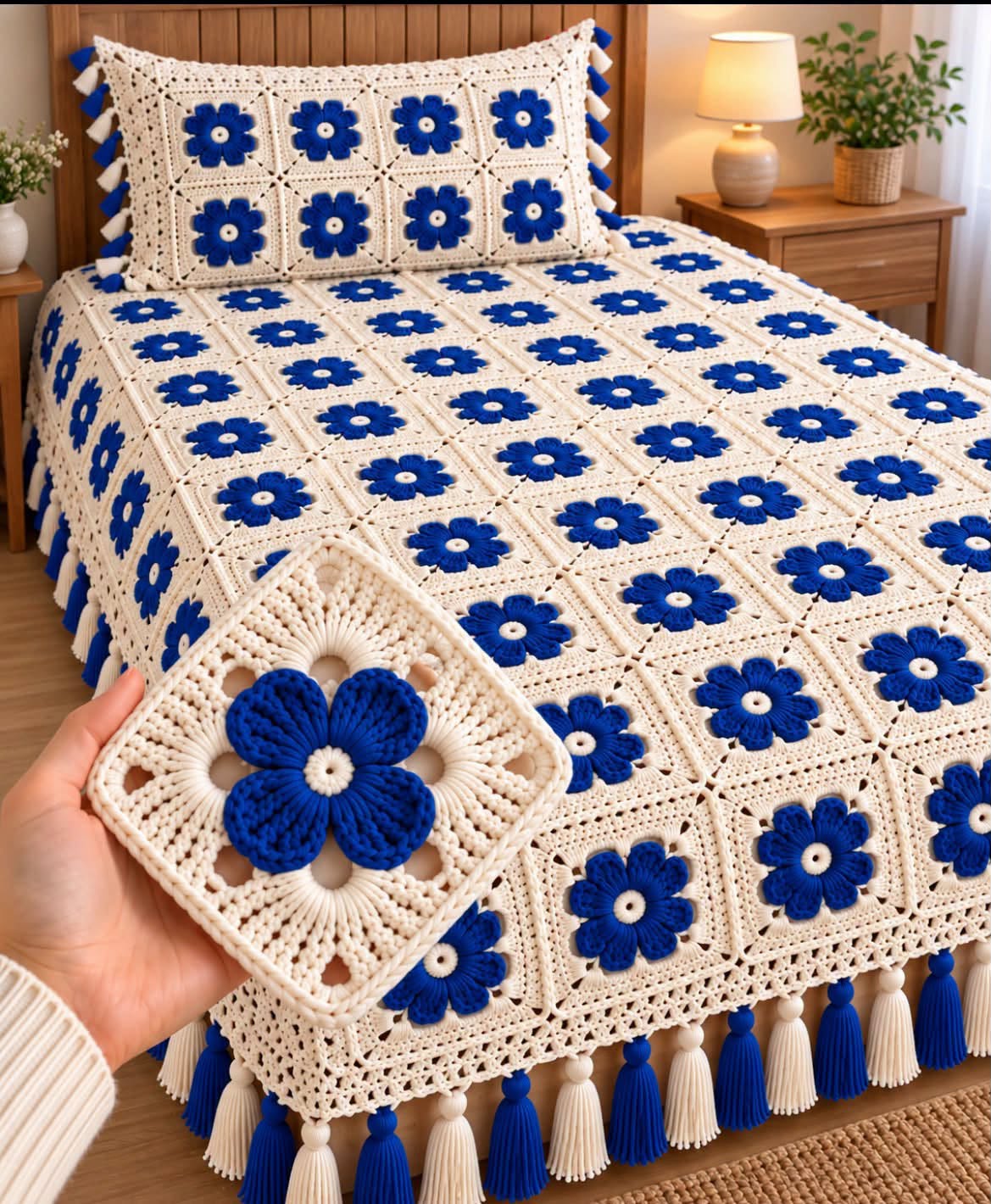
The reference highlights royal blue and ivory in a blue flower and ivory bedspread. The written construction preserves the overall idea while simplifying details that cannot be reliably recovered from a photograph.
Materials, gauge and size
Smooth DK yarn, approximately 1,500–3,500 g for a full cover, or 800–1,800 g for a measured sofa set; 3.5–4.5 mm hook. Colors: royal blue and ivory. These are estimates: weigh a sample, multiply by the planned component count and add 15–20% for assembly and adjustments.
Also use a yarn needle, scissors, stitch markers and a measuring tape. Make and wash one complete motif. Measure width W, calculate motif count from the actual bed or sofa, and weigh the sample before buying all yarn. No photographic scale is assumed.
Daisy square
- Round 1: With the center color work 8 sc in a magic ring; join. [8 sc]
- Round 2: With the petal color, in each sc work (sc, ch 3, dc, ch 3, sl st). [Eight petals]
- Round 3: Behind the petals, work sc around each Round-1 sc post, ch 3 after each sc; join. [Eight sc, eight ch-3 spaces]
- Round 4: With the frame color, in the first space work (3 dc, ch 2, 3 dc), 3 dc in next space; repeat four times. [36 dc, four corners]
- Round 5: Sc in each dc, and (sc, ch 2, sc) in each corner. [44 sc, four corners; 11 sc along each side] Block square.
Layout, joining and border
- Make 168 identical motifs. Block each to the same measured square width W. Lay out 12 columns by 14 rows; approximate finished size before borders is 12W by 14W. At W = 12 cm this is 144 × 168 cm; choose the motif size and layout from the actual bed measurements.
- With right sides together, whipstitch matching edge stitches through the outside loops. Join all vertical seams, then all horizontal seams. Match corresponding corners and leave no unsupported gap between four motifs.
- Border Round 1: sc in each exposed stitch, one sc in each ch-1 space and two sc in each ch-2 space; at the four outside corners work (sc, ch 2, sc). Adjust only at seam junctions to keep the border flat. Round 2: sc in each stitch, (sc, ch 2, sc) at each corner. Round 3: repeat Round 2. Record the actual perimeter count because motif layouts and seam junctions change it.
- For a cushion front, make a separate 3 × 3 motif panel. Sew three sides to a same-size fabric backing and use an envelope fabric overlap on the fourth side. The insert is purchased; there is no hidden crochet backing pattern.
Assembly and finishing
- Check all counts before joining. Weave ends through several stitches in three directions. Sew point joins more than once and distribute tension evenly.
- Wash a sample using the yarn care instructions, block gently and allow it to dry completely. Recheck fit or motif size after washing. These original patterns are photo-inspired and physically untested; they do not reproduce a verified photographed chart.
3. Sunflower-Style Beige Bedspread

The reference highlights gold, cream and beige in a sunflower-style beige bedspread. The written construction preserves the overall idea while simplifying details that cannot be reliably recovered from a photograph.
Materials, gauge and size
Smooth DK yarn, approximately 1,500–3,500 g for a full cover, or 800–1,800 g for a measured sofa set; 3.5–4.5 mm hook. Colors: gold, cream and beige. These are estimates: weigh a sample, multiply by the planned component count and add 15–20% for assembly and adjustments.
Also use a yarn needle, scissors, stitch markers and a measuring tape. Make and wash one complete motif. Measure width W, calculate motif count from the actual bed or sofa, and weigh the sample before buying all yarn. No photographic scale is assumed.
Two-layer flower square
- Round 1: With the center color work 8 sc in a magic ring; join [8]. Round 2: in each sc work (sc, ch 3, dc, ch 3, sl st) [eight small petals].
- Round 3: Behind the petals, sc around each Round-1 sc post, ch 5 after each sc [eight anchors, eight loops]. Round 4: into each loop work (sc, hdc, 5 dc, hdc, sc), then sl st into the next anchor sc [eight outer petals, nine stitches per petal plus eight anchor sl sts].
- Round 5: Behind the outer petals, sc around each Round-3 anchor post and ch 5 after each sc [eight anchors and eight loops]. Round 6: (3 dc, ch 2, 3 dc) in first loop, 3 dc in next loop; repeat four times [36 dc, four corners].
- Round 7: Dc in each dc and (2 dc, ch 2, 2 dc) in each corner [52 dc]. Round 8: sc in each dc and (sc, ch 2, sc) in each corner [60 sc, four corners]. Block square. Use the stated palette: the first contrasting shade for the center, a pale shade for small petals, the main flower color for larger petals and the background shade for the frame.
Layout, joining and border
- Make 168 identical motifs. Block each to the same measured square width W. Lay out 12 columns by 14 rows; approximate finished size before borders is 12W by 14W. At W = 12 cm this is 144 × 168 cm; choose the motif size and layout from the actual bed measurements.
- With right sides together, whipstitch matching edge stitches through the outside loops. Join all vertical seams, then all horizontal seams. Match corresponding corners and leave no unsupported gap between four motifs.
- Border Round 1: sc in each exposed stitch, one sc in each ch-1 space and two sc in each ch-2 space; at the four outside corners work (sc, ch 2, sc). Adjust only at seam junctions to keep the border flat. Round 2: sc in each stitch, (sc, ch 2, sc) at each corner. Round 3: repeat Round 2. Record the actual perimeter count because motif layouts and seam junctions change it.
- For a cushion front, make a separate 3 × 3 motif panel. Sew three sides to a same-size fabric backing and use an envelope fabric overlap on the fourth side. The insert is purchased; there is no hidden crochet backing pattern.
Assembly and finishing
- Check all counts before joining. Weave ends through several stitches in three directions. Sew point joins more than once and distribute tension evenly.
- Wash a sample using the yarn care instructions, block gently and allow it to dry completely. Recheck fit or motif size after washing. These original patterns are photo-inspired and physically untested; they do not reproduce a verified photographed chart.
4. Golden Floral Lace Coverlet

The reference highlights golden yellow in a golden floral lace coverlet. The written construction preserves the overall idea while simplifying details that cannot be reliably recovered from a photograph.
Materials, gauge and size
Smooth DK yarn, approximately 1,500–3,500 g for a full cover, or 800–1,800 g for a measured sofa set; 3.5–4.5 mm hook. Colors: golden yellow. These are estimates: weigh a sample, multiply by the planned component count and add 15–20% for assembly and adjustments.
Also use a yarn needle, scissors, stitch markers and a measuring tape. Make and wash one complete motif. Measure width W, calculate motif count from the actual bed or sofa, and weigh the sample before buying all yarn. No photographic scale is assumed.
Eight-petal lace medallion
- Joined rounds: ch 4 and join to form a ring. Round 1: 16 sc into ring [16]. Round 2: (sc in next stitch, ch 7, skip next stitch) eight times; join [8 anchors and 8 loops].
- Round 3: into each loop work (sc, hdc, 3 dc, ch 2, 3 dc, hdc, sc); sl st into next anchor [8 petals; 10 stitches and one ch-2 tip each]. Round 4: behind each petal, sc around its Round-2 anchor post and ch 9 [8 anchors, 8 loops].
- Round 5: into each back loop work (sc, hdc, 4 dc, ch 2, 4 dc, hdc, sc); sl st into the next anchor [8 larger petals; 12 stitches per petal]. Round 6: sc in every petal stitch and (sc, ch 3, sc) in each tip; skip old anchor sl sts [112 sc and 8 ch-3 tips].
- For a square frame, Round 7: from a tip work (3 dc, ch 2, 3 dc) in that tip; ch 3, work 3 dc in the next tip, ch 3. Repeat four times around, using alternate tips for corners [36 dc, 4 corner spaces and 8 ch-3 side spaces]. Round 8: sc in each dc, 3 sc in every side space and (sc, ch 2, sc) in each corner [68 sc, 4 corners; 17 sc per side]. This square frame is an original simplification; block it before committing to a full bedspread.
Layout, joining and border
- Make 168 identical motifs. Block each to the same measured square width W. Lay out 12 columns by 14 rows; approximate finished size before borders is 12W by 14W. At W = 12 cm this is 144 × 168 cm; choose the motif size and layout from the actual bed measurements.
- With right sides together, whipstitch matching edge stitches through the outside loops. Join all vertical seams, then all horizontal seams. Match corresponding corners and leave no unsupported gap between four motifs.
- Border Round 1: sc in each exposed stitch, one sc in each ch-1 space and two sc in each ch-2 space; at the four outside corners work (sc, ch 2, sc). Adjust only at seam junctions to keep the border flat. Round 2: sc in each stitch, (sc, ch 2, sc) at each corner. Round 3: repeat Round 2. Record the actual perimeter count because motif layouts and seam junctions change it.
- For a cushion front, make a separate 3 × 3 motif panel. Sew three sides to a same-size fabric backing and use an envelope fabric overlap on the fourth side. The insert is purchased; there is no hidden crochet backing pattern.
Assembly and finishing
- Check all counts before joining. Weave ends through several stitches in three directions. Sew point joins more than once and distribute tension evenly.
- Wash a sample using the yarn care instructions, block gently and allow it to dry completely. Recheck fit or motif size after washing. These original patterns are photo-inspired and physically untested; they do not reproduce a verified photographed chart.
5. Teal Butterfly-Square Bedspread
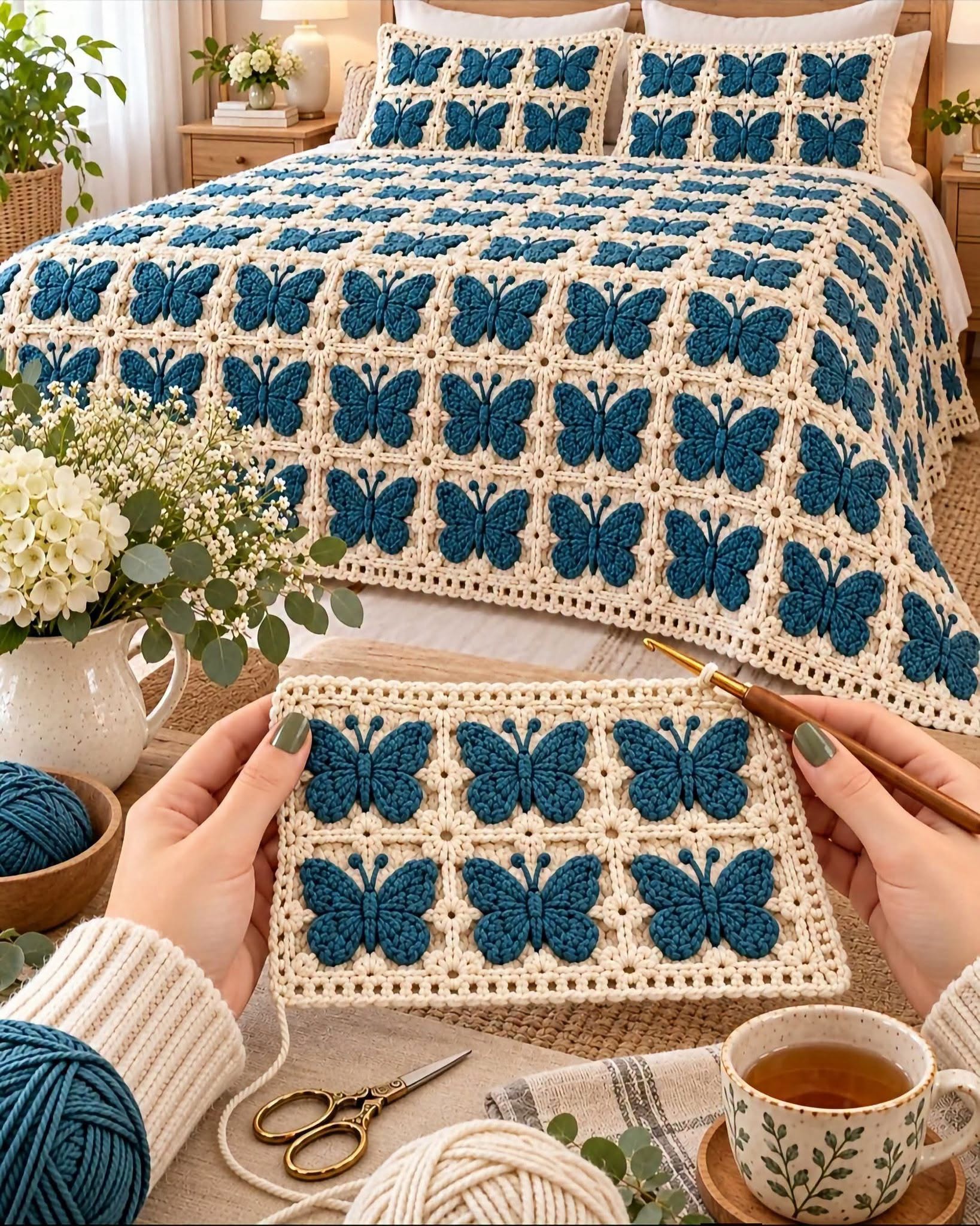
The reference highlights teal and ivory in a teal butterfly-square bedspread. The written construction preserves the overall idea while simplifying details that cannot be reliably recovered from a photograph.
Materials, gauge and size
Smooth DK yarn, approximately 1,500–3,500 g for a full cover, or 800–1,800 g for a measured sofa set; 3.5–4.5 mm hook. Colors: teal and ivory. These are estimates: weigh a sample, multiply by the planned component count and add 15–20% for assembly and adjustments.
Also use a yarn needle, scissors, stitch markers and a measuring tape. Make and wash one complete motif. Measure width W, calculate motif count from the actual bed or sofa, and weigh the sample before buying all yarn. No photographic scale is assumed.
Solid square with butterfly appliqué
- Round 1: In a magic ring work (3 dc, ch 2) four times; join to the first dc. [12 dc, four ch-2 corners]
- Round 2: Join the second color in a corner. Work (2 dc, ch 2, 2 dc) in each corner and 1 dc in each of the three side stitches; join. [28 dc, four ch-2 corners; seven dc per side]
- Round 3: With the third color, work 1 dc in each dc and (2 dc, ch 2, 2 dc) in each corner; join. [44 dc; 11 per side]
- Round 4: Repeat Round 3. [60 dc; 15 per side]
- Round 5: Repeat Round 3. [76 dc; 19 per side] Block to approximately 12 cm; change hook size if necessary. Each contrasting frame creates a geometric outline.
Butterfly wings and body
- Ch 4, join. Round 1: work (3 dc, ch 2) four times into ring [12 dc, 4 loops]. Round 2: work (sc, 2 hdc, 5 dc, 2 hdc, sc) into each loop [4 wings, 11 stitches each]. Fasten off. Make one butterfly per square.
- Fold gently between the pairs of wings to mark the center. Wrap contrasting yarn six times around the middle and secure at the back; embroider two short antennae. Sew the butterfly body and each wing tip flat onto the square, keeping every sewing stitch inside the square border. Do not fold the whole flower shut. This appliqué method replaces the reference’s more integrated openwork.
Layout, joining and border
- Make 168 identical motifs. Block each to the same measured square width W. Lay out 12 columns by 14 rows; approximate finished size before borders is 12W by 14W. At W = 12 cm this is 144 × 168 cm; choose the motif size and layout from the actual bed measurements.
- With right sides together, whipstitch matching edge stitches through the outside loops. Join all vertical seams, then all horizontal seams. Match corresponding corners and leave no unsupported gap between four motifs.
- Border Round 1: sc in each exposed stitch, one sc in each ch-1 space and two sc in each ch-2 space; at the four outside corners work (sc, ch 2, sc). Adjust only at seam junctions to keep the border flat. Round 2: sc in each stitch, (sc, ch 2, sc) at each corner. Round 3: repeat Round 2. Record the actual perimeter count because motif layouts and seam junctions change it.
- For a cushion front, make a separate 3 × 3 motif panel. Sew three sides to a same-size fabric backing and use an envelope fabric overlap on the fourth side. The insert is purchased; there is no hidden crochet backing pattern.
Assembly and finishing
- Check all counts before joining. Weave ends through several stitches in three directions. Sew point joins more than once and distribute tension evenly.
- Wash a sample using the yarn care instructions, block gently and allow it to dry completely. Recheck fit or motif size after washing. These original patterns are photo-inspired and physically untested; they do not reproduce a verified photographed chart.
6. Turquoise Daisy Bedspread

The reference highlights turquoise, gold and ivory in a turquoise daisy bedspread. The written construction preserves the overall idea while simplifying details that cannot be reliably recovered from a photograph.
Materials, gauge and size
Smooth DK yarn, approximately 1,500–3,500 g for a full cover, or 800–1,800 g for a measured sofa set; 3.5–4.5 mm hook. Colors: turquoise, gold and ivory. These are estimates: weigh a sample, multiply by the planned component count and add 15–20% for assembly and adjustments.
Also use a yarn needle, scissors, stitch markers and a measuring tape. Make and wash one complete motif. Measure width W, calculate motif count from the actual bed or sofa, and weigh the sample before buying all yarn. No photographic scale is assumed.
Daisy square
- Round 1: With the center color work 8 sc in a magic ring; join. [8 sc]
- Round 2: With the petal color, in each sc work (sc, ch 3, dc, ch 3, sl st). [Eight petals]
- Round 3: Behind the petals, work sc around each Round-1 sc post, ch 3 after each sc; join. [Eight sc, eight ch-3 spaces]
- Round 4: With the frame color, in the first space work (3 dc, ch 2, 3 dc), 3 dc in next space; repeat four times. [36 dc, four corners]
- Round 5: Sc in each dc, and (sc, ch 2, sc) in each corner. [44 sc, four corners; 11 sc along each side] Block square.
Layout, joining and border
- Make 168 identical motifs. Block each to the same measured square width W. Lay out 12 columns by 14 rows; approximate finished size before borders is 12W by 14W. At W = 12 cm this is 144 × 168 cm; choose the motif size and layout from the actual bed measurements.
- With right sides together, whipstitch matching edge stitches through the outside loops. Join all vertical seams, then all horizontal seams. Match corresponding corners and leave no unsupported gap between four motifs.
- Border Round 1: sc in each exposed stitch, one sc in each ch-1 space and two sc in each ch-2 space; at the four outside corners work (sc, ch 2, sc). Adjust only at seam junctions to keep the border flat. Round 2: sc in each stitch, (sc, ch 2, sc) at each corner. Round 3: repeat Round 2. Record the actual perimeter count because motif layouts and seam junctions change it.
- For a cushion front, make a separate 3 × 3 motif panel. Sew three sides to a same-size fabric backing and use an envelope fabric overlap on the fourth side. The insert is purchased; there is no hidden crochet backing pattern.
Assembly and finishing
- Check all counts before joining. Weave ends through several stitches in three directions. Sew point joins more than once and distribute tension evenly.
- Wash a sample using the yarn care instructions, block gently and allow it to dry completely. Recheck fit or motif size after washing. These original patterns are photo-inspired and physically untested; they do not reproduce a verified photographed chart.
7. Sage Floral Sofa Cover
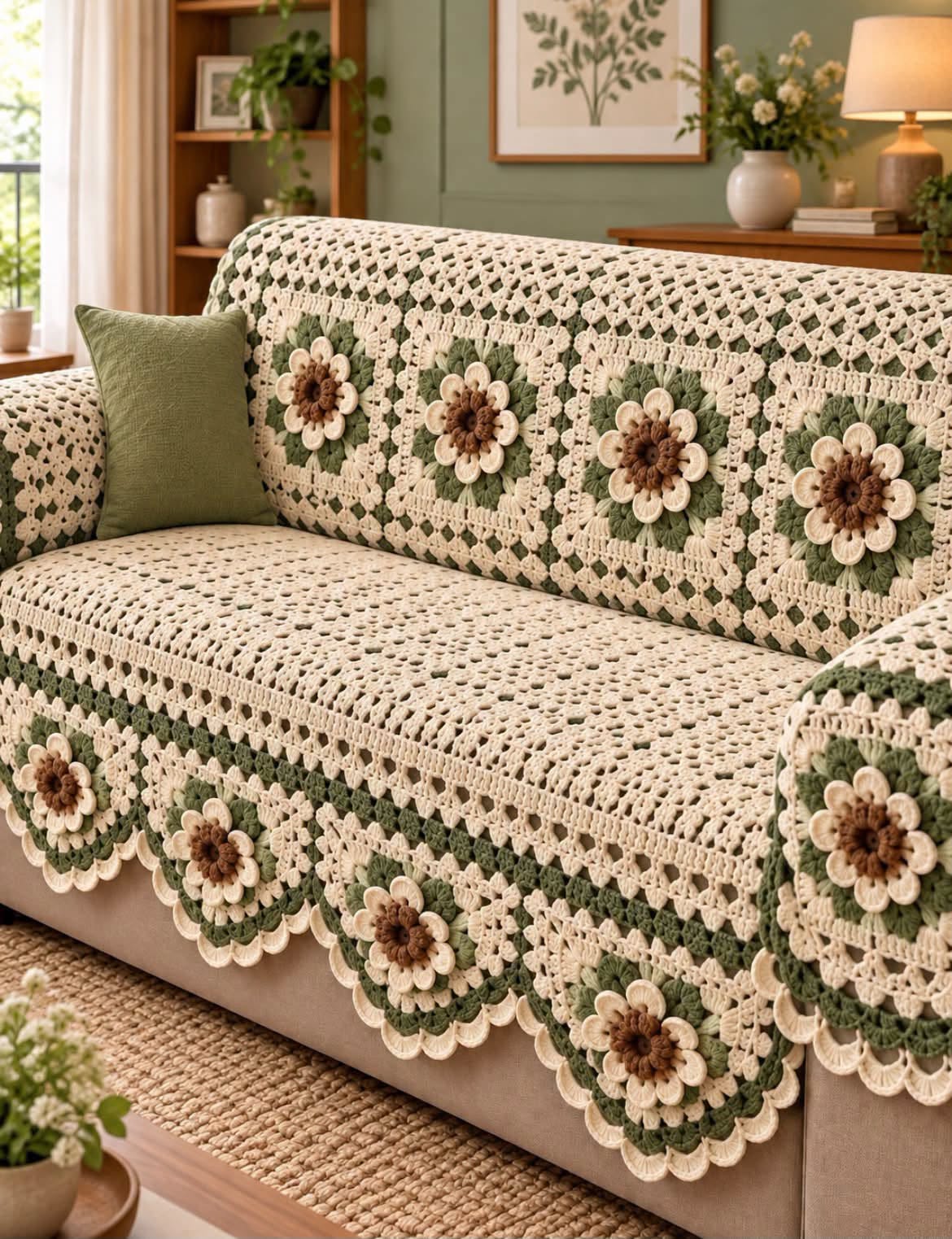
The reference highlights sage, oatmeal, cream and brown in a sage floral sofa cover. The written construction preserves the overall idea while simplifying details that cannot be reliably recovered from a photograph.
Materials, gauge and size
Smooth DK yarn, approximately 1,500–3,500 g for a full cover, or 800–1,800 g for a measured sofa set; 3.5–4.5 mm hook. Colors: sage, oatmeal, cream and brown. These are estimates: weigh a sample, multiply by the planned component count and add 15–20% for assembly and adjustments.
Also use a yarn needle, scissors, stitch markers and a measuring tape. Make and wash one complete motif. Measure width W, calculate motif count from the actual bed or sofa, and weigh the sample before buying all yarn. No photographic scale is assumed.
Daisy square
- Round 1: With the center color work 8 sc in a magic ring; join. [8 sc]
- Round 2: With the petal color, in each sc work (sc, ch 3, dc, ch 3, sl st). [Eight petals]
- Round 3: Behind the petals, work sc around each Round-1 sc post, ch 3 after each sc; join. [Eight sc, eight ch-3 spaces]
- Round 4: With the frame color, in the first space work (3 dc, ch 2, 3 dc), 3 dc in next space; repeat four times. [36 dc, four corners]
- Round 5: Sc in each dc, and (sc, ch 2, sc) in each corner. [44 sc, four corners; 11 sc along each side] Block square.
Measured sofa panels
- Measure the seat width A, depth B and back height C without pulling the tape into gaps. Let washed motif width be W. For the seat make ceil(A/W) columns and ceil(B/W) rows; for the back use the same columns and ceil(C/W) rows. For example A = 180 cm, B = 60 cm, C = 60 cm and W = 15 cm need two separate 12 × 4 panels, 96 squares total.
- Join each panel separately with matching edge stitches. Work two sc border rounds, with (sc, ch 2, sc) at outside corners. Add a front valance of 12 × 2 squares for a 30 cm drop in the example. Sew its top edge to the seat front only; leave arm edges free.
- For each exposed front corner, make a tie: ch 51, sc in second chain and across [50]; fasten off and reinforce its base. Tie around a suitable sofa support without stretching the motifs. Use a washable fabric underlayer for grip. Fit panels on the actual sofa before attaching the valance; the pictured cushion covers require separate panels.
Assembly and finishing
- Check all counts before joining. Weave ends through several stitches in three directions. Sew point joins more than once and distribute tension evenly.
- Wash a sample using the yarn care instructions, block gently and allow it to dry completely. Recheck fit or motif size after washing. These original patterns are photo-inspired and physically untested; they do not reproduce a verified photographed chart.
8. Purple Spiral-Medallion Coverlet

The reference highlights purple and ivory in a purple spiral-medallion coverlet. The written construction preserves the overall idea while simplifying details that cannot be reliably recovered from a photograph.
Materials, gauge and size
Smooth DK yarn, approximately 1,500–3,500 g for a full cover, or 800–1,800 g for a measured sofa set; 3.5–4.5 mm hook. Colors: purple and ivory. These are estimates: weigh a sample, multiply by the planned component count and add 15–20% for assembly and adjustments.
Also use a yarn needle, scissors, stitch markers and a measuring tape. Make and wash one complete motif. Measure width W, calculate motif count from the actual bed or sofa, and weigh the sample before buying all yarn. No photographic scale is assumed.
Two-color spiral disc
- Work in a continuous spiral with two active loops, one per color. Use removable holders so neither loop is lost. In a magic ring, color A works sc, hdc, 4 dc; park the loop. Join B in the same ring and work sc, hdc, 4 dc; tighten ring [12 stitches total, 6 per color].
- Round 2: with A, work 2 dc into each of the six B stitches, stopping at the parked B loop [12 A dc]. With B work 2 dc into each of the six original A stitches, stopping at the parked A loop [12 B dc; 24 total]. Keep the two advancing color boundaries marked.
- Round 3: each color works (dc in next stitch, 2 dc in next) six times into the other color’s twelve stitches [18 per color; 36 total]. Round 4: each works (dc in next 2, 2 dc in next) six times [24 per color; 48 total]. Round 5: each works (dc in next 3, 2 dc in next) six times [30 per color; 60 total].
- Round 6: each color works (dc in next 4, 2 dc in next) six times [36 per color; 72 total]. Taper each color by replacing its last three dc with hdc, sc, sl st; count the sl st as a position in this round. Fasten off both loops.
- Join ivory at a marked beginning. Square-up Round 7: (sc in next 3 positions, hdc in next 3, dc in next 2, [2 tr, ch 2, 2 tr] in next position, dc in next 2, hdc in next 3, sc in next 4) four times [84 stitches and 4 corners]. Each repeat consumes 18 old positions and makes 21 stitches. Round 8: sc in each stitch and (sc, ch 2, sc) in each corner [92 sc; 23 per side]. Block to a square. This framed spiral is an interpretation of the reference’s individually shaped spiral units.
Layout, joining and border
- Make 168 identical motifs. Block each to the same measured square width W. Lay out 12 columns by 14 rows; approximate finished size before borders is 12W by 14W. At W = 12 cm this is 144 × 168 cm; choose the motif size and layout from the actual bed measurements.
- With right sides together, whipstitch matching edge stitches through the outside loops. Join all vertical seams, then all horizontal seams. Match corresponding corners and leave no unsupported gap between four motifs.
- Border Round 1: sc in each exposed stitch, one sc in each ch-1 space and two sc in each ch-2 space; at the four outside corners work (sc, ch 2, sc). Adjust only at seam junctions to keep the border flat. Round 2: sc in each stitch, (sc, ch 2, sc) at each corner. Round 3: repeat Round 2. Record the actual perimeter count because motif layouts and seam junctions change it.
- For a cushion front, make a separate 3 × 3 motif panel. Sew three sides to a same-size fabric backing and use an envelope fabric overlap on the fourth side. The insert is purchased; there is no hidden crochet backing pattern.
Assembly and finishing
- Check all counts before joining. Weave ends through several stitches in three directions. Sew point joins more than once and distribute tension evenly.
- Wash a sample using the yarn care instructions, block gently and allow it to dry completely. Recheck fit or motif size after washing. These original patterns are photo-inspired and physically untested; they do not reproduce a verified photographed chart.
9. Blue, Cream and Red Granny Bedspread

The reference highlights navy, turquoise, red and cream in a blue, cream and red granny bedspread. The written construction preserves the overall idea while simplifying details that cannot be reliably recovered from a photograph.
Materials, gauge and size
Smooth DK yarn, approximately 1,500–3,500 g for a full cover, or 800–1,800 g for a measured sofa set; 3.5–4.5 mm hook. Colors: navy, turquoise, red and cream. These are estimates: weigh a sample, multiply by the planned component count and add 15–20% for assembly and adjustments.
Also use a yarn needle, scissors, stitch markers and a measuring tape. Make and wash one complete motif. Measure width W, calculate motif count from the actual bed or sofa, and weigh the sample before buying all yarn. No photographic scale is assumed.
Classic granny square
- Round 1: In a magic ring work (3 dc, ch 2) four times; join. [12 dc, four ch-2 corners]
- Round 2: In every corner work (3 dc, ch 2, 3 dc); ch 1 between corner groups. [24 dc, four ch-2 corners and four ch-1 side spaces]
- Round 3: Work (3 dc, ch 2, 3 dc) in each corner and 3 dc in each side ch-1 space, separating every group with ch 1 except within the ch-2 corners. [36 dc, four corners and eight side ch-1 spaces]
- Rounds 4–5: Repeat Round 3, placing one 3-dc group in each side space. Round 4 has 48 dc and twelve side spaces; Round 5 has 60 dc and sixteen side spaces. Both have four ch-2 corners.
- Round 6: Sc in each dc and 1 sc in each side ch-1 space; work (sc, ch 2, sc) in each corner. [84 sc and four ch-2 corners; 21 sc per side] Block square without pulling the holes out of shape.
Layout, joining and border
- Make 168 identical motifs. Block each to the same measured square width W. Lay out 12 columns by 14 rows; approximate finished size before borders is 12W by 14W. At W = 12 cm this is 144 × 168 cm; choose the motif size and layout from the actual bed measurements.
- With right sides together, whipstitch matching edge stitches through the outside loops. Join all vertical seams, then all horizontal seams. Match corresponding corners and leave no unsupported gap between four motifs.
- Border Round 1: sc in each exposed stitch, one sc in each ch-1 space and two sc in each ch-2 space; at the four outside corners work (sc, ch 2, sc). Adjust only at seam junctions to keep the border flat. Round 2: sc in each stitch, (sc, ch 2, sc) at each corner. Round 3: repeat Round 2. Record the actual perimeter count because motif layouts and seam junctions change it.
- For a cushion front, make a separate 3 × 3 motif panel. Sew three sides to a same-size fabric backing and use an envelope fabric overlap on the fourth side. The insert is purchased; there is no hidden crochet backing pattern.
Assembly and finishing
- Check all counts before joining. Weave ends through several stitches in three directions. Sew point joins more than once and distribute tension evenly.
- Wash a sample using the yarn care instructions, block gently and allow it to dry completely. Recheck fit or motif size after washing. These original patterns are photo-inspired and physically untested; they do not reproduce a verified photographed chart.
10. Lavender Layered-Flower Bedspread
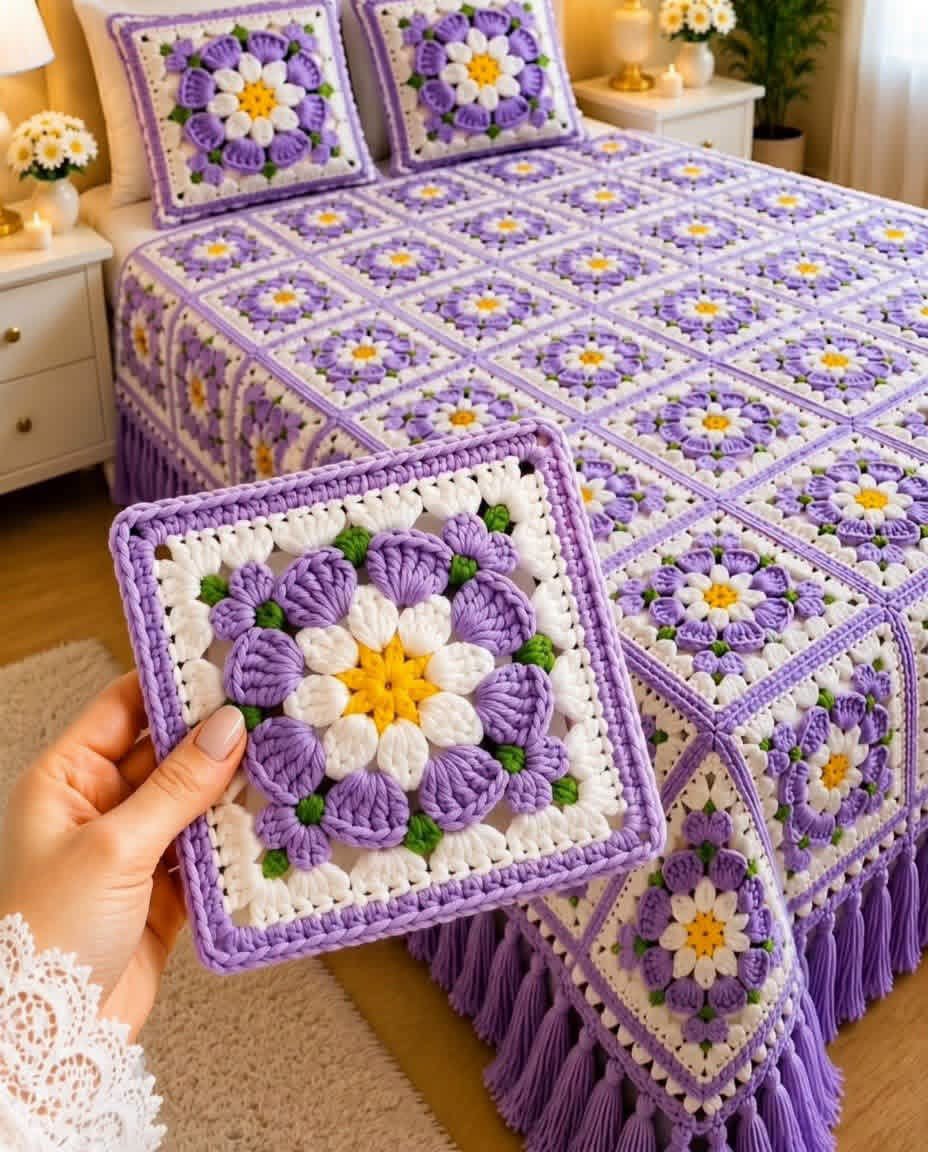
The reference highlights lavender, ivory and gold in a lavender layered-flower bedspread. The written construction preserves the overall idea while simplifying details that cannot be reliably recovered from a photograph.
Materials, gauge and size
Smooth DK yarn, approximately 1,500–3,500 g for a full cover, or 800–1,800 g for a measured sofa set; 3.5–4.5 mm hook. Colors: lavender, ivory and gold. These are estimates: weigh a sample, multiply by the planned component count and add 15–20% for assembly and adjustments.
Also use a yarn needle, scissors, stitch markers and a measuring tape. Make and wash one complete motif. Measure width W, calculate motif count from the actual bed or sofa, and weigh the sample before buying all yarn. No photographic scale is assumed.
Two-layer flower square
- Round 1: With the center color work 8 sc in a magic ring; join [8]. Round 2: in each sc work (sc, ch 3, dc, ch 3, sl st) [eight small petals].
- Round 3: Behind the petals, sc around each Round-1 sc post, ch 5 after each sc [eight anchors, eight loops]. Round 4: into each loop work (sc, hdc, 5 dc, hdc, sc), then sl st into the next anchor sc [eight outer petals, nine stitches per petal plus eight anchor sl sts].
- Round 5: Behind the outer petals, sc around each Round-3 anchor post and ch 5 after each sc [eight anchors and eight loops]. Round 6: (3 dc, ch 2, 3 dc) in first loop, 3 dc in next loop; repeat four times [36 dc, four corners].
- Round 7: Dc in each dc and (2 dc, ch 2, 2 dc) in each corner [52 dc]. Round 8: sc in each dc and (sc, ch 2, sc) in each corner [60 sc, four corners]. Block square. Use the stated palette: the first contrasting shade for the center, a pale shade for small petals, the main flower color for larger petals and the background shade for the frame.
Layout, joining and border
- Make 168 identical motifs. Block each to the same measured square width W. Lay out 12 columns by 14 rows; approximate finished size before borders is 12W by 14W. At W = 12 cm this is 144 × 168 cm; choose the motif size and layout from the actual bed measurements.
- With right sides together, whipstitch matching edge stitches through the outside loops. Join all vertical seams, then all horizontal seams. Match corresponding corners and leave no unsupported gap between four motifs.
- Border Round 1: sc in each exposed stitch, one sc in each ch-1 space and two sc in each ch-2 space; at the four outside corners work (sc, ch 2, sc). Adjust only at seam junctions to keep the border flat. Round 2: sc in each stitch, (sc, ch 2, sc) at each corner. Round 3: repeat Round 2. Record the actual perimeter count because motif layouts and seam junctions change it.
- For a cushion front, make a separate 3 × 3 motif panel. Sew three sides to a same-size fabric backing and use an envelope fabric overlap on the fourth side. The insert is purchased; there is no hidden crochet backing pattern.
Assembly and finishing
- Check all counts before joining. Weave ends through several stitches in three directions. Sew point joins more than once and distribute tension evenly.
- Wash a sample using the yarn care instructions, block gently and allow it to dry completely. Recheck fit or motif size after washing. These original patterns are photo-inspired and physically untested; they do not reproduce a verified photographed chart.
11. Vintage Rose and Sage Granny Cover

The reference highlights rose, sage, beige and ivory in a vintage rose and sage granny cover. The written construction preserves the overall idea while simplifying details that cannot be reliably recovered from a photograph.
Materials, gauge and size
Smooth DK yarn, approximately 1,500–3,500 g for a full cover, or 800–1,800 g for a measured sofa set; 3.5–4.5 mm hook. Colors: rose, sage, beige and ivory. These are estimates: weigh a sample, multiply by the planned component count and add 15–20% for assembly and adjustments.
Also use a yarn needle, scissors, stitch markers and a measuring tape. Make and wash one complete motif. Measure width W, calculate motif count from the actual bed or sofa, and weigh the sample before buying all yarn. No photographic scale is assumed.
Two-layer flower square
- Round 1: With the center color work 8 sc in a magic ring; join [8]. Round 2: in each sc work (sc, ch 3, dc, ch 3, sl st) [eight small petals].
- Round 3: Behind the petals, sc around each Round-1 sc post, ch 5 after each sc [eight anchors, eight loops]. Round 4: into each loop work (sc, hdc, 5 dc, hdc, sc), then sl st into the next anchor sc [eight outer petals, nine stitches per petal plus eight anchor sl sts].
- Round 5: Behind the outer petals, sc around each Round-3 anchor post and ch 5 after each sc [eight anchors and eight loops]. Round 6: (3 dc, ch 2, 3 dc) in first loop, 3 dc in next loop; repeat four times [36 dc, four corners].
- Round 7: Dc in each dc and (2 dc, ch 2, 2 dc) in each corner [52 dc]. Round 8: sc in each dc and (sc, ch 2, sc) in each corner [60 sc, four corners]. Block square. Use the stated palette: the first contrasting shade for the center, a pale shade for small petals, the main flower color for larger petals and the background shade for the frame.
Layout, joining and border
- Make 168 identical motifs. Block each to the same measured square width W. Lay out 12 columns by 14 rows; approximate finished size before borders is 12W by 14W. At W = 12 cm this is 144 × 168 cm; choose the motif size and layout from the actual bed measurements.
- With right sides together, whipstitch matching edge stitches through the outside loops. Join all vertical seams, then all horizontal seams. Match corresponding corners and leave no unsupported gap between four motifs.
- Border Round 1: sc in each exposed stitch, one sc in each ch-1 space and two sc in each ch-2 space; at the four outside corners work (sc, ch 2, sc). Adjust only at seam junctions to keep the border flat. Round 2: sc in each stitch, (sc, ch 2, sc) at each corner. Round 3: repeat Round 2. Record the actual perimeter count because motif layouts and seam junctions change it.
- For a cushion front, make a separate 3 × 3 motif panel. Sew three sides to a same-size fabric backing and use an envelope fabric overlap on the fourth side. The insert is purchased; there is no hidden crochet backing pattern.
Assembly and finishing
- Check all counts before joining. Weave ends through several stitches in three directions. Sew point joins more than once and distribute tension evenly.
- Wash a sample using the yarn care instructions, block gently and allow it to dry completely. Recheck fit or motif size after washing. These original patterns are photo-inspired and physically untested; they do not reproduce a verified photographed chart.
12. Sage Floral Lace Bedspread
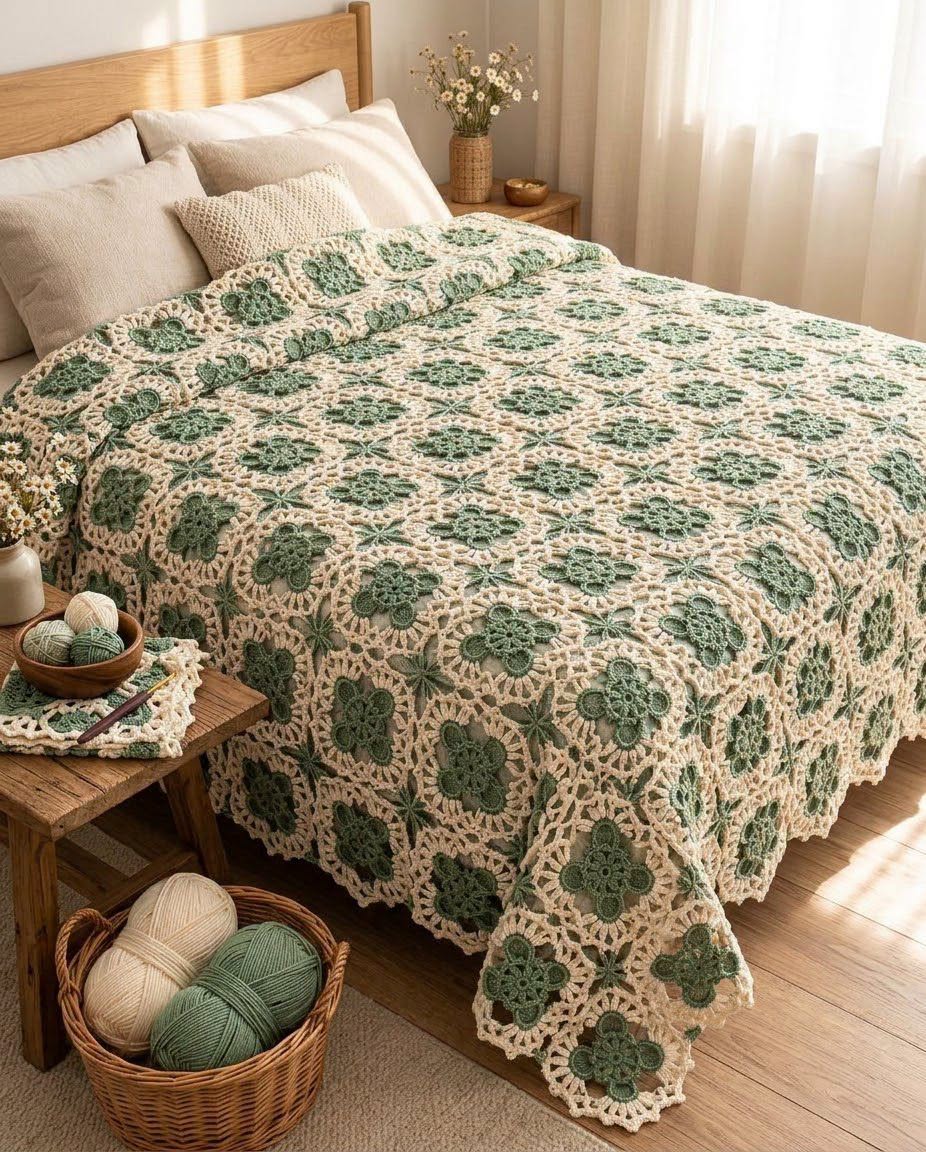
The reference highlights sage and cream in a sage floral lace bedspread. The written construction preserves the overall idea while simplifying details that cannot be reliably recovered from a photograph.
Materials, gauge and size
Smooth DK yarn, approximately 1,500–3,500 g for a full cover, or 800–1,800 g for a measured sofa set; 3.5–4.5 mm hook. Colors: sage and cream. These are estimates: weigh a sample, multiply by the planned component count and add 15–20% for assembly and adjustments.
Also use a yarn needle, scissors, stitch markers and a measuring tape. Make and wash one complete motif. Measure width W, calculate motif count from the actual bed or sofa, and weigh the sample before buying all yarn. No photographic scale is assumed.
Daisy square
- Round 1: With the center color work 8 sc in a magic ring; join. [8 sc]
- Round 2: With the petal color, in each sc work (sc, ch 3, dc, ch 3, sl st). [Eight petals]
- Round 3: Behind the petals, work sc around each Round-1 sc post, ch 3 after each sc; join. [Eight sc, eight ch-3 spaces]
- Round 4: With the frame color, in the first space work (3 dc, ch 2, 3 dc), 3 dc in next space; repeat four times. [36 dc, four corners]
- Round 5: Sc in each dc, and (sc, ch 2, sc) in each corner. [44 sc, four corners; 11 sc along each side] Block square.
Layout, joining and border
- Make 168 identical motifs. Block each to the same measured square width W. Lay out 12 columns by 14 rows; approximate finished size before borders is 12W by 14W. At W = 12 cm this is 144 × 168 cm; choose the motif size and layout from the actual bed measurements.
- With right sides together, whipstitch matching edge stitches through the outside loops. Join all vertical seams, then all horizontal seams. Match corresponding corners and leave no unsupported gap between four motifs.
- Border Round 1: sc in each exposed stitch, one sc in each ch-1 space and two sc in each ch-2 space; at the four outside corners work (sc, ch 2, sc). Adjust only at seam junctions to keep the border flat. Round 2: sc in each stitch, (sc, ch 2, sc) at each corner. Round 3: repeat Round 2. Record the actual perimeter count because motif layouts and seam junctions change it.
- For a cushion front, make a separate 3 × 3 motif panel. Sew three sides to a same-size fabric backing and use an envelope fabric overlap on the fourth side. The insert is purchased; there is no hidden crochet backing pattern.
Assembly and finishing
- Check all counts before joining. Weave ends through several stitches in three directions. Sew point joins more than once and distribute tension evenly.
- Wash a sample using the yarn care instructions, block gently and allow it to dry completely. Recheck fit or motif size after washing. These original patterns are photo-inspired and physically untested; they do not reproduce a verified photographed chart.