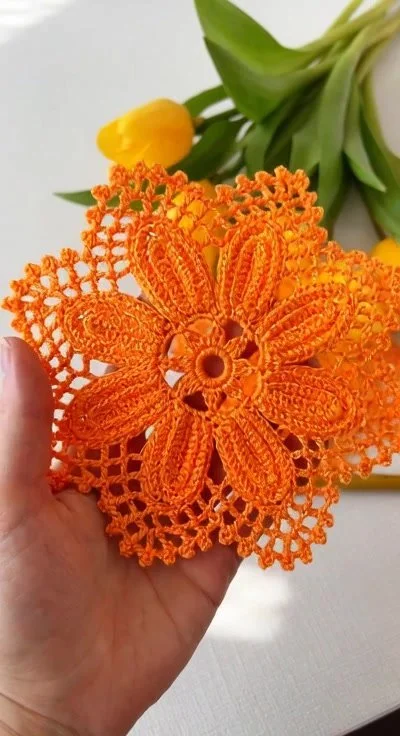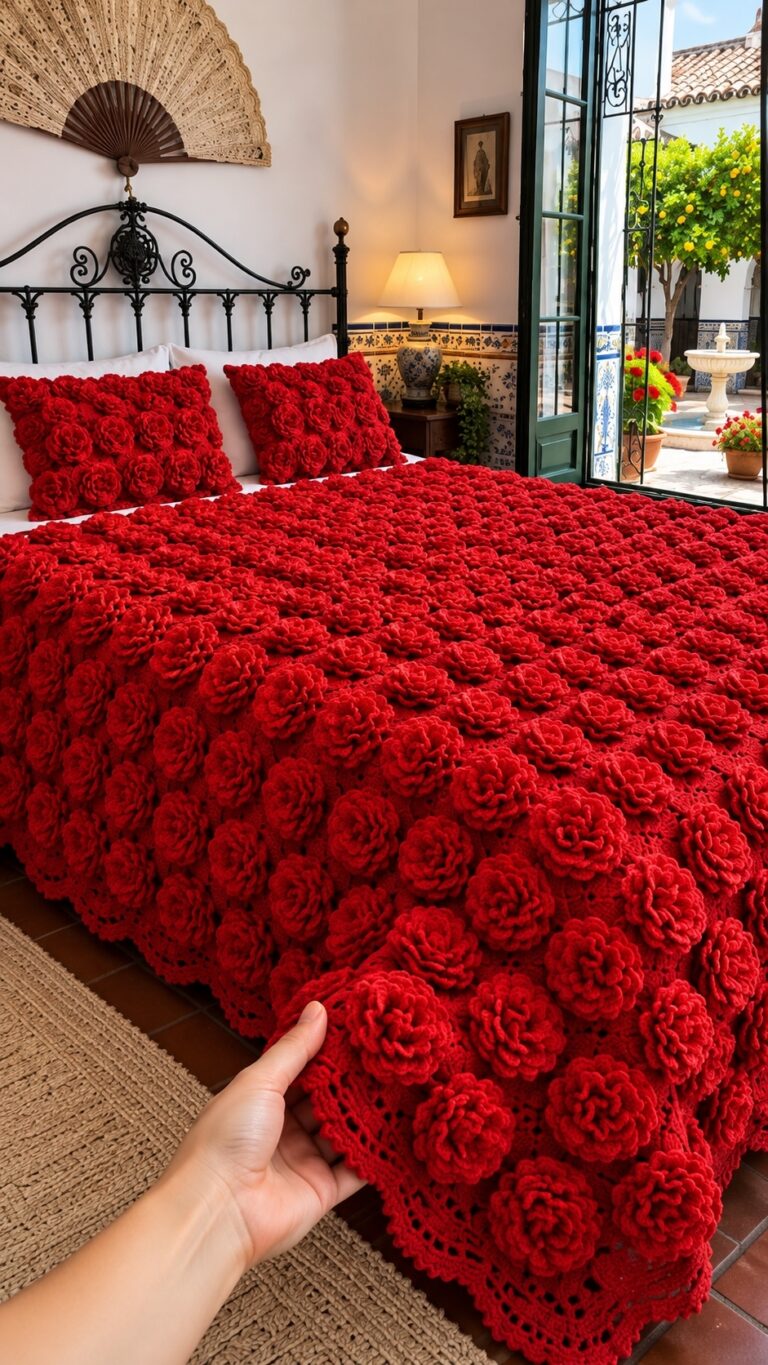
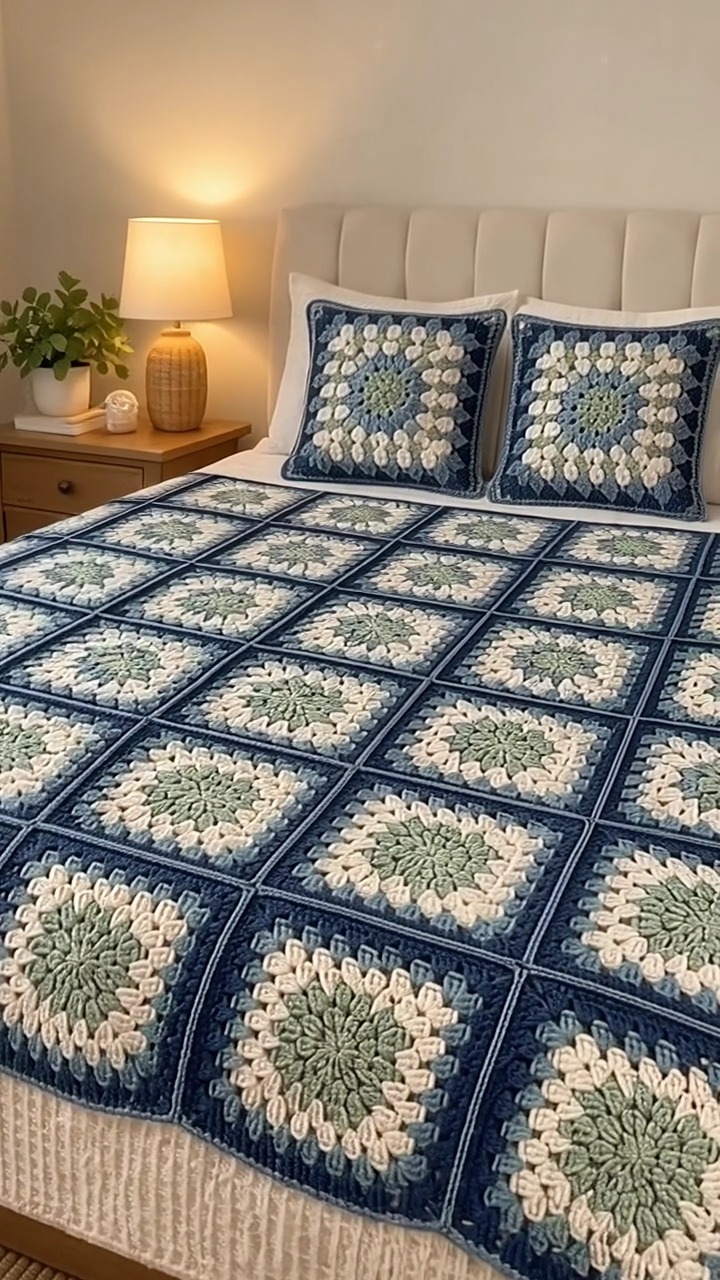
4 Crochet Bedspread Ideas: Granny Squares and Flower Squares
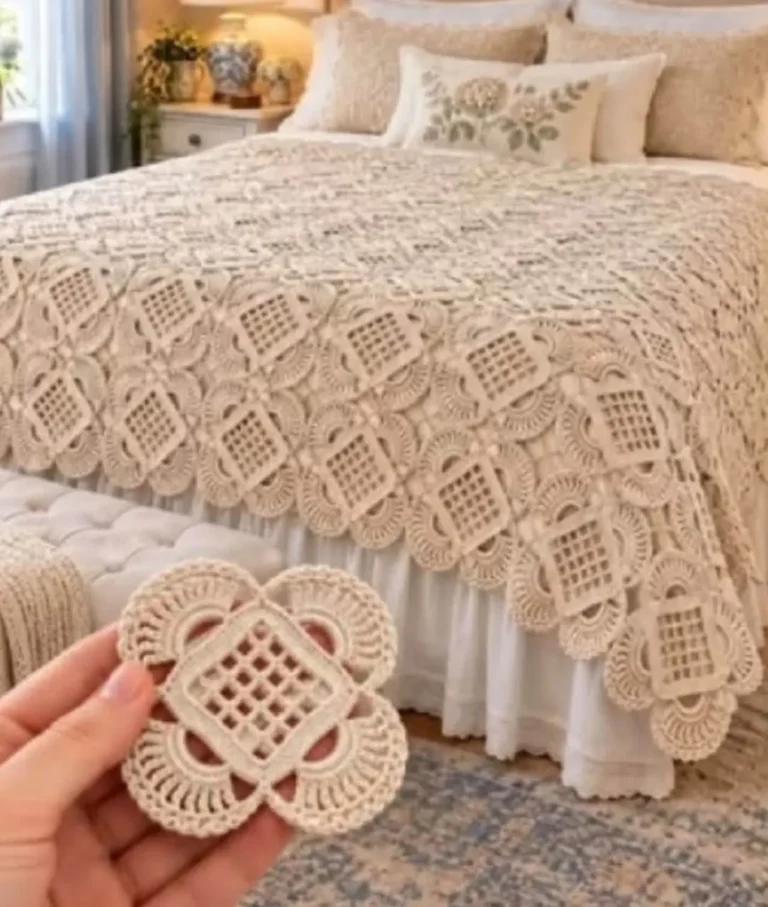
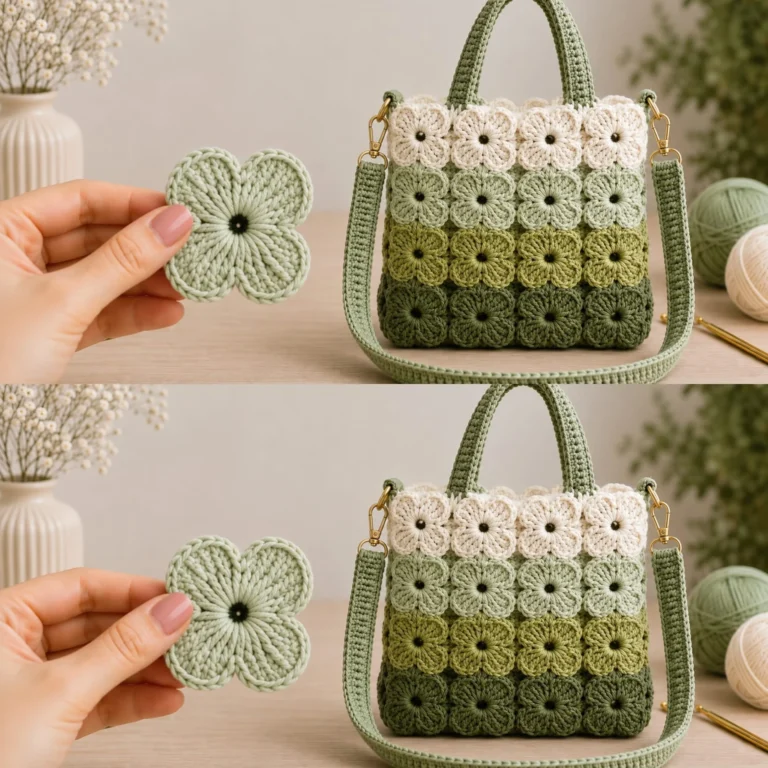
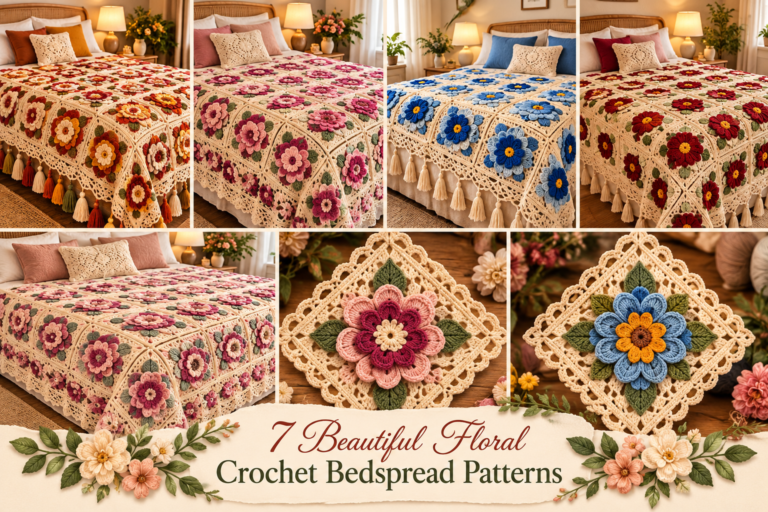
This collection brings together four crochet bedspread references that pair granny squares with flower squares in cream, ivory, navy, sage, teal, blue and terracotta. Each photo shows a bedspread built from repeating motifs: some are dense square grids with dark seams, while others use open mesh fields with stand-up flowers and scalloped borders. Together they show how colour and edging can change a simple square into a full bed set.
Two practice-pattern families give counted starting points for these photos: a classic granny square and a layered five-petal flower square. The granny square is new here, while the flower square already exists in the library and is used for three references. Each related reference links back to the same full counted instructions, so you can start with the square that matches your bed.
Before You Start: Materials and Measurements
Choose yarn for the intended project rather than assuming the photographs identify a particular fiber. Smooth cotton is a useful material to sample for defined lace and table pieces; a cotton blend or another washable yarn may suit larger decorative pieces and blankets. Start with the hook range on the yarn label and change it until the fabric looks right for the project.
Prepare a yarn needle, scissors, stitch markers, a tape measure and paper for planning layouts. Make one whole component, finish it using the intended care method and measure it after drying. Record width, height, weight and any changes to the written instructions before multiplying it into a larger piece.
US Crochet Terms and Working Rules
Ch = chain; sl st = slip stitch; sc = single crochet; hdc = half double crochet; dc = double crochet; tr = treble crochet; inc = 2 stitches in one stitch; sc2tog / dc2tog = work two stitches together; st = stitch; sp = space. An adjustable ring is a yarn loop that can be tightened after the first round is worked. Repeats in parentheses are worked the stated number of times, and numbers in brackets give the count at the end of a row or round.
Unless a pattern explicitly counts the starting chain, it is only a height chain: use ch 1 before sc rounds and ch 2 before dc rounds, then work the first real stitch in the first indicated stitch or space. Join rounds to the first real stitch. Do not add stitches when changing colors.
For terminology, see the Craft Yarn Council pattern-reading reference. If using a separate chart, check its own key as well as the standard crochet chart symbols.
Browse the 4 Photo References
1. Navy, Sage and Ivory Granny Square Bedspread
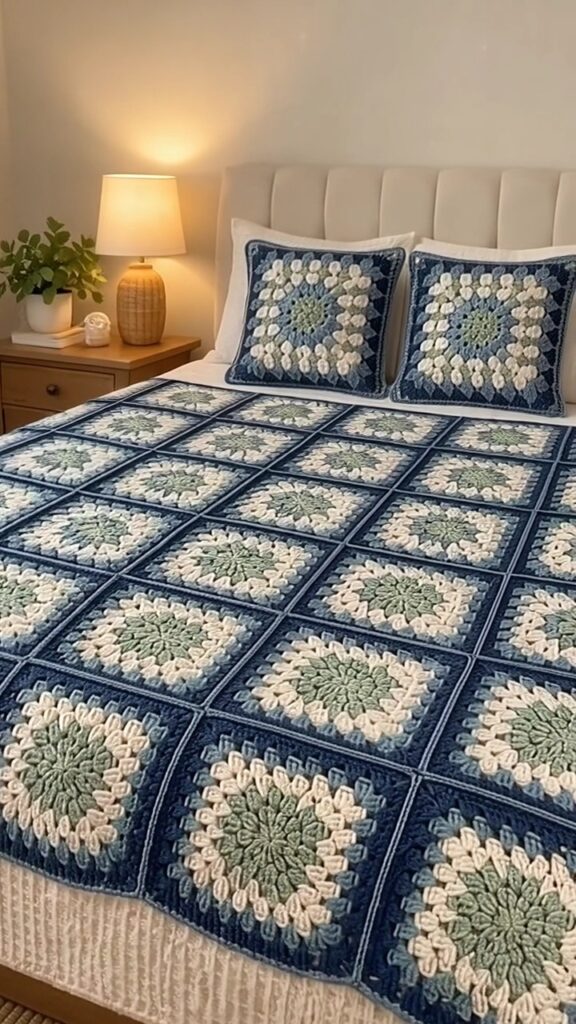
Many granny-style square motifs sit in a grid on a deep navy background, each with an ivory outer round, a sage green centre and a powder blue ring between. Matching square pillow covers repeat the motif with a navy border, so the bed reads as one dense textile.
Construction and Pattern Direction
Start with the classic granny square family: a ring foundation, then rounds of 3-dc groups worked into ch-2 corners. Sample the ivory outer round first, then the powder blue ring and the sage centre, so the colour order matches the photo. Change only the colours and the seam colour for this photo.
Layout and Finishing
Layout and Finishing: Arrange the squares in a grid and join them with dark seams, then add a plain navy border for the edge. Measure one finished square and multiply by the number of squares across and down. The photo does not give a yarn weight or stitch count, so the 30 cm size is an estimate.
Complete Practice Pattern: Three-Round Granny Square Practice Motif
Materials: A sport or DK weight cotton in two or three colours is one suggestion, with a 4 mm to 4.5 mm hook as one option, not a photographed specification.
Scope: Counted original practice component, physically untested; see the adaptation notes before scaling up.
- Foundation: Ch 4, sl st in first ch to form a ring.
- Round 1: Ch 3 (counts as first dc), 2 dc in ring, ch 2, [3 dc in ring, ch 2] three times; join with sl st to top of ch 3. [12 dc, four ch-2 corner spaces]
- Round 2: Sl st across to the next ch-2 space, ch 3, (2 dc, ch 2, 3 dc) in the same space; [ch 1, (3 dc, ch 2, 3 dc) in the next ch-2 space] three times; ch 1; join with sl st to top of ch 3. [24 dc, four ch-2 corners, four ch-1 side spaces]
- Round 3: Sl st to the next ch-2 corner space, ch 3, (2 dc, ch 2, 3 dc) in the same space; [ch 1, 3 dc in the next ch-1 side space, ch 1, (3 dc, ch 2, 3 dc) in the next corner space] three times; ch 1, 3 dc in the last ch-1 side space, ch 1; join with sl st to top of ch 3. [36 dc, four ch-2 corners, eight ch-1 spaces]
- Finish: Fasten off, weave in ends, and block the square flat. [36 dc total]
- Resize note: Keep four corners and four side groups of 3 dc each; to change size, change the hook or yarn rather than adding rounds, so each side still totals 9 dc per round.
Assembly and Adaptation
Measure the finished sample flat after blocking, then multiply by the number of squares across and down in the photo grid. Join the squares with a single crochet seam through the back loops or a whip stitch in a dark colour so the seams read as they do in the photo. The photo does not show stitch count, gauge or hook size, so the 30 cm squares are only a visual estimate.
2. Cream and Terracotta Floral Bedspread Set
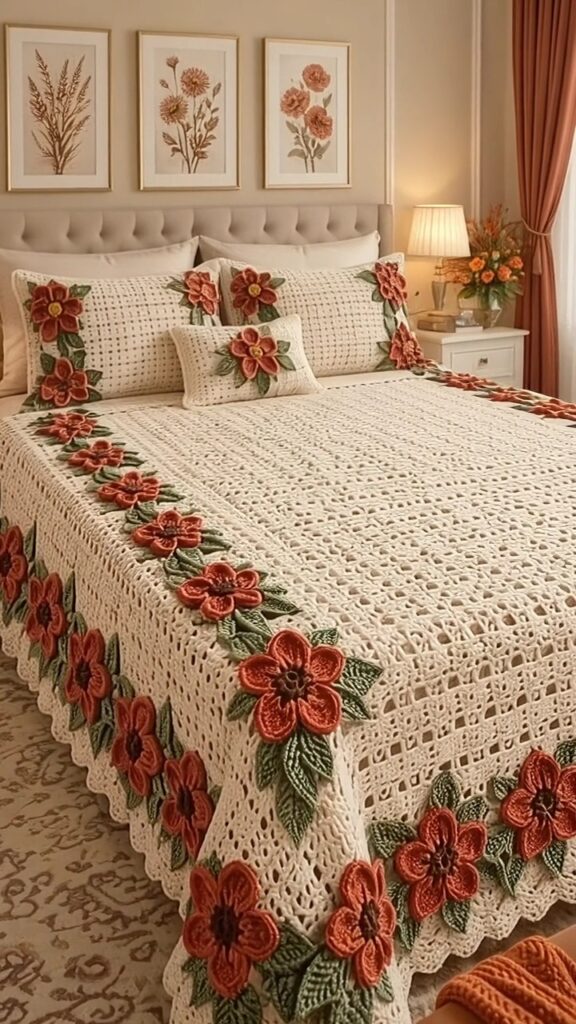
A cream open-mesh field carries raised terracotta five-petal flowers with dark brown centres and sage green layered leaves along the edges. Matching pillow shams and a bolster-style cushion repeat the flower-and-leaf motif, and a scalloped border finishes the bottom and sides.
Construction and Pattern Direction
Use the layered five-petal flower square family as your starting point, and sample one flower with its brown centre before you decide on the mesh field. Change the colours to terracotta, rust and sage to match the photo. Work the petals stand-up so they read as dimensional motifs.
Layout and Finishing
Arrange the flower motifs as separate squares appliqued or joined onto a mesh ground, then finish the edge with a scalloped border. Measure one finished flower motif and the mesh panel before joining, since the photo does not show gauge or overall bedspread size.
Complete Practice Pattern: Layered Five-Petal Flower Square Practice Motif
Materials: A cotton or cotton-blend sport weight yarn with a 3.0 to 3.5 mm hook as one option, not a photographed specification.
Scope: Counted original practice component, physically untested; see the adaptation notes before scaling up.
- Foundation: Ch 6, join with sl st to form a ring [6 ch].
- Round 1: Ch 3 (counts as first dc), 15 dc in ring, join to top of ch 3 [16 dc].
- Round 2: Ch 5 (counts as dc and ch 2), dc in next dc, ch 2, repeat that unit 15 more times, join to third ch of ch 5 [16 dc, 16 ch-2 spaces].
- Round 3: Ch 1, 5 dc in next ch-2 space, ch 1, skip next ch-2 space, repeat that unit 7 more times, join to first ch 1 [8 five-dc petals, 8 ch-1 spaces].
- Round 4: Sl st into next ch-1 space, ch 3, sc in next ch-1 space, repeat that unit 7 more times, join [8 ch-3 loops].
- Finish: Fasten off and weave in ends. Check that the square lies flat before measuring.
Assembly and Adaptation
Measure the finished sample across two opposite points so you know its true size. To join squares, work slip stitches through the ch-3 loops of adjoining motifs, or sew them edge to edge with the same yarn. The photo does not show exact dimensions, pillow sham edging or how the flowers are attached to the ground mesh.
Looking for more? You may also like 14 Crochet Bedspread, Blanket and Decor Ideas: Granny Squares, Flower Squares and Lace Medallions, 10 Crochet Bedspread and Table Runner Ideas: Rosette, Flower and Granny Squares and 20 Crochet Bedspread, Blanket and Home Decor Ideas: Flower Squares, Lace Medallions and Granny Squares.
3. Cream and Teal Flower Bedspread with Green Leaves
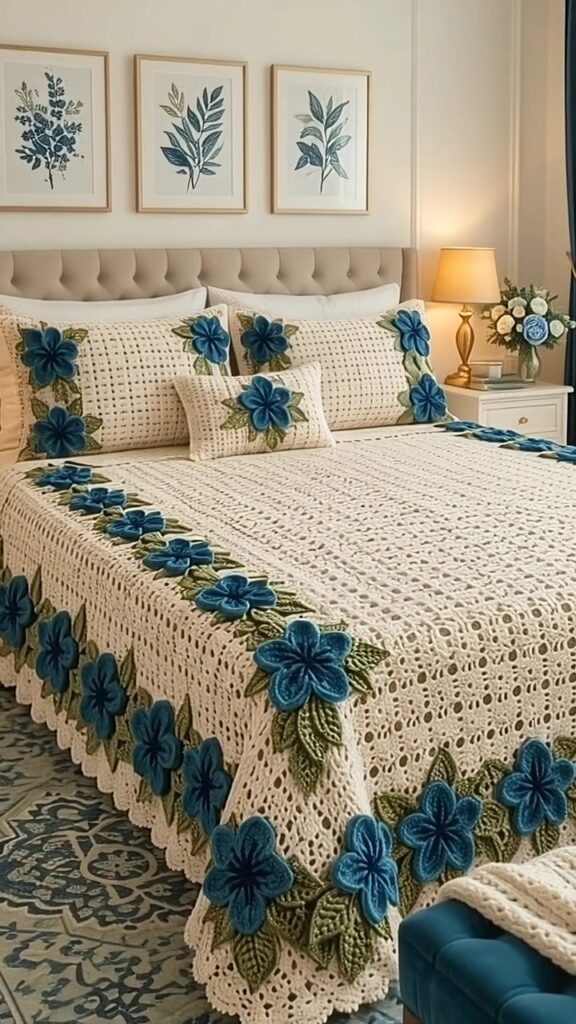
A cream open-mesh lace bedspread has a wide border of raised teal five-petal flowers, each sitting on olive green leaf clusters. The same flower-and-leaf motif repeats on the pillow shams and a small accent pillow, and a scalloped picot-style edge finishes the bottom.
Construction and Pattern Direction
Start from the layered five-petal flower square family and sample one teal flower on an olive leaf cluster. Change only the colours, teal for the flowers and olive for the leaves, and keep the stand-up petal layering. Work the border as a row of separate motifs before joining them into the mesh field.
Layout and Finishing
Set the flower border as a band along the edges, joined to a mesh lace field that reads as a grid of square blocks. Measure the finished border and field before joining, since the photo does not give a hook size or motif count.
Practice pattern: Layered Five-Petal Flower Square Practice Motif (full counted steps with photo 2).
4. Blue and Ivory Flower Square Bedspread with Pillow Shams
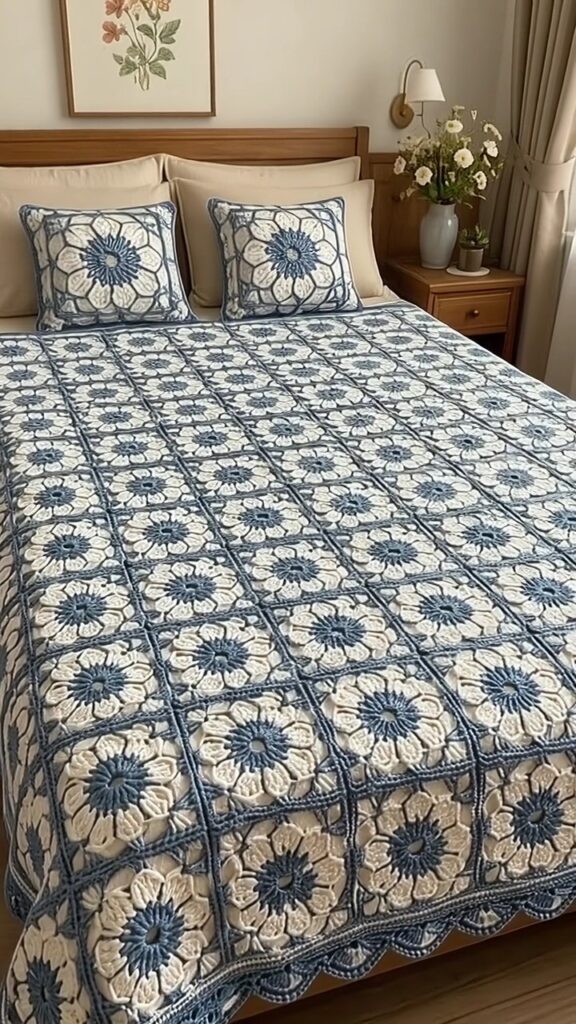
A full bedspread of square motifs each carries a raised ivory flower of rounded petals around a dense blue centre, framed by blue lattice-like seams. Matching square pillow shams repeat the motif with a blue piped edge, and a scalloped blue band runs along the bottom.
Construction and Pattern Direction
Use the layered flower square family and sample one motif with raised rounded petals around a blue centre first. Keep the ivory flower and blue centre, and treat the blue lattice seams as the joins between motifs. Write the raised petals as the stand-up layer so the motif reads as textured.
Layout and Finishing
Join the squares in a grid with blue seams, then add a scalloped band along the bottom edge. Measure one finished square and count the squares across and down, since the photo gives no stitch count or bed dimensions.
Practice pattern: Layered Five-Petal Flower Square Practice Motif (full counted steps with photo 2).