20 Crochet Bedspread, Blanket and Home Decor Ideas: Flower Squares, Lace Medallions and Granny Squares
This collection brings together twenty bedspread, blanket, coaster and doily photos that share a soft palette of cream, ivory, blue, taupe and lilac. Many pieces are built from repeated squares or round medallions, so the photos show how flower squares, lace medallions and granny-style blocks look when joined into a larger field. Some images show a single hand-held motif beside the full throw, which makes the scale easy to compare.
Nine practice-pattern families give counted starting points for these photos, eight from the existing library and one new teardrop-loop medallion written for this roundup. Related references link back to the same full instructions, so a flower square or swirl medallion can be sampled once and then resized for a bedspread, pillow sham or coaster.
Before You Start: Materials and Measurements
Choose yarn for the intended project rather than assuming the photographs identify a particular fiber. Smooth cotton is a useful material to sample for defined lace and table pieces; a cotton blend or another washable yarn may suit larger decorative pieces and blankets. Start with the hook range on the yarn label and change it until the fabric looks right for the project.
Prepare a yarn needle, scissors, stitch markers, a tape measure and paper for planning layouts. Make one whole component, finish it using the intended care method and measure it after drying. Record width, height, weight and any changes to the written instructions before multiplying it into a larger piece.
US Crochet Terms and Working Rules
Ch = chain; sl st = slip stitch; sc = single crochet; hdc = half double crochet; dc = double crochet; tr = treble crochet; inc = 2 stitches in one stitch; sc2tog / dc2tog = work two stitches together; st = stitch; sp = space. An adjustable ring is a yarn loop that can be tightened after the first round is worked. Repeats in parentheses are worked the stated number of times, and numbers in brackets give the count at the end of a row or round.
Unless a pattern explicitly counts the starting chain, it is only a height chain: use ch 1 before sc rounds and ch 2 before dc rounds, then work the first real stitch in the first indicated stitch or space. Join rounds to the first real stitch. Do not add stitches when changing colors.
For terminology, see the Craft Yarn Council pattern-reading reference. If using a separate chart, check its own key as well as the standard crochet chart symbols.
Browse the 20 Photo References
- Cream and Blue Heart Lace Bedspread
- White Swirled Spoke Medallion Lace — Crochet Adaptation
- Taupe Teardrop Lace Motif Coasters
- Taupe Lace Pinwheel Squares
- Lilac and Cream Flower Bedspread
- Bubblegum Pink Scalloped Doily
- Lavender and Ivory Daisy Square Blanket
- Yellow and White Flower Motif Bedspread
- Yellow and Grey Swirl Medallion Bedspread
- Periwinkle and Cornflower Blue Layered Flower Square
- Blue and Ivory Flower Motif Bedspread
- Burgundy and Blush Granny Square Blanket
- Pink, Sage and Cream Floral Crochet Bedspread
- Sage and Ivory Flower Square Bedspread
- Royal Blue Diamond Lace Bedspread
- Navy and Ivory Medallion Bedspread
- Grey and Ivory Five-Petal Flower Blanket
- Cream and Red Flower Square Bedspread
- Green and Ivory Flower Square Bedspread
- Bright Emerald Green Lace Bedspread and Motif
1. Cream and Blue Heart Lace Bedspread
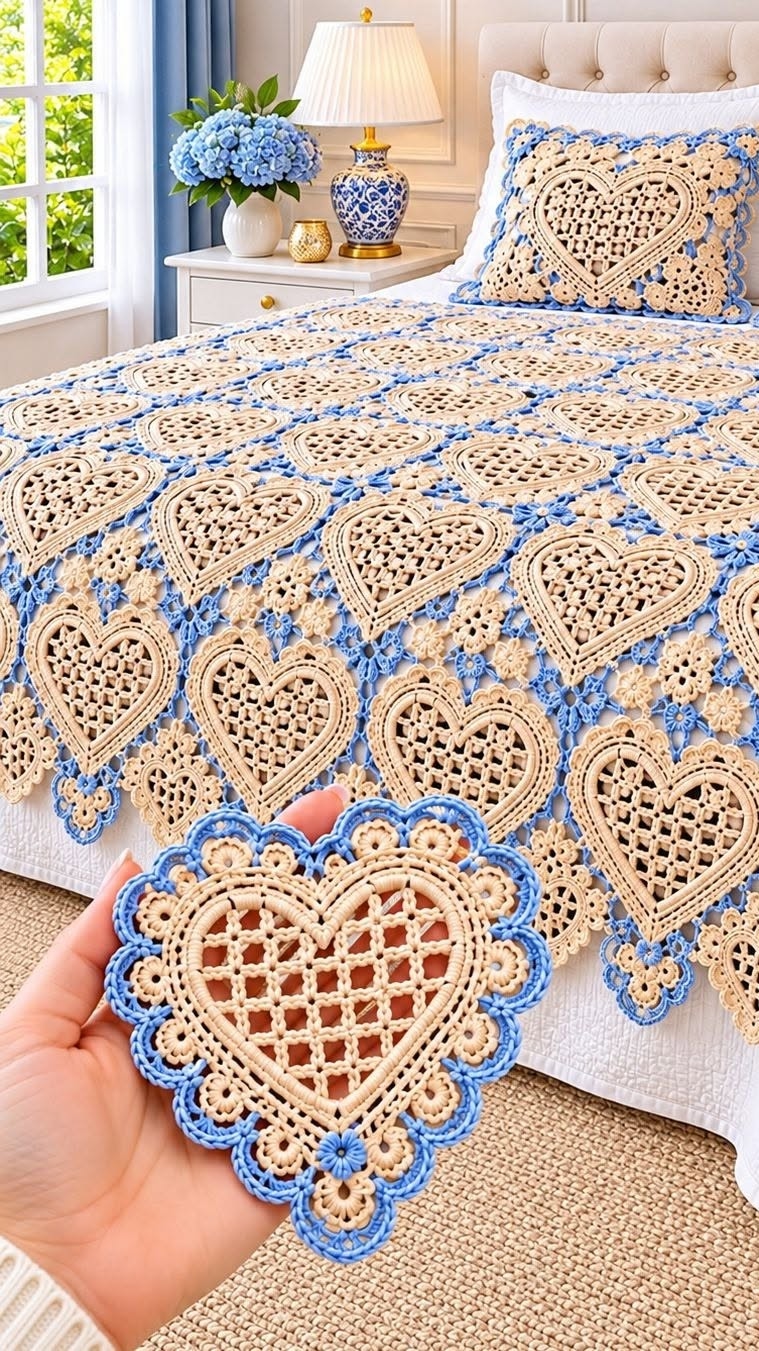
The bedspread repeats open lace heart motifs in cream, with a blue scalloped border and small five-petal flowers in the gaps between hearts. A matching pillow sham and a palm-sized heart coaster repeat the same outline and edging.
Construction and Pattern Direction
Begin with a filet-style square sampled from the Twelve-Unit Filet Mesh Practice Square, working the open diamond lattice in cream first. Once the mesh reads clearly, add the raised heart outline in the same cream and finish each heart with the blue scalloped edge as a separate round, which is where the photo’s picot links would be placed.
Layout and Finishing
Join the hearts edge to edge with blue chain and picot links to match the drop-edge look, and set the scalloped border after joining. Measure one finished heart and the full bedspread before deciding how many to make; the photo does not give heart size, grid count or yarn weight.
Complete Practice Pattern: Twelve-Unit Filet Mesh Practice Square with Block Rows
Materials: Use a sport-weight cotton in one solid color with a hook range of 2.25 to 3.0 mm as one option, not a photographed specification.
Scope: Counted original practice component, physically untested; see the adaptation notes before scaling up.
- Row 1 (foundation): Ch 39. Dc in the fourth ch from hook and each ch across [36 dc].
- Row 2 (mesh): Ch 3 (counts as first dc), turn. Dc in the next 2 dc, [ch 2, skip 2 dc, dc in next dc] 10 times, dc in each of the last 3 dc [16 dc, 10 ch-2 spaces].
- Row 3 (block): Ch 3 (counts as first dc), turn. Dc in each dc and work 2 dc in each ch-2 space across [36 dc].
- Row 4 (mesh): Repeat Row 2 [16 dc, 10 ch-2 spaces].
- Row 5 (block): Repeat Row 3 [36 dc].
- Rows 6 to 9: Continue alternating mesh and block rows, so Row 6 is mesh [16 dc, 10 ch-2 spaces], Row 7 is block [36 dc], Row 8 is mesh [16 dc, 10 ch-2 spaces] and Row 9 is block [36 dc].
- Finish: Fasten off and weave in ends. The 9-row sample is a complete practice square.
- Resize: For n repeats of 3 stitches, work the foundation as Ch 3n + 3 and make Row 1 3n dc. Row 2 then uses n minus 2 mesh repeats, so 12 repeats give 10 and 9 repeats give 7.
Assembly and Adaptation
Measure the finished sample flat without stretching; the photo does not show the width, the number of squares or whether the mesh is blocked. Scale the square by changing n and the number of rows, then join squares with a whip stitch through the outer block edges. The practice square does not show the bed layout or where any cross or star motif is placed.
2. White Swirled Spoke Medallion Lace — Crochet Adaptation
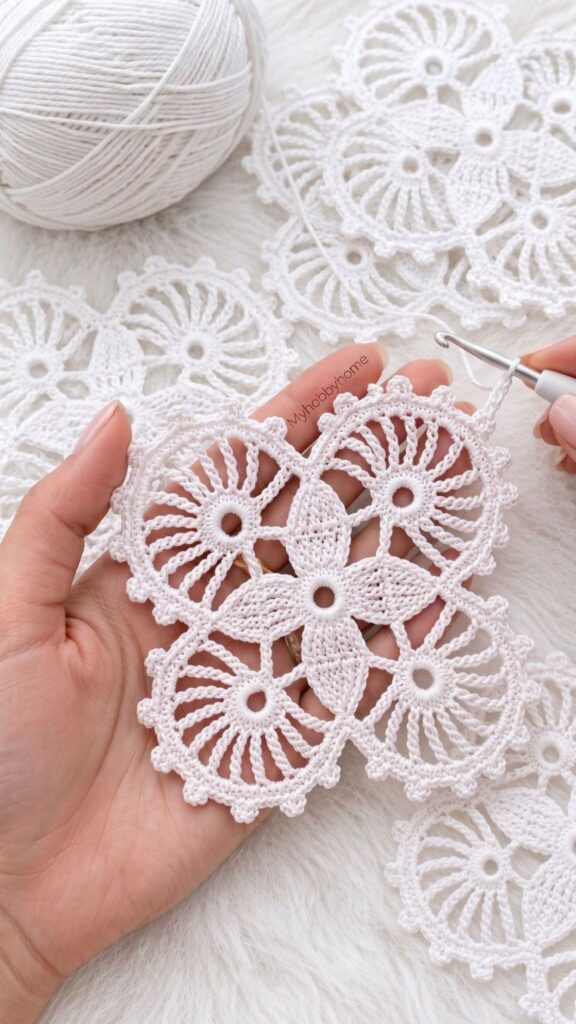
Round white medallions have a small open ring at the centre and many twisted, rope-like spokes that fan out like a wheel. The outer edge is scalloped with raised picots, and adjacent medallions share chain-space bridges.
Construction and Pattern Direction
Start with the Swirled Pinwheel Medallion with Picot Edge, which gives counted rounds of 12, 24 and 32 stitches with picot loops on the outside. Replace the leaf-like centre petals in the photo with a simple ring of double crochet and chain spaces so the piece reads as crochet rather than knitted petals.
Layout and Finishing
Join medallions by working the chain-space bridges as each one is completed, placing them in a row for a doily or runner. Measure the finished medallion across the picot points before choosing how many to join; the photo does not show hook size, yarn or total length.
Complete Practice Pattern: Swirled Pinwheel Medallion with Picot Edge
Materials: A cotton or cotton-blend sport weight yarn with a 3.0 to 3.5 mm hook as one option, not a photographed specification.
Scope: Counted original practice component, physically untested; see the adaptation notes before scaling up.
- Foundation: Ch 6, join with sl st to form a ring [6 ch].
- Round 1: Ch 3 (counts as first dc), 11 dc in ring, join [12 dc].
- Round 2: Ch 3 (counts as first dc), 1 dc in same st, 2 dc in each remaining st around, join [24 dc].
- Round 3 (pinwheel): Ch 3 (counts as first dc), 2 dc in next st, dc in next 2 sts, repeat that group 6 more times, join [8 groups, 32 dc].
- Round 4: Ch 5 (counts as dc and ch 2), dc in next dc, ch 2, repeat that unit 31 more times, join [32 dc, 32 ch-2 spaces].
- Round 5: Ch 1, (sc, ch 3, sc) in next ch-2 space, repeat that unit around, join [32 ch-3 picot loops].
- Finish: Fasten off and weave in ends.
Assembly and Adaptation
Measure the finished medallion across the widest point and record it. Join medallions with a lace mesh by chaining between picots, scaling the number of mesh chains to match the width you need. The photo does not show how the mesh fills the spaces or the exact medallion diameter.
3. Taupe Teardrop Lace Motif Coasters
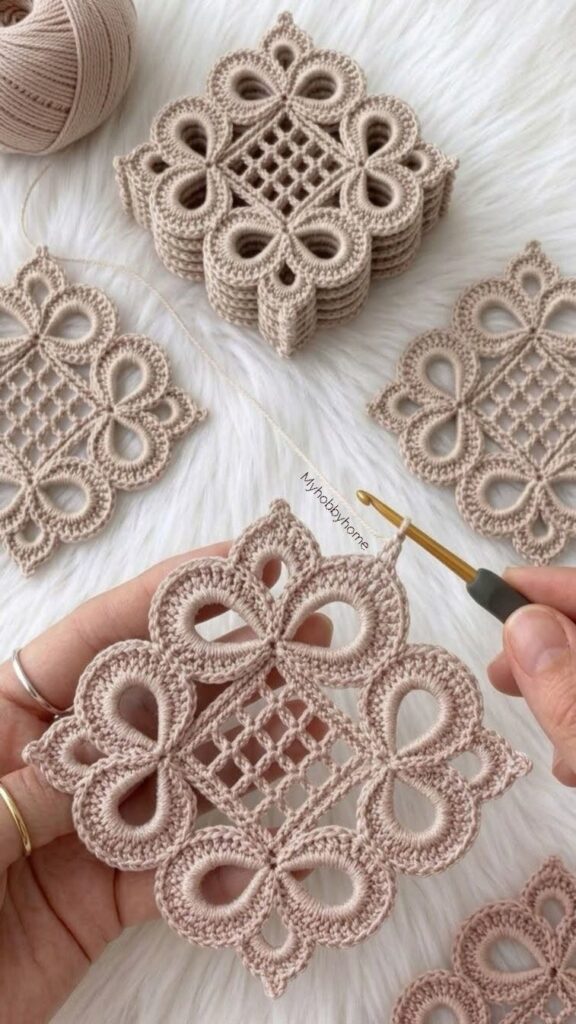
Diamond-shaped coasters each have four large open teardrop lobes around a central mesh of small squares. The pointed outer scallops and raised border make each piece look like part of a matching set.
Construction and Pattern Direction
Work the Eight-Petal Star Lace Motif with Teardrop Lobes family, using its sixteen-dc centre ring and ch-4 lobe rounds. Keep only four of the eight petals so the coaster shows four teardrop lobes, and recount the stitches in that round so the total matches what you have actually worked.
Layout and Finishing
Join the coasters through their outer edges, or work them individually as a set. Measure a finished coaster across two opposite lobe tips before making the full set; the photo does not show hook size or yarn.
Complete Practice Pattern: Eight-Petal Star Lace Motif with Teardrop Lobes
Materials: A fine to sport-weight cotton in two contrasting colours, with a hook range of 1.75 to 2.25 mm as one option, not a photographed specification.
Scope: Counted original practice component, physically untested; see the adaptation notes before scaling up.
- Foundation: Ch 4, join with sl st to form a ring. Round 1: Ch 3 (counts as first dc), 15 dc in ring, join to top of ch 3 [16 dc].
- Round 2: Ch 1, sc in first dc, *ch 5, skip next dc, sc in next dc; repeat from * 6 more times, ch 5, join to first sc [8 sc, eight ch-5 loops].
- Round 3: Sl st into first ch-5 loop, ch 3 (counts as first dc), 6 dc in same loop [7 dc], sc in next sc; *7 dc in next ch-5 loop, sc in next sc; repeat from * 6 more times [8 petals of 7 dc, 8 sc, 64 stitches total].
- Round 4: Ch 1, sc in first sc between petals, *ch 4, sc in next sc between petals; repeat from * 6 more times, ch 4, join to first sc [8 sc, eight ch-4 spaces].
- Round 5: Sl st into first ch-4 space, ch 1, (2 sc, ch 2, 2 sc) in same space, *sc in next sc, (2 sc, ch 2, 2 sc) in next ch-4 space; repeat from * 6 more times, sc in next sc, join to first sc [40 sc, eight ch-2 corners].
- Check: 16 dc in round 1, 8 petals of 7 dc in round 3, 8 sc between petals, and 40 sc in round 5 with eight ch-2 corners.
Assembly and Adaptation
Measure the finished motif across opposite ch-2 corners after blocking. To join, work the round-5 ch-2 corners together on the diagonal with sc, using one corner space from each motif, which keeps the grid square-edged like the photo. The photo’s mustard wedges come from a solid background colour that this round-motif pattern does not provide, and the photo does not show a gauge or finished size.
4. Taupe Lace Pinwheel Squares
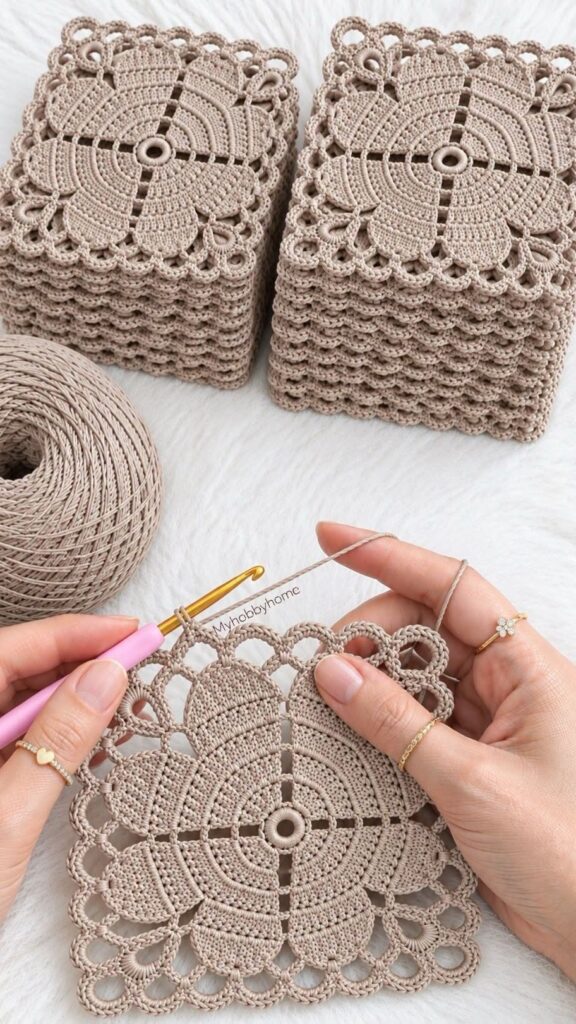
Stacked square lace motifs in taupe show an open ring centre with four fan-like petals and open loops between them. The outer edge is scalloped, with open teardrop lobes at the corners.
Construction and Pattern Direction
Use the Layered Five-Petal Flower Square Practice Motif as the starting point, since its counted rounds of 16 dc, 16 ch-2 spaces and eight five-dc petals suit the layered fan look. Change the petals to four dense fan rounds and add a scalloped edge with teardrop corners in the final round, recounting any round you change.
Layout and Finishing
Stack or join the squares edge to edge, sized by measuring a finished square. The photo does not show the yarn weight, hook or total number of squares.
Complete Practice Pattern: Layered Five-Petal Flower Square Practice Motif
Materials: A cotton or cotton-blend sport weight yarn with a 3.0 to 3.5 mm hook as one option, not a photographed specification.
Scope: Counted original practice component, physically untested; see the adaptation notes before scaling up.
- Foundation: Ch 6, join with sl st to form a ring [6 ch].
- Round 1: Ch 3 (counts as first dc), 15 dc in ring, join to top of ch 3 [16 dc].
- Round 2: Ch 5 (counts as dc and ch 2), dc in next dc, ch 2, repeat that unit 15 more times, join to third ch of ch 5 [16 dc, 16 ch-2 spaces].
- Round 3: Ch 1, 5 dc in next ch-2 space, ch 1, skip next ch-2 space, repeat that unit 7 more times, join to first ch 1 [8 five-dc petals, 8 ch-1 spaces].
- Round 4: Sl st into next ch-1 space, ch 3, sc in next ch-1 space, repeat that unit 7 more times, join [8 ch-3 loops].
- Finish: Fasten off and weave in ends. Check that the square lies flat before measuring.
Assembly and Adaptation
Measure the finished sample across two opposite points so you know its true size. To join squares, work slip stitches through the ch-3 loops of adjoining motifs, or sew them edge to edge with the same yarn. The photo does not show exact dimensions, pillow sham edging or how the flowers are attached to the ground mesh.
5. Lilac and Cream Flower Bedspread
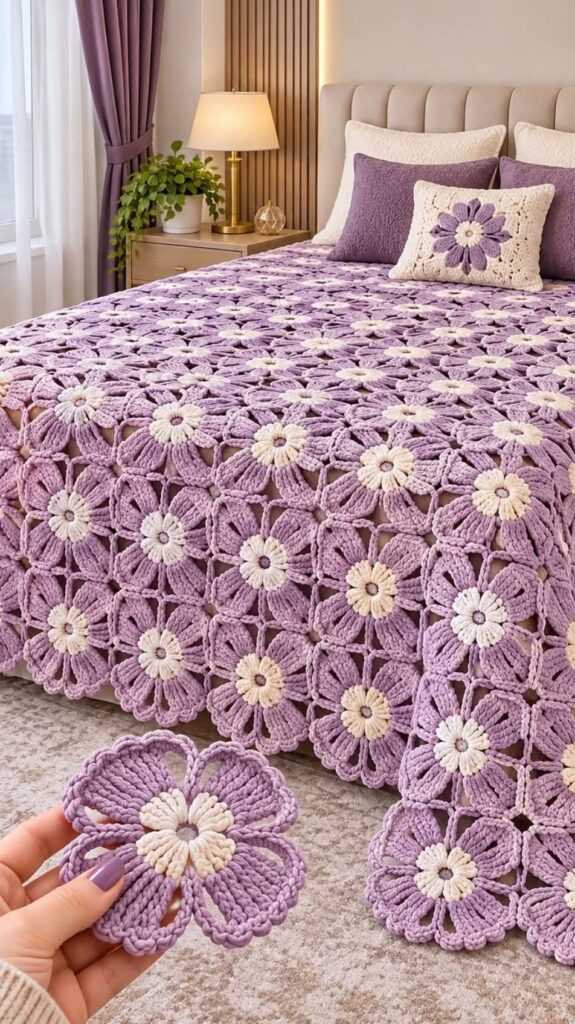
A bedspread of joined flower motifs has cream centre rings and five to seven lilac petals, each with a scalloped, rounded tip. The petals stand up with a raised texture, and the motifs meet in a square grid with lacy gaps at the seams.
Construction and Pattern Direction
Begin with the Layered Five-Petal Flower Square Practice Motif, the closest counted family, and sample it in a chunky-weight adaptation to match the thick, raised look. Make the centre ring the first round and add a scalloped picot to the outer round to give the rounded lilac petal tips.
Layout and Finishing
Join the flat square units in a grid, leaving a small chain-space gap at each seam for lace. Measure one finished square and multiply by the number of rows to plan the bedspread size; the photo does not give a size or yarn specification.
Practice pattern: Layered Five-Petal Flower Square Practice Motif (full counted steps with photo 4).
6. Bubblegum Pink Scalloped Doily
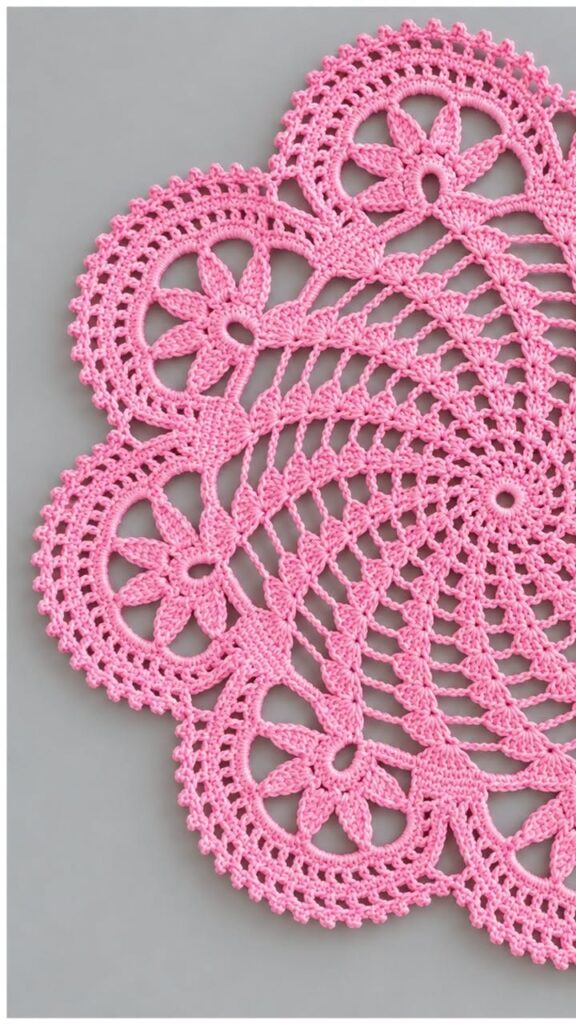
A round doily has a large scalloped outer edge with a bumpy picot border, and five-petal flowers sit in arched spaces around the outer ring. Inner rounds of fan and mesh radiate toward a small open centre ring.
Construction and Pattern Direction
Work the Concentric Rose Lace Medallion with Scalloped Border, which gives counted rounds of 12 sc, 24 dc and 12 scallop groups. Place the five-petal flowers in the arched spaces by working them as the outer scallop groups, and keep the centre ring small.
Layout and Finishing
Block the doily to measure its finished diameter before adding more rounds. For the roughly six-scallop edge in the photo, work every second scallop group of the family; the photo does not give a size or yarn.
Complete Practice Pattern: Concentric Rose Lace Medallion with Scalloped Border
Materials: A fine cotton or cotton-blend thread with a 1.75 to 2.25 mm hook as one option, not a photographed specification.
Scope: Counted original practice component, physically untested; see the adaptation notes before scaling up.
- Foundation: Ch 6, join with sl st to form a ring [6 ch].
- Round 1: Ch 1, 12 sc in ring, join [12 sc].
- Round 2: Ch 3 (counts as first dc), 1 dc in same st, 2 dc in each remaining st around, join [24 dc].
- Round 3: Ch 4 (counts as dc and ch 1), dc in next dc, ch 1, repeat that unit 23 more times, join to third ch of ch 4 [24 dc, 24 ch-1 spaces].
- Round 4: Ch 5 (counts as dc and ch 2), dc in next ch-1 space, ch 2, repeat that unit 23 more times, join [24 dc, 24 ch-2 spaces].
- Round 5: Ch 1, (sc, ch 5, sc) in next ch-2 space, skip next ch-2 space, repeat that unit around, join [12 sc-ch5-sc groups, 12 ch-5 loops].
- Round 6: Sl st across to first ch-5 loop, ch 1, 5 dc in same loop, ch 1, sl st across to next ch-5 loop, repeat that unit around, join [12 five-dc scallops].
Assembly and Adaptation
Measure the finished motif from scallop tip to scallop tip and note the width. Join motifs by working the final round through adjoining scallops so the square grid forms the bedspread. The photo does not show the exact motif size, the join method or how many motifs the pillow shams use.
7. Lavender and Ivory Daisy Square Blanket
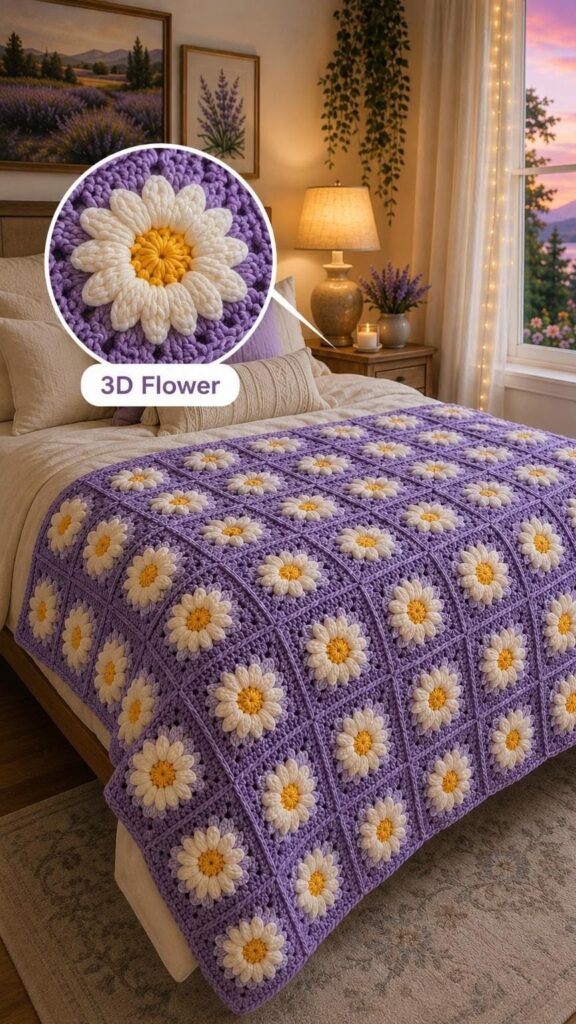
A large throw is made of square blocks in lavender, each with a raised ivory daisy and a golden centre disc. The purple background is dense textured crochet with post-style stitches, and the squares are joined edge to edge.
Construction and Pattern Direction
Use the Layered Rosette Square with Stand-Up Petals practice pattern, which gives counted rounds of 12 sc, 24 dc and twelve five-part petals, then add the golden centre disc as a separate round. Work the textured background by using post-style stitches in the outer rounds.
Layout and Finishing
Join the squares edge to edge in a grid, measuring one finished block to plan the throw. The photo does not provide the block count, yarn weight or hook size.
Complete Practice Pattern: Layered Rosette Square with Stand-Up Petals
Materials: A cotton or cotton-blend sport weight yarn with a 3.0 to 3.5 mm hook as one option, not a photographed specification.
Scope: Counted original practice component, physically untested; see the adaptation notes before scaling up.
- Foundation: Ch 6, join with sl st to form a ring [6 ch].
- Round 1: Ch 1, 12 sc in ring, join [12 sc].
- Round 2: Ch 3 (counts as first dc), 1 dc in same st, 2 dc in each remaining st around, join [24 dc].
- Round 3: Ch 4 (counts as dc and ch 1), dc in next dc, ch 1, repeat that unit 23 more times, join [24 dc, 24 ch-1 spaces].
- Round 4 (petals): (sc, hdc, 3 dc, hdc, sc) in next ch-1 space, skip next ch-1 space, repeat that unit around, join [12 petals of 7 sts each, 12 ch-1 spaces left].
- Round 5 (back): Ch 1, sc in each of the 12 remaining ch-1 spaces, join [12 sc].
- Finish: Fasten off and weave in ends.
Assembly and Adaptation
Measure the finished rosette across the petal tips and record the number. Join rosettes by working through the back sc round or sewing each rosette to a mesh base. The photo does not show the base mesh or whether the rosettes are sewn or worked directly onto the ground.
8. Yellow and White Flower Motif Bedspread
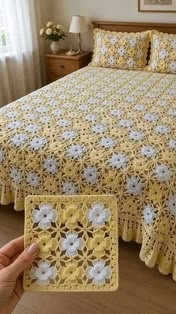
Square flower motifs with white five-petal blossoms sit on a yellow ground, joined in a grid. A matching pair of pillow shams and a ruffled, scalloped skirt finish the bed.
Construction and Pattern Direction
Start with the Layered Five-Petal Flower Square Practice Motif, using its counted rounds of 16 dc and eight five-dc petals. Work the white layered petals in the centre, then add the yellow chain-space joins as the final round so they read as a frame.
Layout and Finishing
Join motifs edge to edge after measuring one finished square; the ruffled skirt can be added as a separate scalloped round worked after joining. The photo does not give the motif size or yarn.
Practice pattern: Layered Five-Petal Flower Square Practice Motif (full counted steps with photo 4).
9. Yellow and Grey Swirl Medallion Bedspread

Large round medallions in yellow and grey curl inward as spirals with stand-up ridges and open lacy bands. The medallions are joined in staggered rows, and each has a scalloped picot outer edge.
Construction and Pattern Direction
Use the Swirled Pinwheel Medallion with Picot Edge practice pattern, whose counted rounds of 12, 24 and 32 stitches build the swirl. Alternate the yellow and grey rounds so the spiral reads as a colour change, and keep the picot loops on the outer round.
Layout and Finishing
Join in staggered rows by working the chain-space bridges, and measure one finished medallion across the picot points to plan the bedspread. The photo does not show the hook, the number of medallions or the yarn weight.
Practice pattern: Swirled Pinwheel Medallion with Picot Edge (full counted steps with photo 2).
10. Periwinkle and Cornflower Blue Layered Flower Square
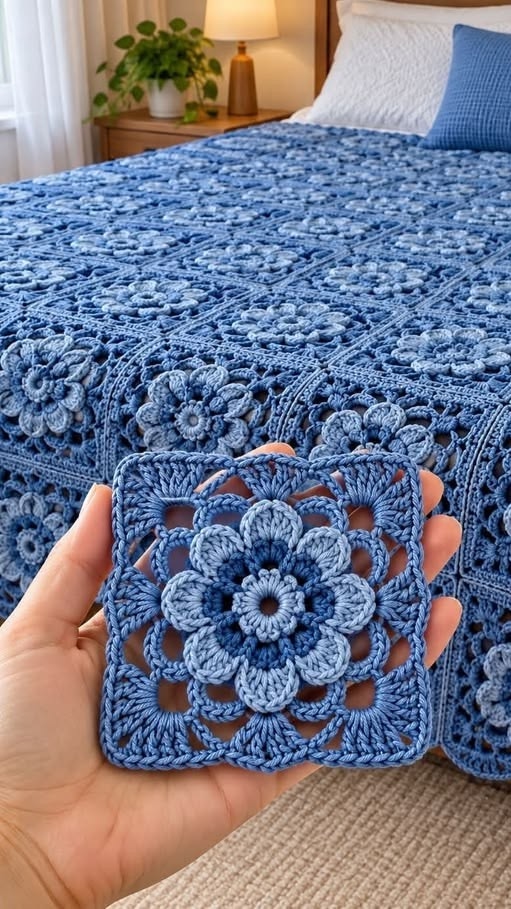
A single square has a large central flower of layered, stand-up petals in two blues, framed by a navy centre ring and a lacy outer border. Fan-like scalloped corners and a crisp, slightly raised edge finish the square.
Construction and Pattern Direction
Work the Layered Rosette Square with Stand-Up Petals, which gives counted rounds of 12 sc, 24 dc, 12 five-part petals and 12 back sc. Use the two blues for the petal rounds and navy for the centre ring, and keep the post-style texture by working the petals in the back loop.
Layout and Finishing
The photo shows the square repeated in a joined layout on a blanket, so join edge to edge after blocking. Measure the finished square to scale the blanket, since the photo does not give a size.
Practice pattern: Layered Rosette Square with Stand-Up Petals (full counted steps with photo 7).
Looking for more? You may also like 14 Crochet Bedspread, Blanket and Decor Ideas: Granny Squares, Flower Squares and Lace Medallions, 17 Crochet Bedspread, Blanket and Decor Ideas: Flower Squares, Lace Medallions and Filet Mesh and 18 Crochet Home Decor Ideas: Layered Flower Squares and Lace Medallions.
11. Blue and Ivory Flower Motif Bedspread

Alternating powder blue and ivory flower squares sit in a checkerboard-like grid, with some blocks showing layered five-petal flowers and others showing rounded lacy petals. A separate blue medallion shows seven teardrop-shaped open lobes around a centre ring.
Construction and Pattern Direction
Start with the Layered Five-Petal Flower Square Practice Motif for the checkerboard blocks, and use the same counts for the rounder-petal blocks by skipping the picot finish. Work the seven-lobe medallion only as a separate sample if you want it, since this roundup’s practice families do not cover seven lobes.
Layout and Finishing
Alternate the two block types in a checkerboard, joining square to square and planning the grid by rows. Measure a finished block to plan the size; the photo does not show block count, yarn or hook size.
Practice pattern: Layered Five-Petal Flower Square Practice Motif (full counted steps with photo 4).
12. Burgundy and Blush Granny Square Blanket
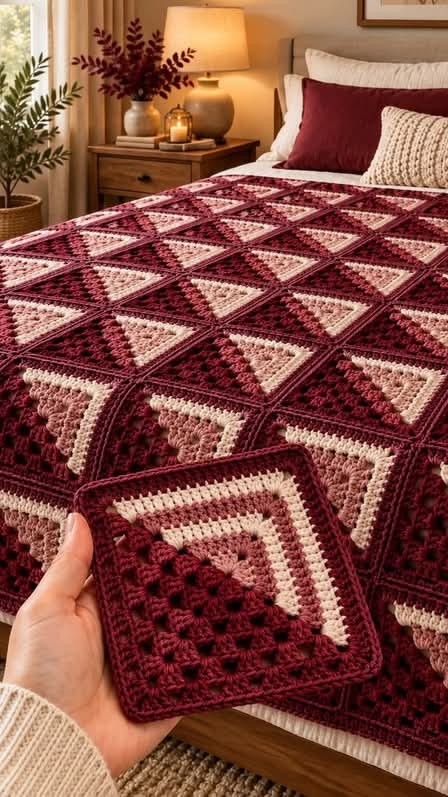
Granny-style squares are arranged on the diagonal, each forming a triangle of colour with a burgundy open centre, a dusty rose band and a cream outer edge. The stitch texture is open at the centre and solid at the border.
Construction and Pattern Direction
Start with the Three-Round Granny Square Practice Motif, whose third round finishes with 36 dc, four ch-2 corners and eight ch-1 sides. Work the burgundy centre first, then change to dusty rose and cream for the outer rounds so each colour forms one triangle band.
Layout and Finishing
Join the squares edge to edge with visible seams, which suits the diagonal layout. Measure one finished square to plan the throw; the photo does not give the yarn, hook or total size.
Complete Practice Pattern: Three-Round Granny Square Practice Motif
Materials: A sport or DK weight cotton in two or three colours is one suggestion, with a 4 mm to 4.5 mm hook as one option, not a photographed specification.
Scope: Counted original practice component, physically untested; see the adaptation notes before scaling up.
- Foundation: Ch 4, sl st in first ch to form a ring.
- Round 1: Ch 3 (counts as first dc), 2 dc in ring, ch 2, [3 dc in ring, ch 2] three times; join with sl st to top of ch 3. [12 dc, four ch-2 corner spaces]
- Round 2: Sl st across to the next ch-2 space, ch 3, (2 dc, ch 2, 3 dc) in the same space; [ch 1, (3 dc, ch 2, 3 dc) in the next ch-2 space] three times; ch 1; join with sl st to top of ch 3. [24 dc, four ch-2 corners, four ch-1 side spaces]
- Round 3: Sl st to the next ch-2 corner space, ch 3, (2 dc, ch 2, 3 dc) in the same space; [ch 1, 3 dc in the next ch-1 side space, ch 1, (3 dc, ch 2, 3 dc) in the next corner space] three times; ch 1, 3 dc in the last ch-1 side space, ch 1; join with sl st to top of ch 3. [36 dc, four ch-2 corners, eight ch-1 spaces]
- Finish: Fasten off, weave in ends, and block the square flat. [36 dc total]
- Resize note: Keep four corners and four side groups of 3 dc each; to change size, change the hook or yarn rather than adding rounds, so each side still totals 9 dc per round.
Assembly and Adaptation
Measure the finished sample flat after blocking, then multiply by the number of squares across and down in the photo grid. Join the squares with a single crochet seam through the back loops or a whip stitch in a dark colour so the seams read as they do in the photo. The photo does not show stitch count, gauge or hook size, so the 30 cm squares are only a visual estimate.
13. Pink, Sage and Cream Floral Crochet Bedspread
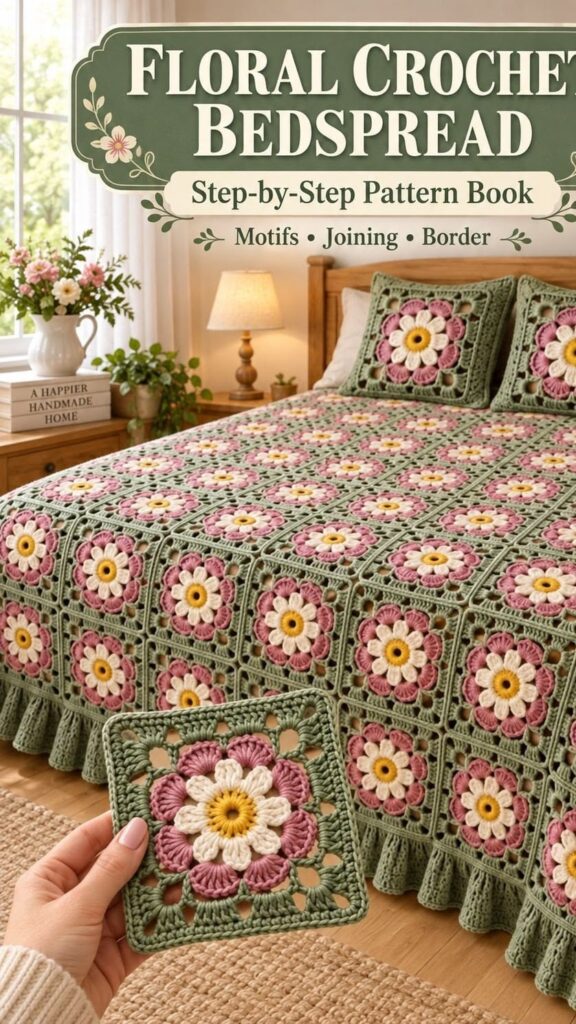
Square flower motifs have a mustard centre ring, a ring of cream five-petal flowers and dusty pink stand-up petals. Sage green mesh sashing forms lacy openings between the squares, with a gathered ruffle at the lower edge.
Construction and Pattern Direction
Use the Layered Five-Petal Flower Square Practice Motif as the base, working its 16 dc first round as the mustard centre and adding the outer petal rounds in dusty pink. Add the sage mesh sashing as a separate join round using chain spaces so the green forms the lacy openings.
Layout and Finishing
Join the squares with the sage sashing, then add the gathered ruffle as a separate round along the lower edge. Measure one finished square before planning the sashing width; the photo does not provide yarn or size.
Practice pattern: Layered Five-Petal Flower Square Practice Motif (full counted steps with photo 4).
14. Sage and Ivory Flower Square Bedspread
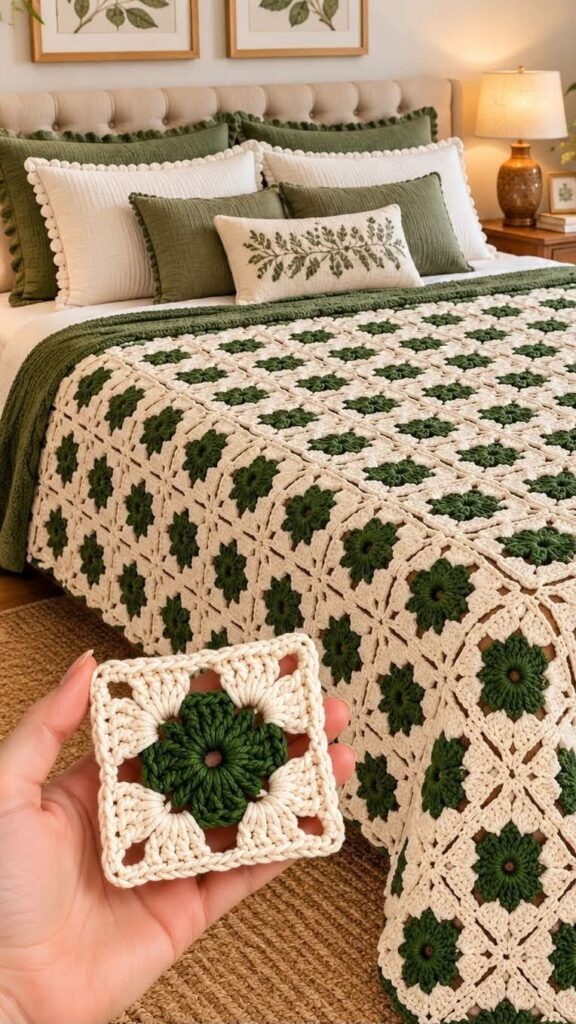
A checkerboard-like bedspread of square motifs has raised green five- or six-petal centres, open ivory corners and chain-space gaps between squares. A plain ivory border with a simple single-crochet finish frames the piece.
Construction and Pattern Direction
Start with the Layered Five-Petal Flower Square Practice Motif and sample the green centre rosette first, using its 16 dc round. Work the ivory petal fans at the corners as the final round, and finish the border with single crochet as a separate edge round.
Layout and Finishing
Join the squares so the ivory forms diagonal lattice lines with small open holes at the joins. Measure a finished square to plan the bedspread; the photo does not show the yarn or hook.
Practice pattern: Layered Five-Petal Flower Square Practice Motif (full counted steps with photo 4).
15. Royal Blue Diamond Lace Bedspread
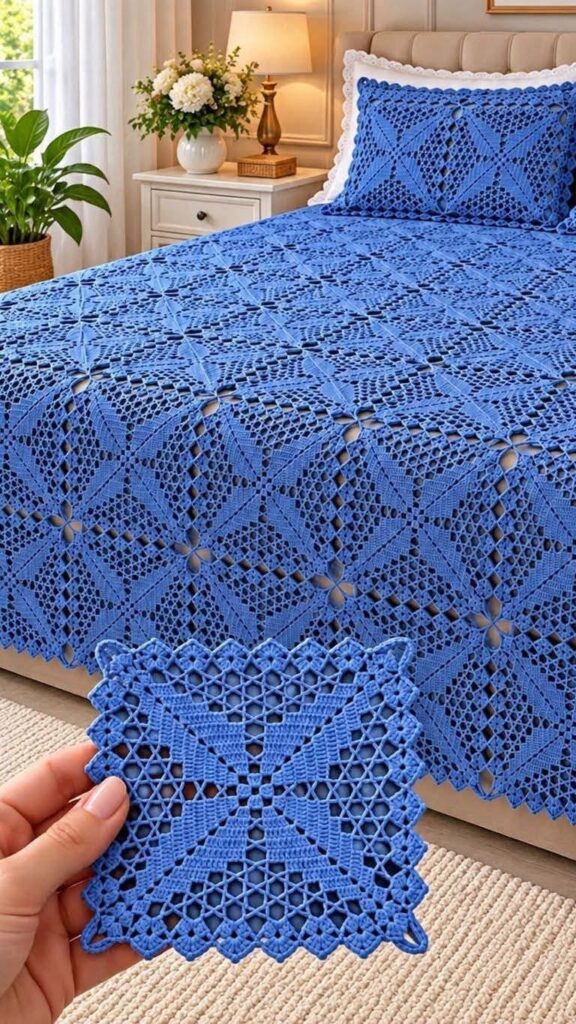
A bedspread and matching pillow sham in royal blue show a repeating grid of large diamond motifs with raised leaf-like petals and open mesh windows. The field is edged with a scalloped border of small points.
Construction and Pattern Direction
Use the Diamond Petal Lace Medallion with Picot Star practice pattern, which gives 16 sc, 16 dc, four petal groups of 6 dc and four lace lobes. Work the diamond units as counted medallions, join them with open lattice seams, and add the scalloped border of small points as the final round.
Layout and Finishing
Join the square units into one field by working the lattice seams as each unit is made, and measure a finished unit across its points to plan the bedspread. The photo does not give the hook, yarn weight or unit count.
Complete Practice Pattern: Diamond Petal Lace Medallion with Picot Star
Materials: A fine cotton thread with a 1.75 to 2.25 mm hook as one option, not a photographed specification.
Scope: Counted original practice component, physically untested; see the adaptation notes before scaling up.
- Foundation: Ch 6, join with sl st to form a ring [6 ch].
- Round 1: Ch 1, 16 sc in ring, join [16 sc].
- Round 2: Ch 5 (counts as dc and ch 2), dc in next sc, ch 2, repeat that unit 15 more times, join [16 dc, 16 ch-2 spaces].
- Round 3: Ch 1, (3 dc, ch 3, 3 dc) in next ch-2 space, skip next 3 ch-2 spaces, repeat that unit 3 more times, join [4 petals of 6 dc, 4 ch-3 points].
- Round 4: In each ch-3 point, work (sc, ch 4, sc) [4 ch-4 lobes].
- Round 5: In each ch-4 lobe, work (2 dc, ch 2, 2 dc) [4 lace lobes, 16 dc, 4 ch-2 spaces].
- Finish: Fasten off and block to shape.
Assembly and Adaptation
Measure the finished motif tip to tip and record the diameter. Join motifs with the ch-2 spaces to make a doily, coaster or larger diamond grid. The photo does not show the finished motif size or the rest of the medallion, which is still in progress.
16. Navy and Ivory Medallion Bedspread

Square granny-style blocks each have a navy ring around a cornflower and ivory centre medallion, set in a white field with small open holes where blocks meet. A scalloped white border runs along the bottom edge, and pillow covers repeat the motif.
Construction and Pattern Direction
Start with the Three-Round Granny Square Practice Motif, using navy for the first ring and cornflower and ivory for the centre rounds. Add the star-like centre texture by working the petals in the back loop of round two, then finish each block with white corners.
Layout and Finishing
Join blocks edge to edge in a grid, and add the scalloped border along the bottom edge as a separate round. Measure one finished block to plan the bedspread; the photo does not show block count or yarn.
Practice pattern: Three-Round Granny Square Practice Motif (full counted steps with photo 12).
17. Grey and Ivory Five-Petal Flower Blanket
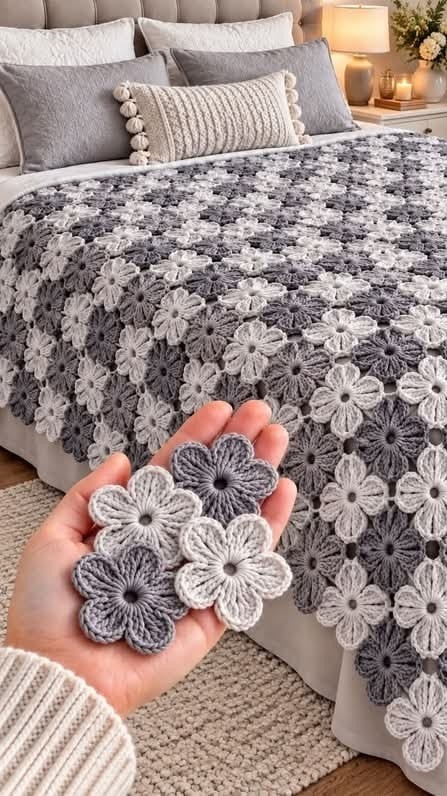
A throw of five-petal flower motifs with dark centres alternates charcoal, slate and ivory in a checkerboard pattern. Loose grey and ivory flowers in the foreground show each motif as a separate flat unit with a textured centre ring.
Construction and Pattern Direction
Start with the Layered Five-Petal Flower Square Practice Motif and sample the 16 dc first round as the textured centre ring. Alternate charcoal, slate and ivory motifs by changing colour at the last round of each square.
Layout and Finishing
Join the flat units edge to edge with small open gaps, following the checkerboard arrangement. Measure a finished motif to plan the blanket; the photo does not provide the size or yarn.
Practice pattern: Layered Five-Petal Flower Square Practice Motif (full counted steps with photo 4).
18. Cream and Red Flower Square Bedspread
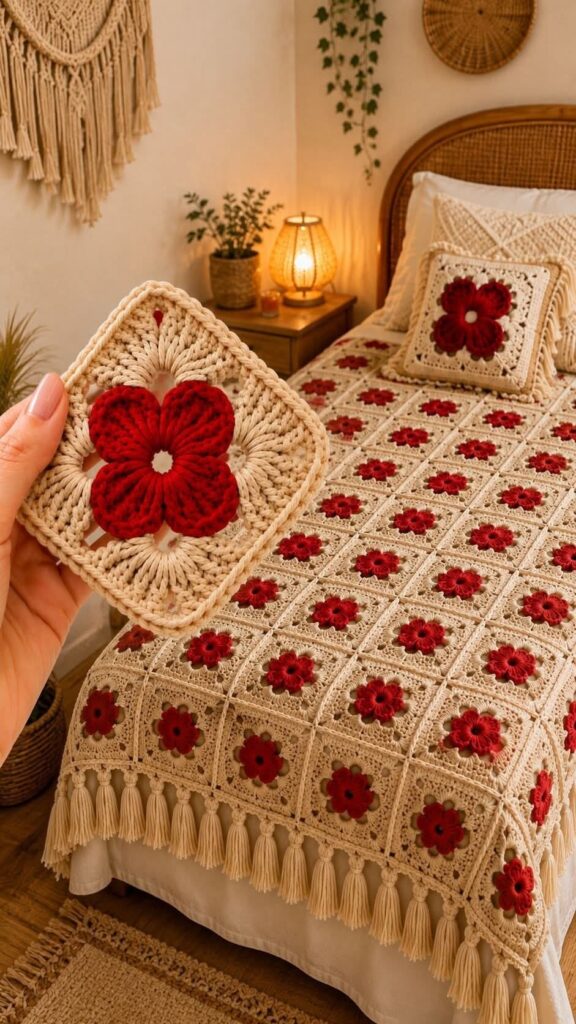
A bedspread of cream square motifs has a raised red five-petal flower at each centre, with open lace chain spaces around it. A row of cream macrame-style tassels hangs from the lower edge, and a matching square pillow has a red centre.
Construction and Pattern Direction
Use the Layered Five-Petal Flower Square Practice Motif, placing the red petals in the centre rounds and the cream in the outer rounds. The red flowers form a diagonal layout, so plan the colour changes by counting the squares in each row.
Layout and Finishing
Join the squares in a grid with visible seams, and add the tassels as a finishing detail after joining. Measure a finished square; the photo does not show the size or yarn.
Practice pattern: Layered Five-Petal Flower Square Practice Motif (full counted steps with photo 4).
19. Green and Ivory Flower Square Bedspread
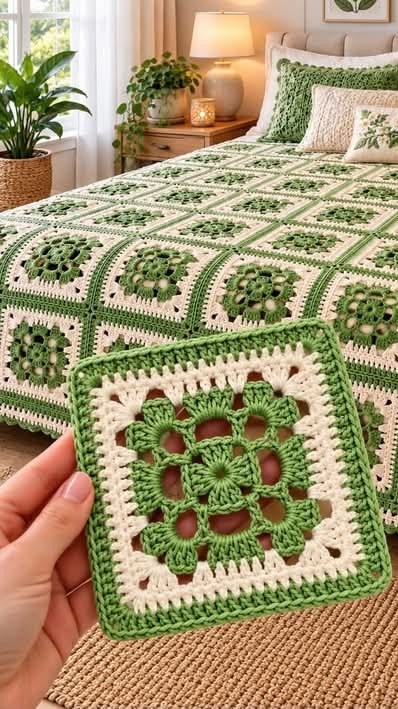
Each square has a central openwork flower of layered green petals and a wide cream border of granny-style clusters with a green outer edge. Green sashing lines separate the squares in the bedspread.
Construction and Pattern Direction
Use the Layered Rosette Square with Stand-Up Petals practice pattern for the centre, working the petals in green over its 12 sc base. Work the cream border as a granny-style cluster round, and finish the outer edge in green.
Layout and Finishing
Join the squares with green sashing, and measure a finished block to plan the spacing. The photo does not show the block count, yarn or hook.
Practice pattern: Layered Rosette Square with Stand-Up Petals (full counted steps with photo 7).
20. Bright Emerald Green Lace Bedspread and Motif
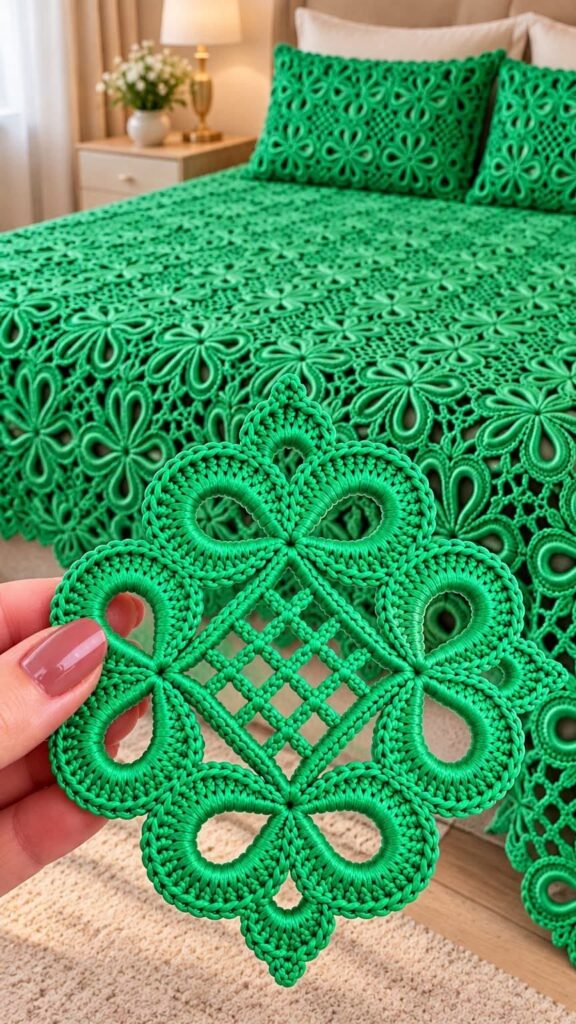
A bedspread and pillow shams are worked in dense, raised lace of teardrop loops and five-petal flowers, with open mesh between motifs. A single hand-held medallion shows a four-lobed teardrop-loop frame around a diamond lattice centre.
Construction and Pattern Direction
Use the new Four-Lobed Teardrop Loop Lace Medallion practice pattern in this article, which gives four teardrop lobes around an open centre. Keep the raised picot edge on the outer round, and if you want the five-petal flowers from the bedspread, add them as a separate motif in the joins.
Layout and Finishing
Join medallions through the outer lobe tips and finish with a scalloped lower border worked after joining. Measure one finished medallion to scale the bedspread; the photo does not give the hook, yarn or size.
Complete Practice Pattern: Four-Lobed Teardrop Loop Lace Medallion
Materials: A fine cotton-blend or lightweight yarn suits the open lace, with a 1.75 to 2.25 mm hook as one option, not a photographed specification.
Scope: Counted original practice component, physically untested; see the adaptation notes before scaling up.
- Round 1: Magic ring, ch 3 (counts as first dc), 11 dc in ring, join to top of ch 3. [12 dc]
- Round 2: Ch 5 (counts as first dc and ch 2), (dc in next dc, ch 2) 11 times, join to 3rd ch of ch 5. [12 dc, 12 ch-2 spaces]
- Round 3: Sl st in first ch-2 space, ch 1, sc in same space, sc in each of the remaining 11 ch-2 spaces. [12 sc]
- Round 4: Ch 1, sc in first sc, (ch 6, skip 2 sc, sc in next sc) 3 times, ch 6, skip 2 sc, join to first sc. [4 sc, 4 ch-6 loops, 8 sc skipped under the loops]
- Round 5: Ch 1, sc in first sc, (7 sts in next ch-6 loop as sc, hdc, 3 dc, hdc, sc; sc in next sc) 3 times, 7 sts in last ch-6 loop, join to first sc. [4 sc, 4 teardrop lobes of 7 stitches; 32 stitches]
- Resize formula: for n lobes, use 3n dc in round 1, 3n ch-2 spaces in round 2 and 3n sc in round 3, then repeat (ch 6, skip 2 sc, sc in next sc) n times in round 4. Round 5 totals 8n stitches (7 per lobe plus one anchor sc per lobe), so 4 lobes gives 32.
Assembly and Adaptation
Measure the finished sample from one lobe tip to the opposite tip, and from side to side, to check the diamond proportions. To join several medallions, work the lobe tips together with slip stitch or single crochet through the ch-6 loops, or whip-stitch the outer edges after blocking. The photo does not show the hook, yarn, medallion count or exact joins, so adjust the lobe count and loop length after sampling.