18 Crochet Home Decor Ideas: Layered Flower Squares and Lace Medallions
This collection brings together eighteen crochet home decor ideas built around layered flower squares, lace medallions, lattice squares and dining-set textiles. The photos share a handful of colour families, including white, silver grey, royal blue and sunflower orange, along with repeated shapes such as stacked squares, scalloped borders and round medallions. Several pieces are shown as joined sets, so you can see how one unit repeats across a runner, rug or blanket.
Several practice-pattern families give counted starting points, including the layered flower square, the rose lace medallion and the diamond lace square, plus one new grid lattice square for the grey piece. Each related reference links back to the same full instructions, so you can choose a starting family, match your hook and yarn, and resize from there.
Before You Start: Materials and Measurements
Choose yarn for the intended project rather than assuming the photographs identify a particular fiber. Smooth cotton is a useful material to sample for defined lace and table pieces; a cotton blend or another washable yarn may suit larger decorative pieces and blankets. Start with the hook range on the yarn label and change it until the fabric looks right for the project.
Prepare a yarn needle, scissors, stitch markers, a tape measure and paper for planning layouts. Make one whole component, finish it using the intended care method and measure it after drying. Record width, height, weight and any changes to the written instructions before multiplying it into a larger piece.
US Crochet Terms and Working Rules
Ch = chain; sl st = slip stitch; sc = single crochet; hdc = half double crochet; dc = double crochet; tr = treble crochet; inc = 2 stitches in one stitch; sc2tog / dc2tog = work two stitches together; st = stitch; sp = space. An adjustable ring is a yarn loop that can be tightened after the first round is worked. Repeats in parentheses are worked the stated number of times, and numbers in brackets give the count at the end of a row or round.
Unless a pattern explicitly counts the starting chain, it is only a height chain: use ch 1 before sc rounds and ch 2 before dc rounds, then work the first real stitch in the first indicated stitch or space. Join rounds to the first real stitch. Do not add stitches when changing colors.
For terminology, see the Craft Yarn Council pattern-reading reference. If using a separate chart, check its own key as well as the standard crochet chart symbols.
Browse the 18 Photo References
- White Flower Lattice Square
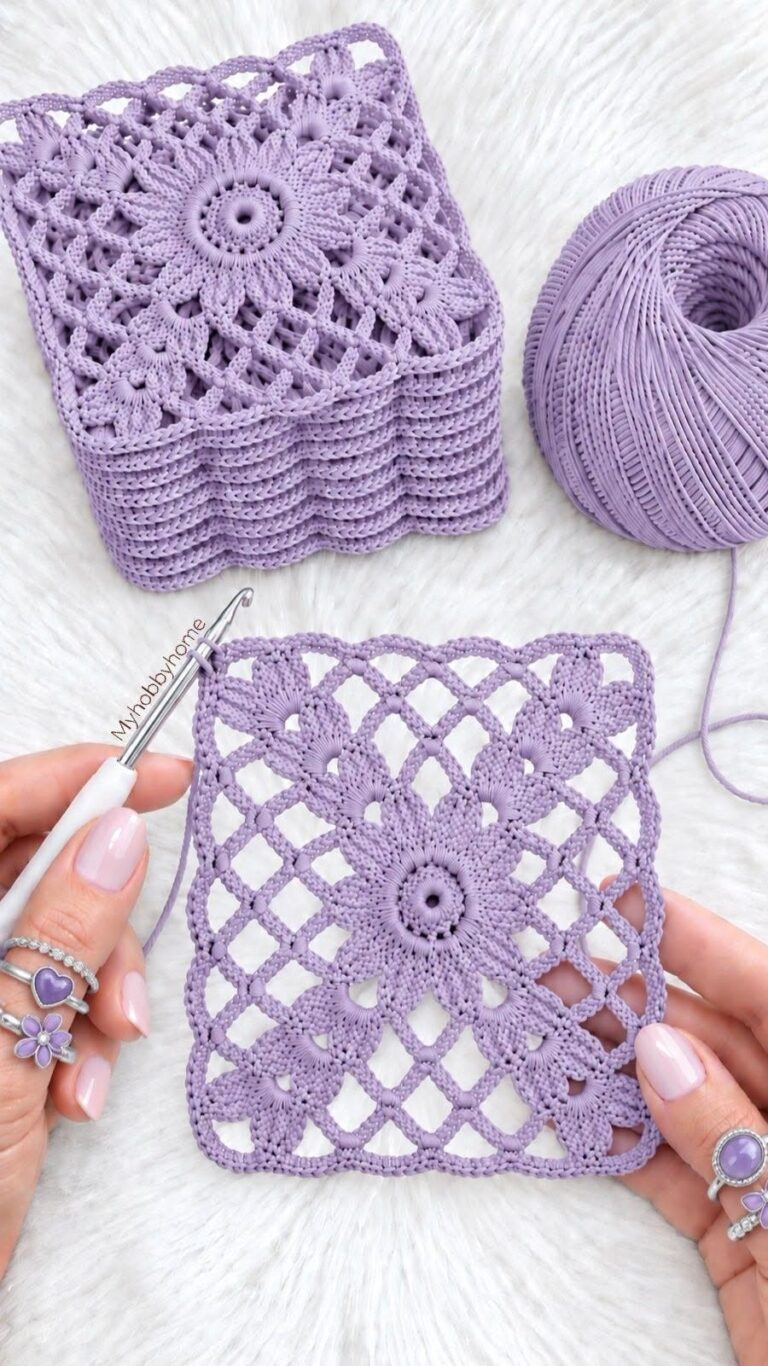
- Silver Grey Flower Square — Crochet Adaptation
- White Lace Diamond Medallion
- Brown and Orange Sunflower Dining Set
- Cream Petal Lace Square
- Grey Lattice Square with Scalloped Border
- Sky Blue Layered Flower Square Motif
- Periwinkle Blue Lacy Flower Square
- Royal Blue Five-Petal Flower Square
- Silver Grey Lattice Flower Square
- Cream Scalloped Lace Medallion
- Lemon Yellow Flower Lace Square
- Plum Purple Lacy Flower Square
- Dusty Rose Lace Medallion with Puff Petals
- Pink Puff Flower Lace Motif
- Dusty Rose Lace Heart Motifs
- Blue, Green and Ivory Flower Dining Set
- Yellow, Orange and Green Floral Dining Set Runner and Chair Covers
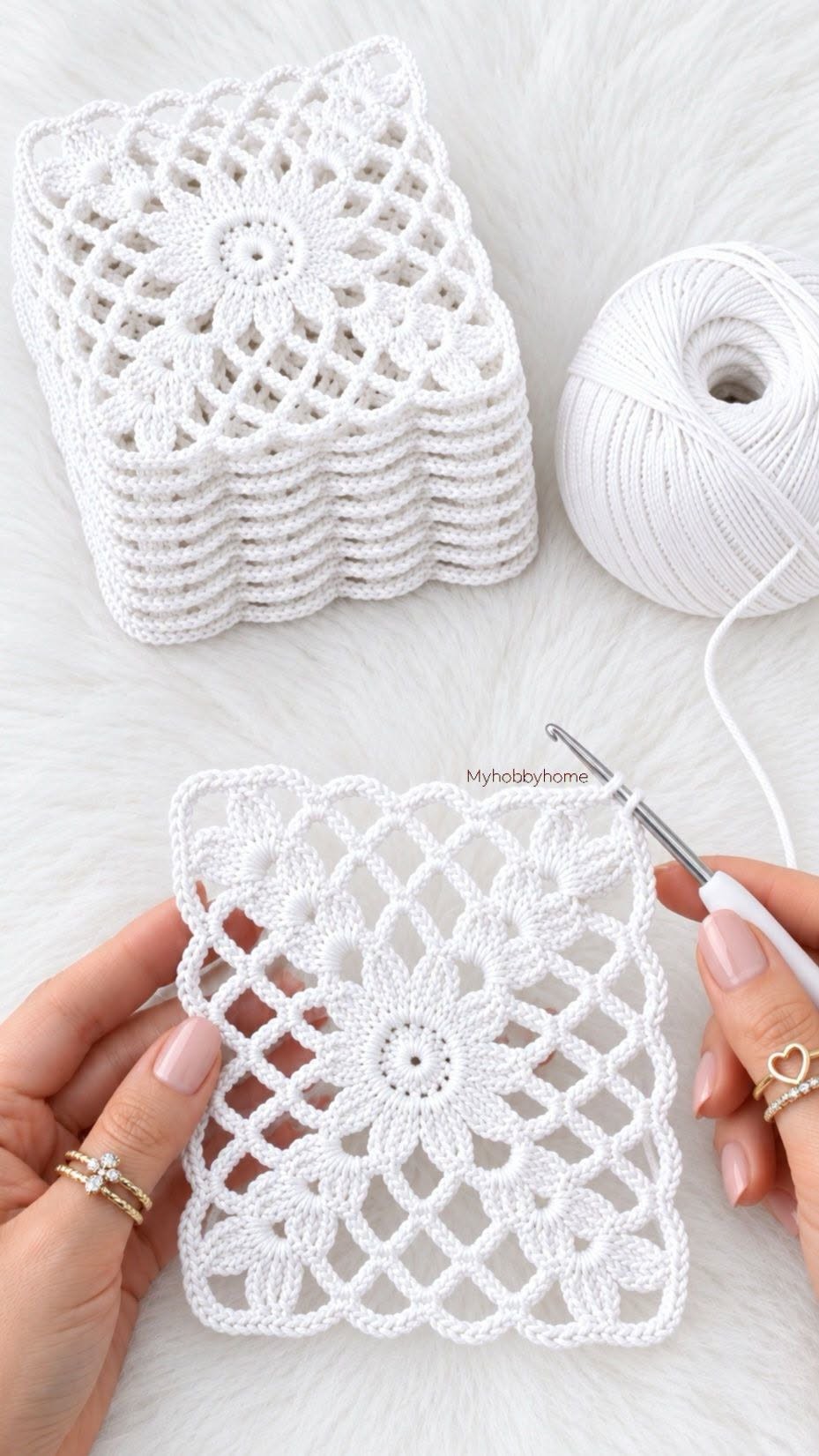
1. White Flower Lattice Square
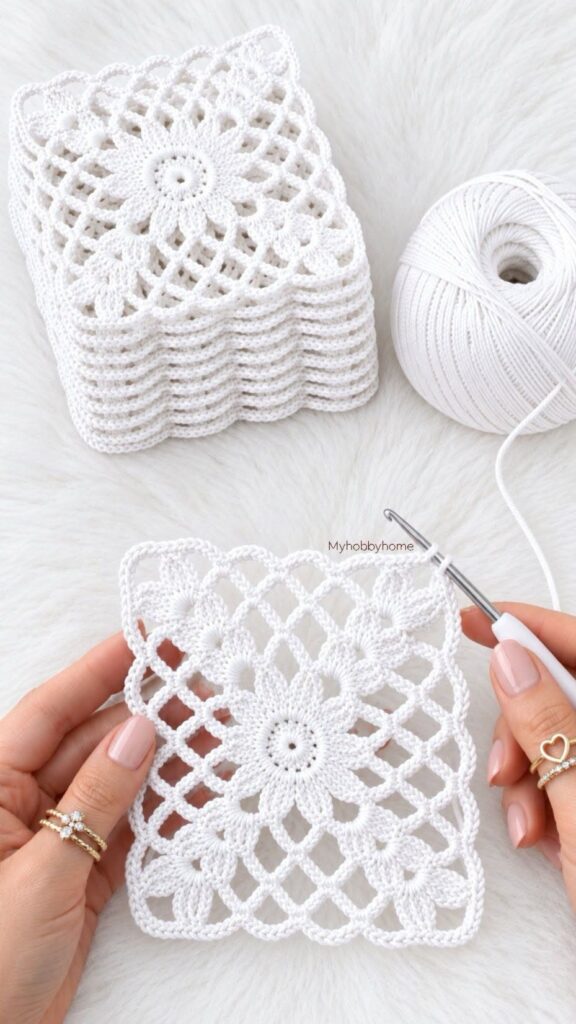
A white square with a central flower of about eight to twelve raised petals around a small ring, set inside an open diamond lattice of chain loops and mesh. A stack of identical squares suggests the units join edge to edge with a firm single-crochet border and scalloped corners.
Construction and Pattern Direction
Start from the centre ring and work outward, using the layered flower square family for the raised petals and open lattice. Sample the petal count first, since the photo suggests eight to twelve petals. Change only the petal groups to match your choice, and keep the round counts from the practice family.
Layout and Finishing
Arrange squares in a grid with the scalloped corners aligned, and size the set by measuring one finished square, since the photo gives no measurement. Join with the chain-space lattice or a single-crochet seam.
Complete Practice Pattern: Layered Five-Petal Flower Square Practice Motif
Materials: A cotton or cotton-blend sport weight yarn with a 3.0 to 3.5 mm hook as one option, not a photographed specification.
Scope: Counted original practice component, physically untested; see the adaptation notes before scaling up.
- Foundation: Ch 6, join with sl st to form a ring [6 ch].
- Round 1: Ch 3 (counts as first dc), 15 dc in ring, join to top of ch 3 [16 dc].
- Round 2: Ch 5 (counts as dc and ch 2), dc in next dc, ch 2, repeat that unit 15 more times, join to third ch of ch 5 [16 dc, 16 ch-2 spaces].
- Round 3: Ch 1, 5 dc in next ch-2 space, ch 1, skip next ch-2 space, repeat that unit 7 more times, join to first ch 1 [8 five-dc petals, 8 ch-1 spaces].
- Round 4: Sl st into next ch-1 space, ch 3, sc in next ch-1 space, repeat that unit 7 more times, join [8 ch-3 loops].
- Finish: Fasten off and weave in ends. Check that the square lies flat before measuring.
Assembly and Adaptation
Measure the finished sample across two opposite points so you know its true size. To join squares, work slip stitches through the ch-3 loops of adjoining motifs, or sew them edge to edge with the same yarn. The photo does not show exact dimensions, pillow sham edging or how the flowers are attached to the ground mesh.
2. Silver Grey Flower Square — Crochet Adaptation
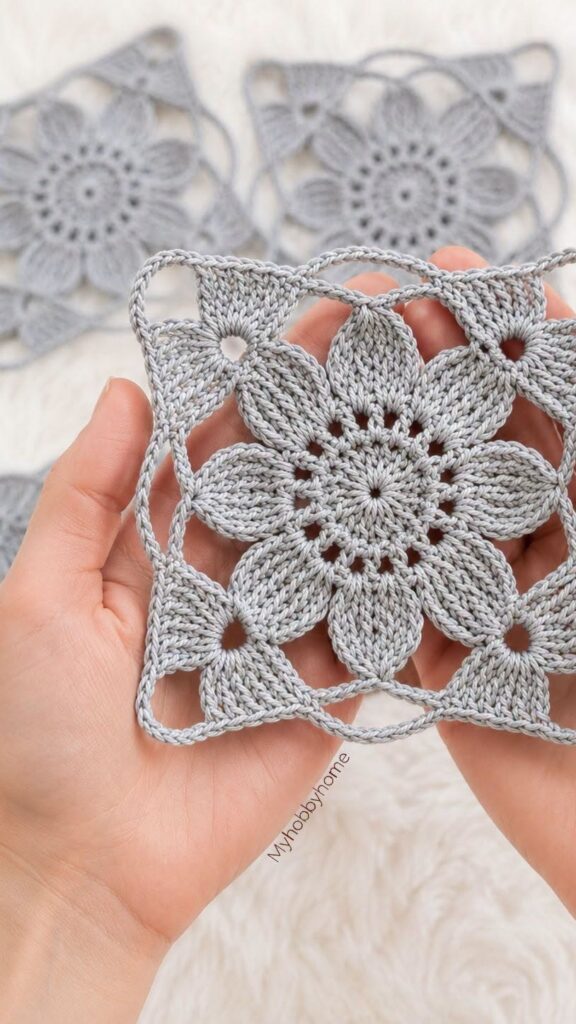
A silver grey square centred on a five- to eight-petal flower with raised, cupped petals that look knit-like in texture. Each corner holds a triangular fan point with an open hole, and the edge reads as a thin chain-look border.
Construction and Pattern Direction
Use the layered flower square family and keep the five-petal groups for the centre, then add a fan point to each corner using chain spaces. Work a sample to check whether the cupped petals hold their shape in your yarn.
Layout and Finishing
Join the squares edge to edge through the open corner holes so the fan points meet, and measure your own finished square before planning a set. The photo does not give a gauge or dimensions.
Practice pattern: Layered Five-Petal Flower Square Practice Motif (full counted steps with photo 1).
3. White Lace Diamond Medallion
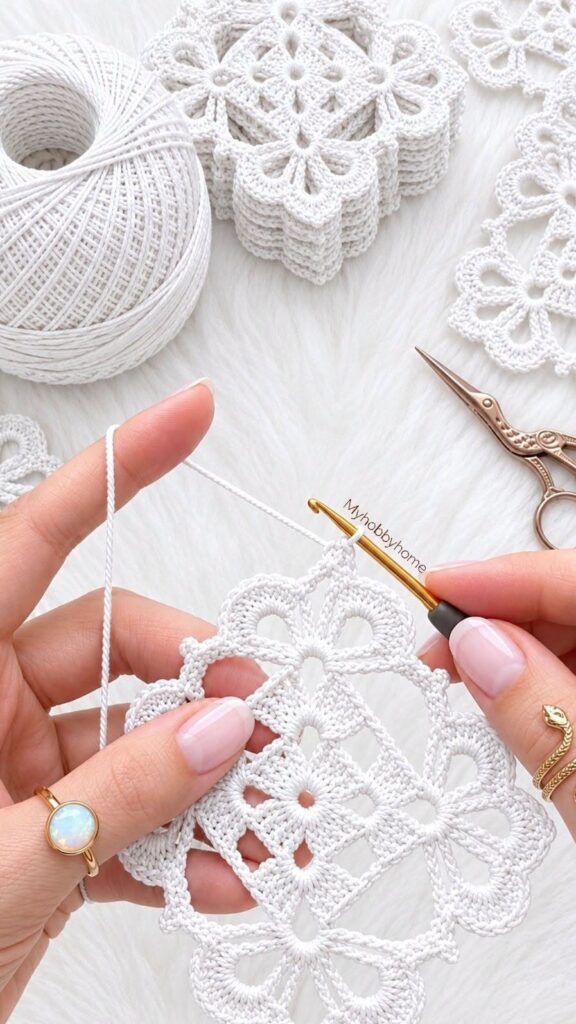
A white cotton-look lace piece built from diamond-shaped sections with open mesh and small flower-like centres. Scalloped teardrop lobes form the outer edge, and stacked coasters in the background show the same five-petal lace repeat.
Construction and Pattern Direction
Use the diamond petal lace medallion family for the teardrop lobes and picot star, changing the lobe count only if you want a different diamond layout. Sample one diamond section first and check that the open mesh spacing matches the photo’s airy look.
Layout and Finishing
Place the finished medallion on a flat surface and block it so the lobes sit evenly; the photo shows a work in progress, so the final size depends on your hook and thread. Stack or join several coasters if you want a set.
Complete Practice Pattern: Diamond Petal Lace Medallion with Picot Star
Materials: A fine cotton thread with a 1.75 to 2.25 mm hook as one option, not a photographed specification.
Scope: Counted original practice component, physically untested; see the adaptation notes before scaling up.
- Foundation: Ch 6, join with sl st to form a ring [6 ch].
- Round 1: Ch 1, 16 sc in ring, join [16 sc].
- Round 2: Ch 5 (counts as dc and ch 2), dc in next sc, ch 2, repeat that unit 15 more times, join [16 dc, 16 ch-2 spaces].
- Round 3: Ch 1, (3 dc, ch 3, 3 dc) in next ch-2 space, skip next 3 ch-2 spaces, repeat that unit 3 more times, join [4 petals of 6 dc, 4 ch-3 points].
- Round 4: In each ch-3 point, work (sc, ch 4, sc) [4 ch-4 lobes].
- Round 5: In each ch-4 lobe, work (2 dc, ch 2, 2 dc) [4 lace lobes, 16 dc, 4 ch-2 spaces].
- Finish: Fasten off and block to shape.
Assembly and Adaptation
Measure the finished motif tip to tip and record the diameter. Join motifs with the ch-2 spaces to make a doily, coaster or larger diamond grid. The photo does not show the finished motif size or the rest of the medallion, which is still in progress.
4. Brown and Orange Sunflower Dining Set
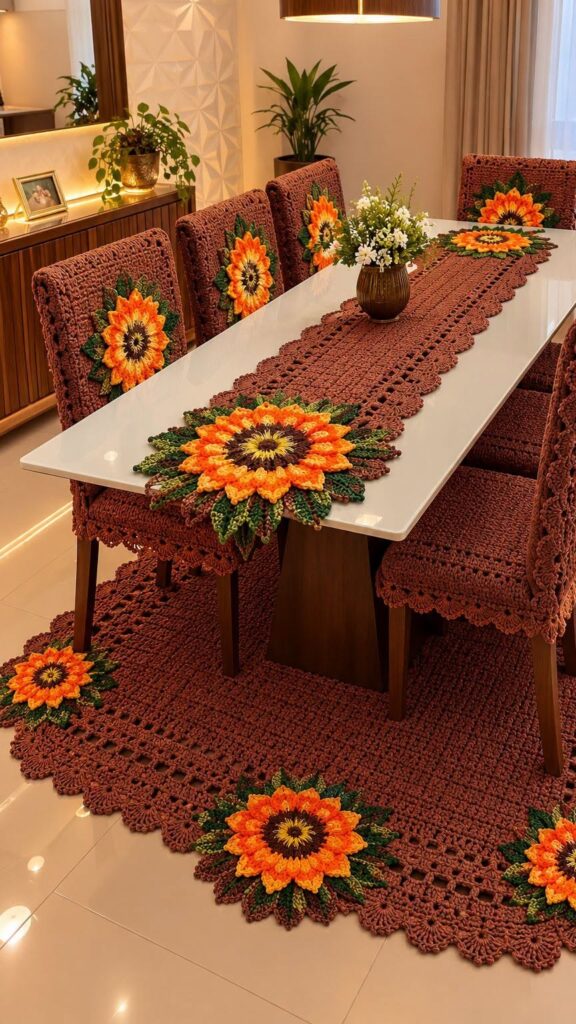
A brown dining set with a table runner, chair back covers and a large rectangular rug, decorated with sunflower medallions in orange, yellow and dark green. Each sunflower has stand-up orange petals with yellow tips around a dark centre, backed by pointed green leaves on a dense brown mesh field.
Construction and Pattern Direction
Use the layered flower square family for each sunflower, working the stand-up petals in orange and yellow and the leaf points in dark green. Practise one flower and one leaf separately, then work the brown field as a mesh or lace panel with a shell-and-picot border.
Layout and Finishing
Lay the runner, chair covers and rug out on a flat surface and measure your table, chairs and rug footprint before choosing how many flower medallions to join. The photo shows the set arranged as a finished room and gives no exact dimensions, so the final sizes are yours to plan.
Practice pattern: Layered Five-Petal Flower Square Practice Motif (full counted steps with photo 1).
5. Cream Petal Lace Square
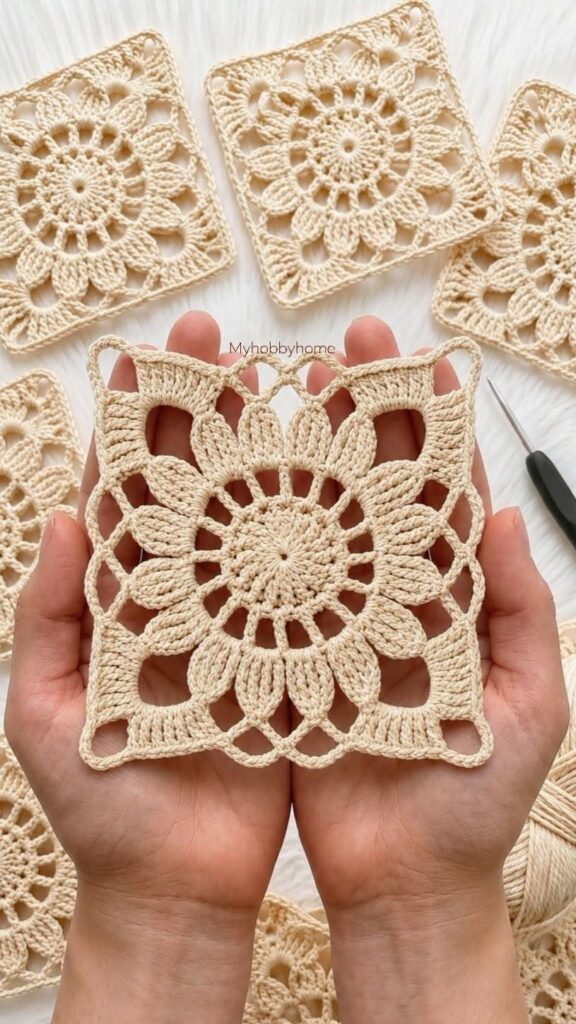
A cream and beige square with a central closed ring of single crochet, surrounded by two rings of raised, cupped petals that look like stand-up leaves. Open lace spaces sit between the petals, and the corners are filled with dense ribbed clusters.
Construction and Pattern Direction
Work from the layered flower square family, using the centre ring and first petal round as your counted base. Add dense ribbed clusters at the corners and a picot-style scalloped edge with chain loops, and sample those corners first.
Layout and Finishing
Use the square as a joining motif for a blanket or coaster set, joining through the chain-loop corners. Measure one finished square and plan the set from that measurement, since the photo does not give a reliable size.
Practice pattern: Layered Five-Petal Flower Square Practice Motif (full counted steps with photo 1).
6. Grey Lattice Square with Scalloped Border
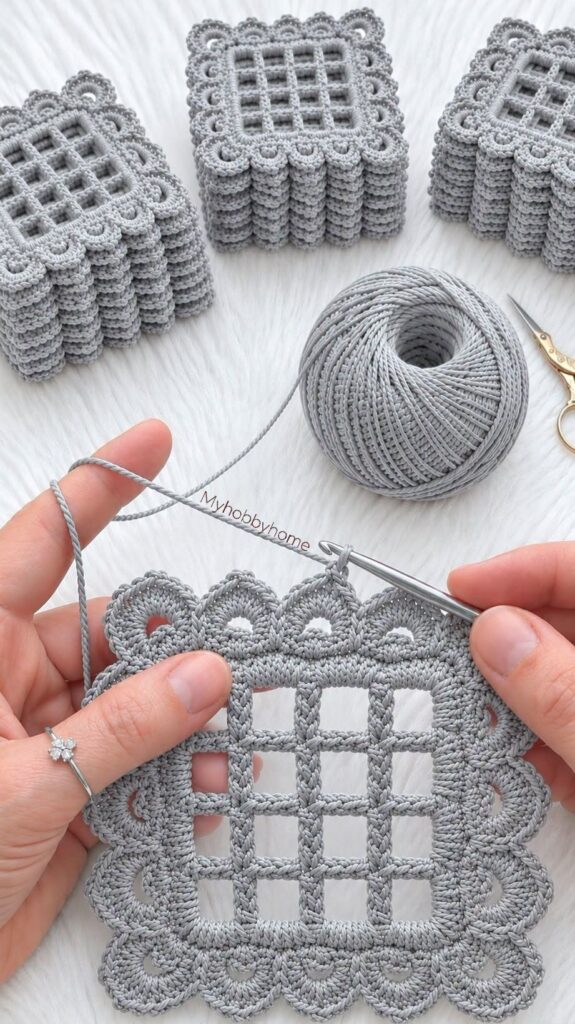
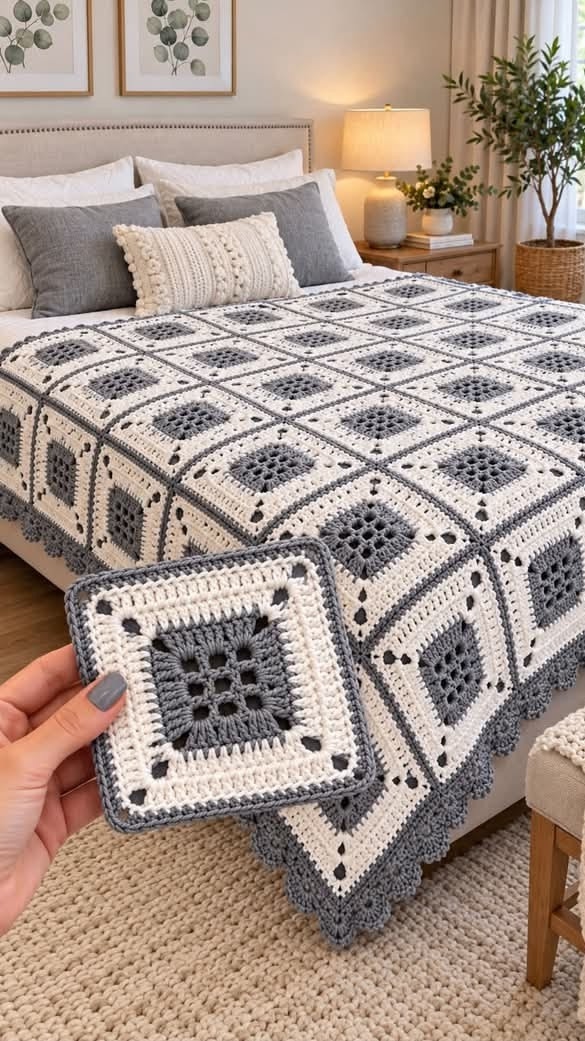
A grey square with a raised lattice of solid ribs enclosing roughly four by four open window spaces. The outer border is a scalloped edge of picot-like loops and small open arches, and the stacked pieces behind it look like square-based holders with ribbed sides.
Construction and Pattern Direction
Use the new grid lattice family to build the ribbed grid and open windows, since no library family matches the solid-rib-and-window construction. Sample the window rows first to check the spacing before adding the scalloped border.
Layout and Finishing
Plan the lattice by counting the window spaces in your finished sample, and use the same count along each side for a balanced square. The photo does not give a gauge, so block the sample and measure it before joining it to a holder or another square.
Complete Practice Pattern: Thirteen-Stitch Grid Lattice Practice Square with Scalloped Edge
Materials: A medium cotton or cotton-blend yarn suits this square; a 3.5 mm hook is one option to start with, not a photographed specification.
Scope: Counted original practice component, physically untested; see the adaptation notes before scaling up.
- Foundation: Ch 14. Sc in the second ch from the hook and each remaining chain [13 sc].
- Row 2 (solid): Ch 1, turn, sc in each sc across [13 sc].
- Row 3 (window): Ch 1, turn, sc in the first sc, *ch 3, skip 3 sc, sc in the next sc; repeat from * across [4 sc and three ch-3 spaces, using 13 stitches].
- Row 4 (rib): Ch 1, turn, sc in each sc and 3 sc in each ch-3 space across [4 sc + 9 sc = 13 sc].
- Row 5 (window): Ch 1, turn, repeat row 3 [4 sc and three ch-3 spaces, using 13 stitches].
- Row 6 (solid): Ch 1, turn, sc in each sc across [13 sc].
- Rows 7 to 13: Repeat rows 3 to 6 once (rows 7 to 10), then work row 11 as a window row, row 12 as a rib row and row 13 as a solid row [13 sc].
- Edge: Ch 1, sc around the outside of the square, working 3 sc in each corner and one sc in each stitch and row end; finish with a scallop of (sc, ch 2, sc) at every third stitch along each side.
Assembly and Adaptation
Measure the finished sample across the top and down one side; it should be close to square. Join several squares edge to edge with the scalloped edge facing out, and check the join so the windows line up. The photo does not show the exact border, the yarn weight, or whether the windows are closed with a second round, so decide those on your own sample before making a set.
7. Sky Blue Layered Flower Square Motif
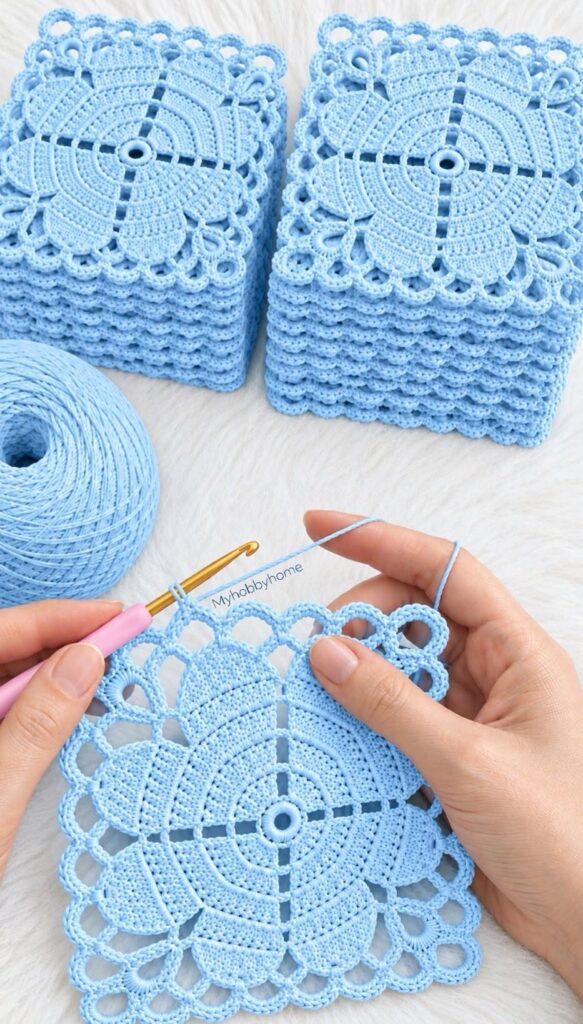
A sky blue square with a central ring and radiating five-petal layered flowers, separated by open lace spaces along the diagonal and cross lines. The edge is scalloped with loops and picot-like teardrop lobes, and several stacked squares show a repeated unit.
Construction and Pattern Direction
Use the layered flower square family, placing the five-petal groups on the diagonal and cross lines. Add the open chain-space ring along the border and sample one teardrop lobe before working the whole edge.
Layout and Finishing
Join the squares edge to edge, following the scalloped lobes as your guide, and check the finished size against your planned coaster or doily. The photo does not give a size, so measure your own sample.
Practice pattern: Layered Five-Petal Flower Square Practice Motif (full counted steps with photo 1).
8. Periwinkle Blue Lacy Flower Square
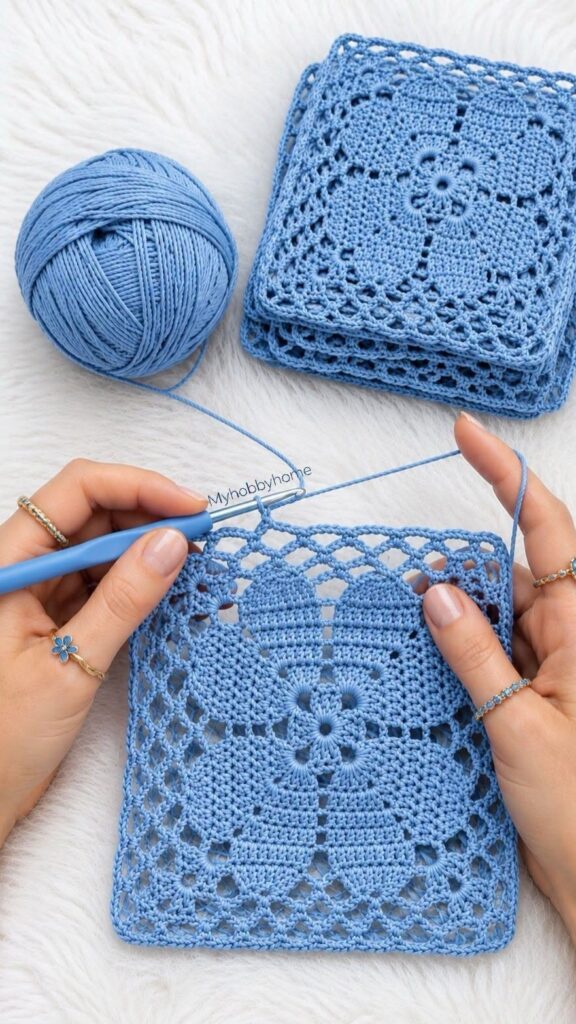
A periwinkle blue square with a lacy open lattice border and a central five-petal flower built from layered rounds. Raised picot-like bobbles sit in the flower centre, and stacked identical squares suggest they join edge to edge.
Construction and Pattern Direction
Use the layered flower square family for the five-petal flower and open mesh chain spaces. Add the picot-like bobbles to the centre petals only after the base rounds are counted and checked.
Layout and Finishing
Arrange the squares in a placemat-sized grid, joining through the mesh border. The photo does not show the exact border count, so measure your finished square before deciding on the layout and keep the edge consistent across the set.
Practice pattern: Layered Five-Petal Flower Square Practice Motif (full counted steps with photo 1).
9. Royal Blue Five-Petal Flower Square
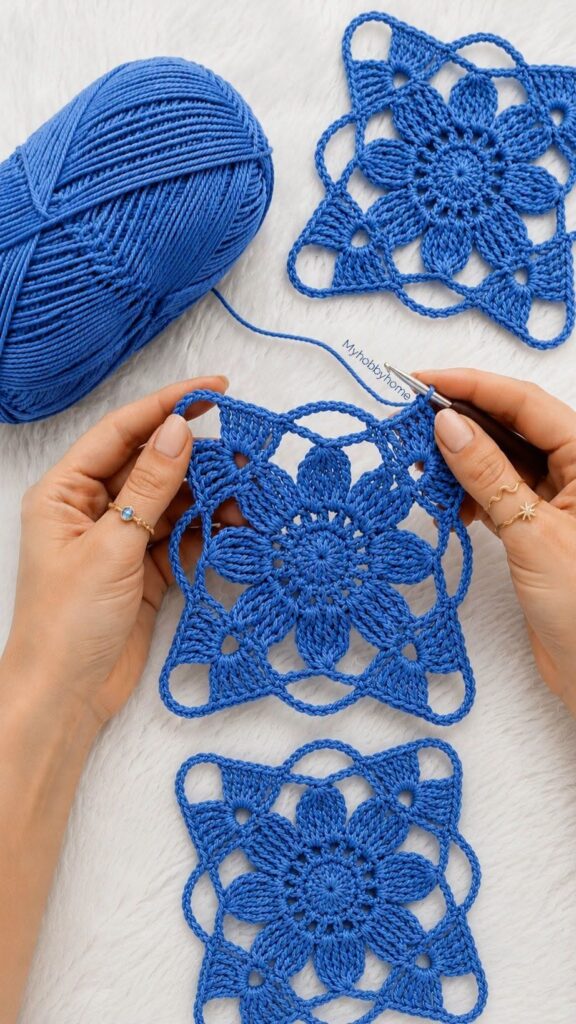
A royal blue square built around a central round of tiny stitches, with a ring of raised, layered petals radiating outward to form a star-like flower. Open lace corners form loops and chain-style spaces, and several identical squares suggest edge-to-edge joining.
Construction and Pattern Direction
Use the layered five-petal flower square practice motif, which gives the counted round structure for the centre and petal rings. Work the open lace corners with chain spaces, and sample the petal round before working the edge.
Layout and Finishing
Join the squares edge to edge in rows, and check the hand-sized square you make against the photo’s proportions. The photo does not give a yarn or hook size, so choose your own and measure the finished square.
Practice pattern: Layered Five-Petal Flower Square Practice Motif (full counted steps with photo 1).
Looking for more? You may also like 20 Crochet Bedspread, Blanket and Home Decor Ideas: Flower Squares, Lace Medallions and Granny Squares, 14 Crochet Bedspread, Blanket and Decor Ideas: Granny Squares, Flower Squares and Lace Medallions and 12 Crochet Home Decor Ideas: Flower Squares, Lace Motifs and Dining Sets.
10. Silver Grey Lattice Flower Square
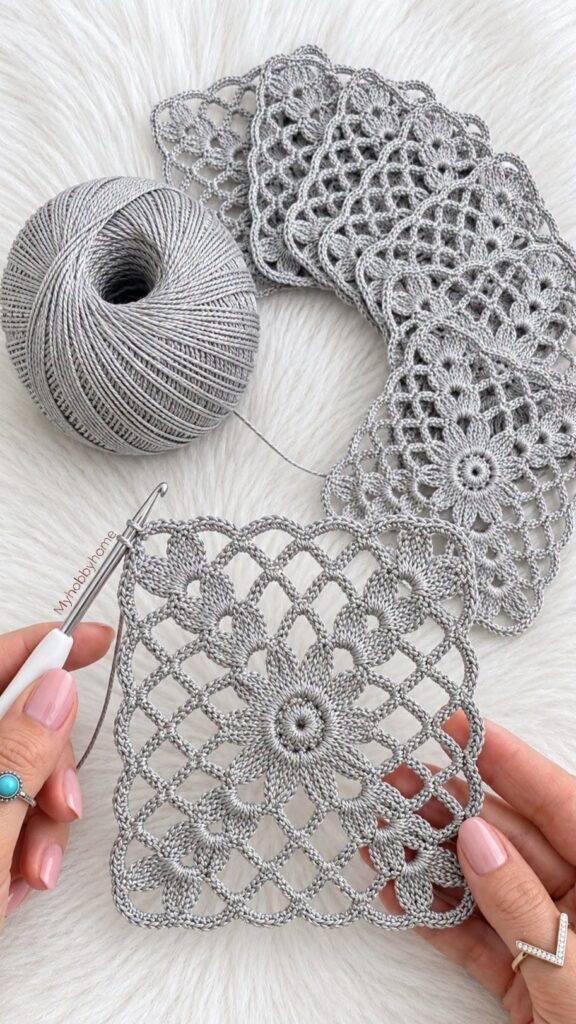
A silver grey lace square with a diamond lattice of open chain loops framing five-petal flowers at the centre and near the corners. A stack of similar squares fans out beside it, showing the motif joins edge to edge through the lattice.
Construction and Pattern Direction
Use the layered five-petal flower square practice motif for the centre flower and the corner flowers. Keep the lattice spaces wide and open by working chain loops between the petals, and sample the lattice before working the edge.
Layout and Finishing
Join through the lattice spaces so the flowers line up in a diagonal grid, and measure the finished square before setting the layout. The photo does not show a gauge, so keep the lattice consistent across the set.
Practice pattern: Layered Five-Petal Flower Square Practice Motif (full counted steps with photo 1).
11. Cream Scalloped Lace Medallion
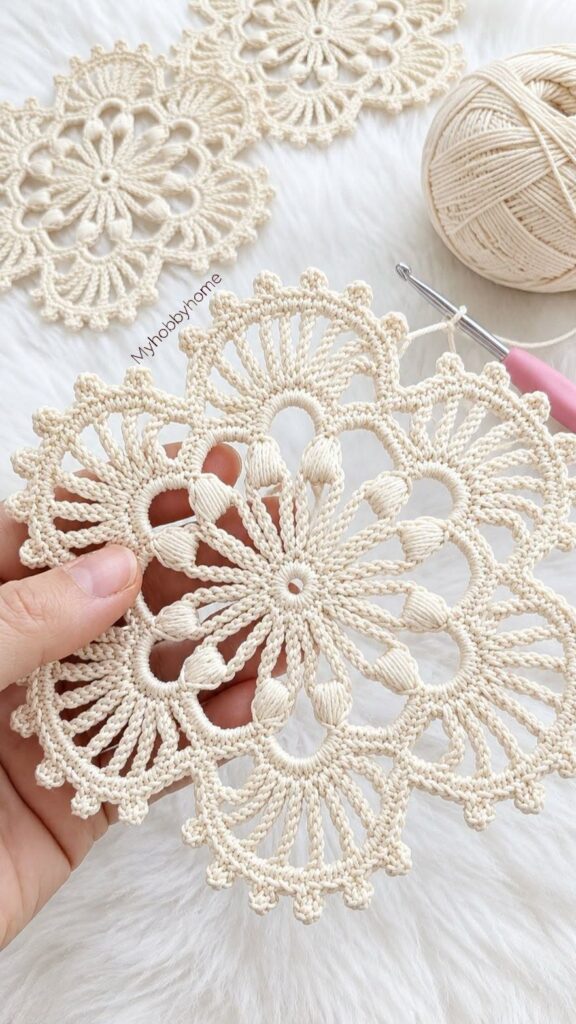
A round cream and ivory lace medallion built from concentric rings of open mesh and radiating fan-like spokes, with a small open centre ring. Puff bobbles sit at the tips of several spokes, and the outer edge is scalloped.
Construction and Pattern Direction
Use the concentric rose lace medallion family for the round rings and scalloped border, then add puff bobbles at the spoke tips as a separate counted round. Sample the centre ring first so the spokes radiate evenly.
Layout and Finishing
Block the medallion and check that the scallops sit evenly around the edge. The photo shows several medallions in the background, which suggests a set, but no size is given, so join medallions once you have measured a finished piece.
Complete Practice Pattern: Concentric Rose Lace Medallion with Scalloped Border
Materials: A fine cotton or cotton-blend thread with a 1.75 to 2.25 mm hook as one option, not a photographed specification.
Scope: Counted original practice component, physically untested; see the adaptation notes before scaling up.
- Foundation: Ch 6, join with sl st to form a ring [6 ch].
- Round 1: Ch 1, 12 sc in ring, join [12 sc].
- Round 2: Ch 3 (counts as first dc), 1 dc in same st, 2 dc in each remaining st around, join [24 dc].
- Round 3: Ch 4 (counts as dc and ch 1), dc in next dc, ch 1, repeat that unit 23 more times, join to third ch of ch 4 [24 dc, 24 ch-1 spaces].
- Round 4: Ch 5 (counts as dc and ch 2), dc in next ch-1 space, ch 2, repeat that unit 23 more times, join [24 dc, 24 ch-2 spaces].
- Round 5: Ch 1, (sc, ch 5, sc) in next ch-2 space, skip next ch-2 space, repeat that unit around, join [12 sc-ch5-sc groups, 12 ch-5 loops].
- Round 6: Sl st across to first ch-5 loop, ch 1, 5 dc in same loop, ch 1, sl st across to next ch-5 loop, repeat that unit around, join [12 five-dc scallops].
Assembly and Adaptation
Measure the finished motif from scallop tip to scallop tip and note the width. Join motifs by working the final round through adjoining scallops so the square grid forms the bedspread. The photo does not show the exact motif size, the join method or how many motifs the pillow shams use.
12. Lemon Yellow Flower Lace Square
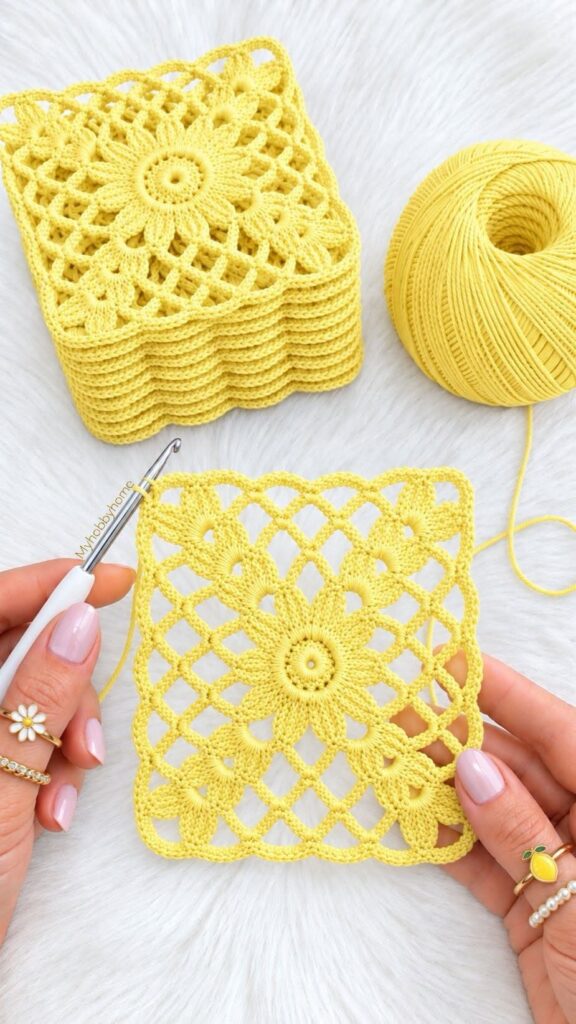
A lemon yellow square with a small central ring of concentric single crochet and five-to-six raised fan-shaped petals with open centres. A diagonal diamond lattice of chain-space mesh runs across the square, and a dense single-crochet border gives a neat, slightly scalloped edge.
Construction and Pattern Direction
Use the diamond lace square family for the diagonal lattice, fan wedges and triangular petals. Count your fan petals in a sample round and adjust the wedge count to match the photo’s five-to-six petal look.
Layout and Finishing
Use the square as a coaster or small mat, or join several for a set, and measure your finished piece because the photo gives no dimensions. Keep the single-crochet border consistent so the scalloped edge stays even.
Complete Practice Pattern: Diamond Lace Square with Fan Wedges and Triangular Petals
Materials: Use a light cotton or cotton-blend fingering or sport weight yarn with a 2.5 to 3.5 mm hook as one option, not a photographed specification.
Scope: Counted original practice component, physically untested; see the adaptation notes before scaling up.
- Round 1: Magic ring, ch 3 (counts as first dc), 15 dc in ring, join to top of ch 3 [16 dc].
- Round 2: Ch 1, *sc in next dc, ch 2, sk next dc*; repeat from * around, join to first sc [8 sc, 8 ch-2 spaces].
- Round 3, opening corner: Sl st into the first ch-2 space, ch 3 (counts as first dc), 4 dc in same space [5 dc]; ch 3, 5 dc in same space [10 dc and one ch-3 corner]; sc in next sc [10 dc, one ch-3 corner, 1 sc].
- Round 3, sides and corners: *5 dc in next ch-2 space, sc in next sc, (5 dc, ch 3, 5 dc) in next ch-2 space, sc in next sc*; repeat from * three times, then 5 dc in next ch-2 space, sc in last sc, join to top of first ch 3 [60 dc, 8 sc, four ch-3 corners].
- Round 4: Ch 1, sc in each dc and sc around, working 3 sc in each ch-3 corner space, join [68 base sc plus 12 corner sc = 80 sc].
- Resizing: To change the size, add or remove full rounds rather than altering the counts in rounds 2 to 4, so the corner maths stays intact.
- Finishing: Weave in ends, then block the square to about 4 inches square, pinning out each ch-3 corner so the lace opens.
Assembly and Adaptation
Measure the blocked sample across opposite sides and record the finished size before joining. Join squares edge to edge through the back loops of the round 4 sc, or sew with a whip stitch through the corner spaces, using one square per measured unit of the bed. The photo does not show this motif’s exact construction, colors or join method, so the sample is only a starting point.
13. Plum Purple Lacy Flower Square
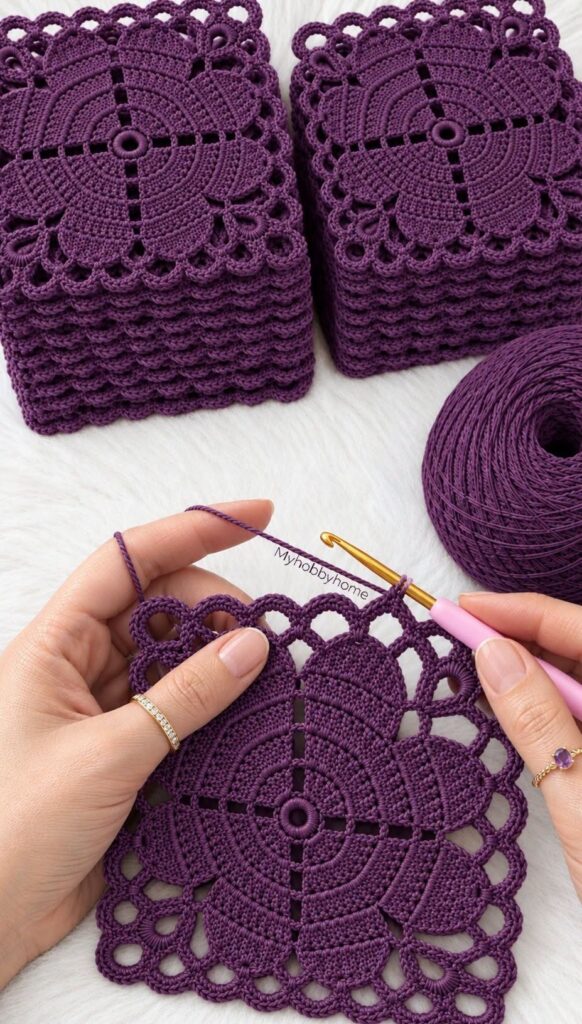
A plum purple square with a central ring and four large layered petal fans radiating from the centre, separated by open chain-space lattice bars. Each corner has a stacked fan of rounded petals, and the outer edge is a scalloped picot-like border.
Construction and Pattern Direction
Use the layered flower square family for the central ring and the four petal fans, placing the corner fans in the counted round. Work the open lattice bars between fans and keep the edge scalloped with loops.
Layout and Finishing
Join squares edge to edge to make a coaster or runner, and check that each square is the same size before joining. The photo gives no dimensions, so measure a finished square before planning the set.
Practice pattern: Layered Five-Petal Flower Square Practice Motif (full counted steps with photo 1).
14. Dusty Rose Lace Medallion with Puff Petals
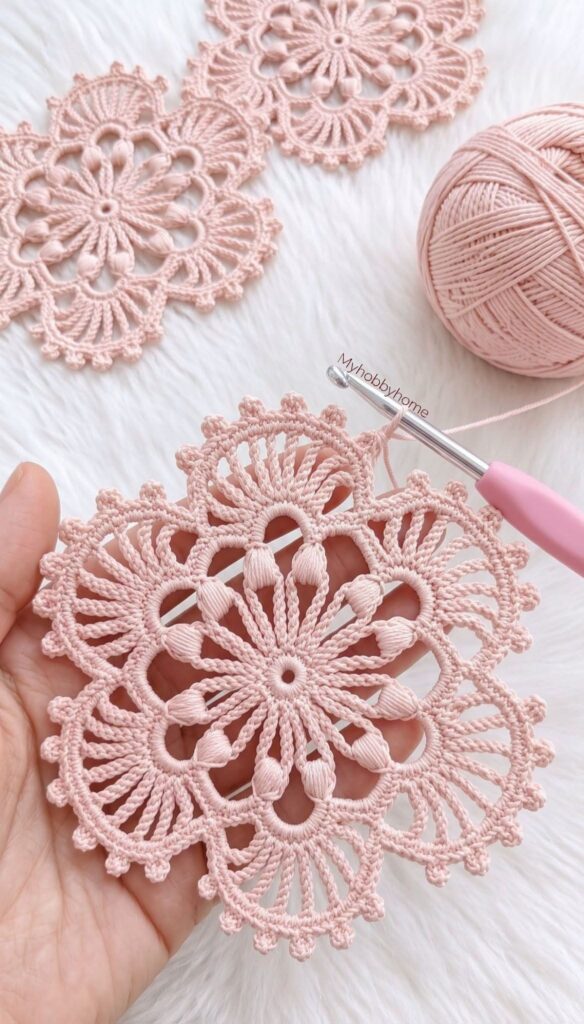
A round dusty pink lace medallion with a small open centre ring surrounded by raised puff bobbles on chain-and-post spokes. Outer rings of open fan-shaped lace arches alternate with spaced picot-like knobs along a scalloped border.
Construction and Pattern Direction
Use the concentric rose lace medallion family for the rings, spokes and scalloped border, and add the puff bobbles at the spoke tips as the centre round. Sample the puff bobbles first, since the raised texture depends on how many you place.
Layout and Finishing
Measure the finished medallion and block it flat so the petals sit in tiers. The photo shows a hand-sized piece without a specified measurement, so plan your set from your own sample.
Practice pattern: Concentric Rose Lace Medallion with Scalloped Border (full counted steps with photo 11).
15. Pink Puff Flower Lace Motif
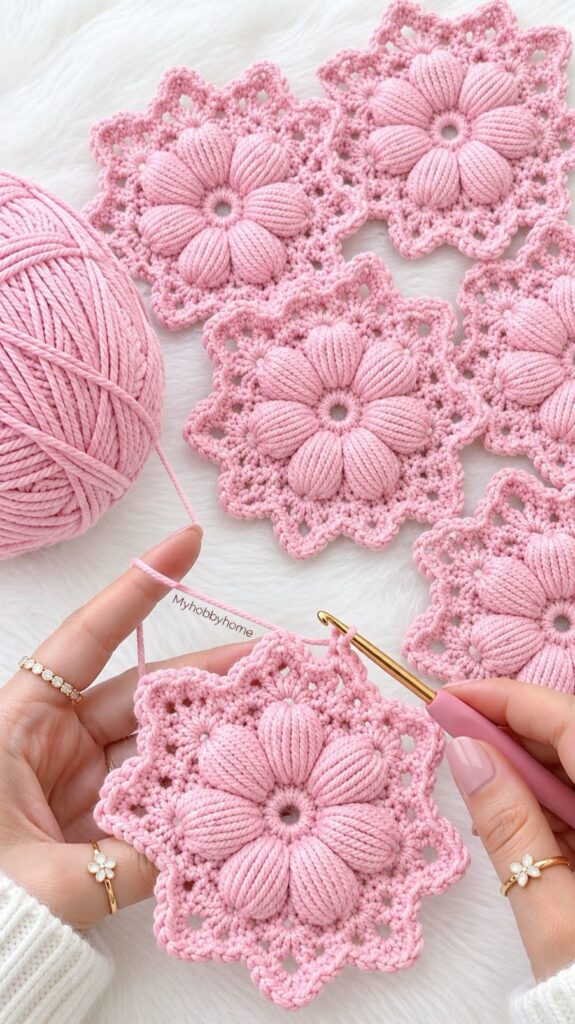
A pink star-shaped motif with a central ring surrounded by six raised, puffed petals made of ribbed, bobble-like clusters. The outer border is a lacy eight-point scalloped edge with open picot holes and a dense single-crochet rim.
Construction and Pattern Direction
Use the layered five-petal flower square family for the central ring and outer rounds, changing the petal count to six puffed petals and adding the eight-point scallop in the border. Sample one puff petal to check how the clusters stand up.
Layout and Finishing
Join the motifs edge to edge in a mosaic, with the scalloped points meeting to form a square-to-star pattern. The photo gives no exact measurements, so measure your own motif before planning the layout.
Practice pattern: Layered Five-Petal Flower Square Practice Motif (full counted steps with photo 1).
16. Dusty Rose Lace Heart Motifs
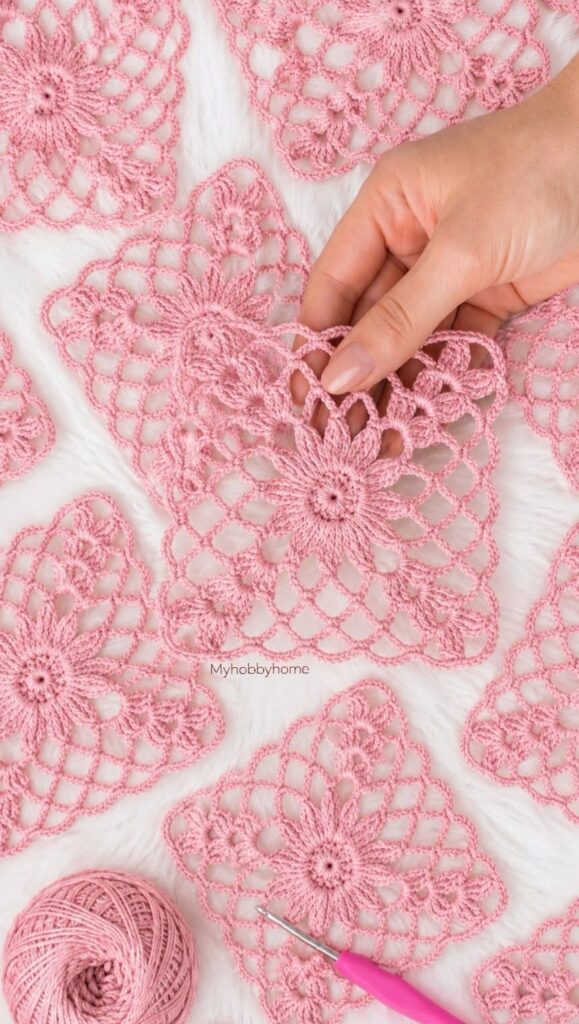
Heart-shaped lace motifs in dusty pink with a central five-petal flower in each, surrounded by open mesh. Each has a scalloped outer edge with a rounded top and pointed bottom, and the motifs look laid side by side or loosely joined.
Construction and Pattern Direction
Use the eight-shell heart lace family for the heart outline and scalloped shape, placing a five-petal flower in the centre round. Sample the heart shape first so the rounded top and pointed bottom are balanced.
Layout and Finishing
Lay the hearts side by side or join them loosely, since the photo shows them on a white background. The photo gives no dimensions, so measure your heart and plan the spacing from that measurement.
Complete Practice Pattern: Eight-Shell Heart Lace Practice Motif
Materials: A fine cotton or cotton-blend sport-weight yarn with a 1.75 to 2.25 mm hook as one option, not a photographed specification.
Scope: Counted original practice component, physically untested; see the adaptation notes before scaling up.
- Round 1: Ch 4, join with sl st to first ch to form a ring. Ch 3 (counts as first dc), 15 dc in ring [16 dc].
- Round 2: Ch 1, (sc in next dc, ch 2, skip next dc) eight times, join to first sc [8 sc, eight ch-2 spaces].
- Round 3: Sl st into the first ch-2 space, ch 3 (counts as first dc), (2 dc, ch 2, 3 dc) in the same space; *sc in next sc, (3 dc, ch 2, 3 dc) in next ch-2 space; repeat from * six more times, sc in last sc, join to top of ch 3 [48 dc, eight ch-2 corners, eight sc].
- Check: six dc in each of eight shells makes 48 dc, and the eight sc sit between the shells.
- Round totals: 16 dc after round 1, 8 sc after round 2, and 48 dc plus 8 sc after round 3 for a 56-stitch motif.
- Resize: To enlarge, work round 1 as ch 3 plus 23 dc [24 dc], round 2 as twelve repeats of sc, ch 2, skip [12 sc, twelve ch-2 spaces], and round 3 as twelve shells with eleven sc between them [72 dc, 12 sc, twelve ch-2 corners].
Assembly and Adaptation
Measure the finished sample across two opposite corners. Join motifs through the ch-2 corners with sl st or sc to form a grid. The photo does not show a round motif; its heart outline is not produced by this round, so if you want hearts, add a second lobe pair at the top with an extra round of shells, and treat the sample as the open mesh centre.
17. Blue, Green and Ivory Flower Dining Set
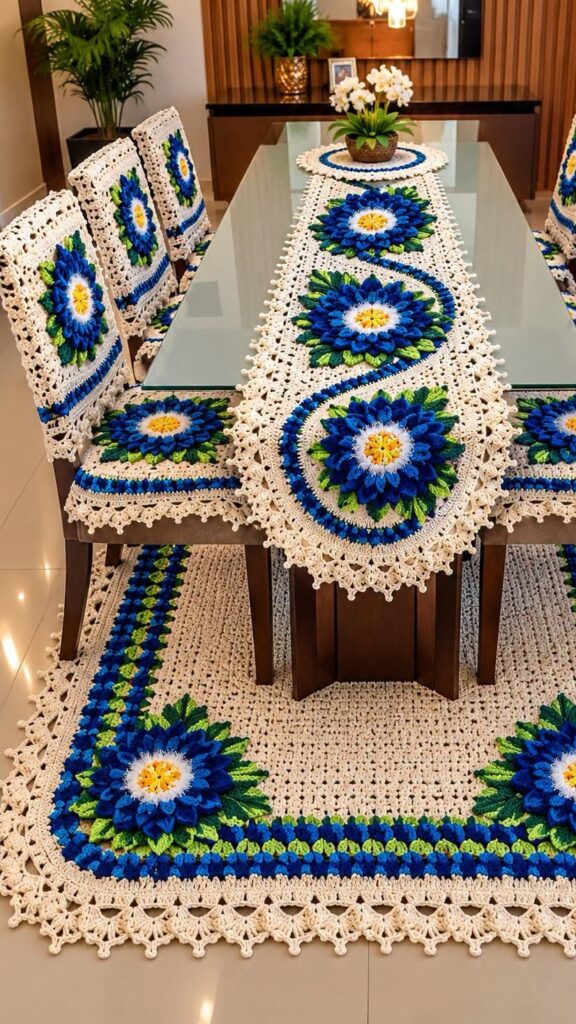
A dining set of runner, rug, chair backs and seat covers in ivory, with large layered flower medallions in royal blue, green sepals and yellow-white centres. The runner has an S-curve of blue rope-like edging connecting the flowers, and the rug has a single-crochet field with bobble rows and a scalloped shell edge.
Construction and Pattern Direction
Use the layered flower square family for each flower medallion, with stand-up blue petals and green sepals. Work the rope-like edging and bobble rows as added counted rounds, sampling each before joining them to the flowers.
Layout and Finishing
Arrange the flowers along the runner’s S-curve or in a rug grid, and measure your table and chairs before planning the number of medallions. The photo gives no gauge or measurement, so block one flower and use it as your scale.
Practice pattern: Layered Five-Petal Flower Square Practice Motif (full counted steps with photo 1).
18. Yellow, Orange and Green Floral Dining Set Runner and Chair Covers
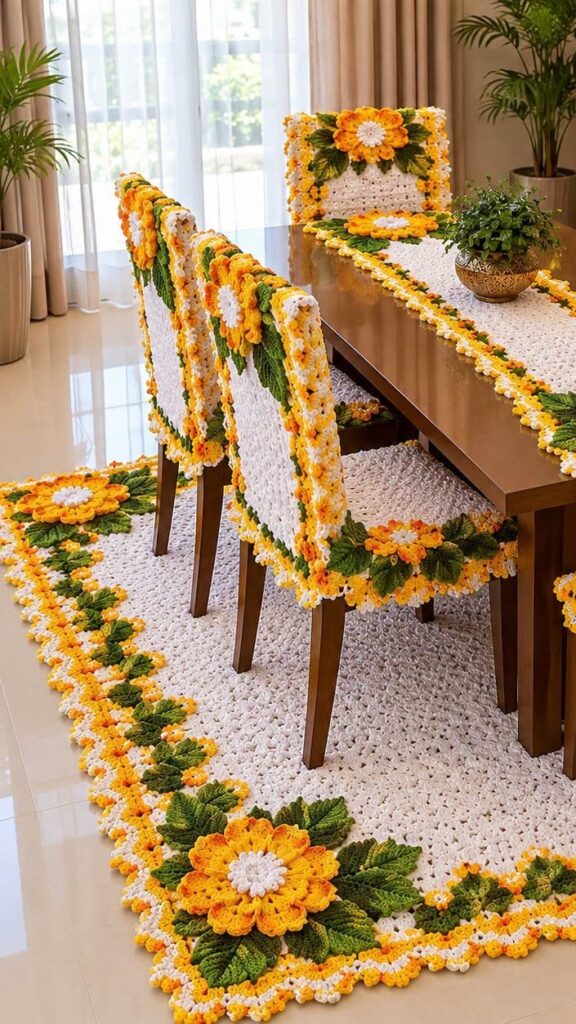
A white dining set with a long table runner, a large rectangular rug, and chair back and seat covers edged in yellow-orange frills. Large layered five-petal flowers with white centres sit among clusters of dense green leaves, with a scalloped yellow, orange and white border.
Construction and Pattern Direction
Use the layered flower square family for the five-petal flowers and their stacked raised petals, adding green leaf clusters as separate small units. Sample a single flower and a leaf cluster before working the white base and frilled border.
Layout and Finishing
Space the flowers evenly across the runner and rug, and measure your table and chairs before deciding on the count. The photo gives no dimensions, so use your own sample as the scale for the set.
Practice pattern: Layered Five-Petal Flower Square Practice Motif (full counted steps with photo 1).