3 Crochet Holiday Decoration Ideas
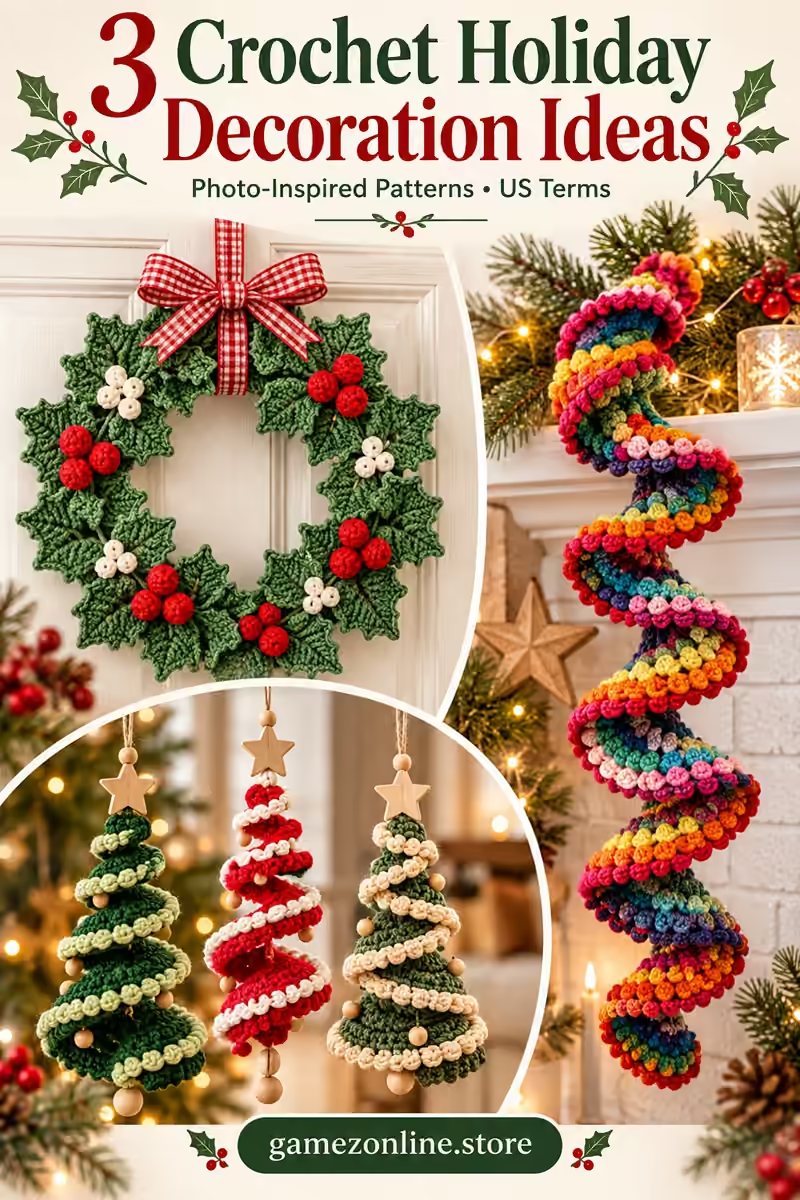
Explore three crochet holiday decoration ideas with original counted patterns for holly leaves and wreaths, a spiral garland and hanging tree spirals. Each image below has its own original written construction, materials, stitch counts, assembly and finishing notes.
US crochet terms and working rules
ch = chain; sl st = slip stitch; sc = single crochet; hdc = half double crochet; dc = double crochet; inc = 2 stitches in one stitch; sc2tog = single crochet two stitches together; st(s) = stitch(es); sp = space; RS = right side. A magic ring is an adjustable yarn loop. Numbers in brackets give end-of-round or end-of-row counts. Repeat instructions between parentheses the stated number of times.
Unless a step explicitly says otherwise, beginning chains do not count as stitches. For dc rounds, ch 2 to reach height, then work the first dc into the first stitch; join to the first real dc. For sc rounds, ch 1 and join to the first sc. For flat sc rows, ch 1 and turn. Flat dc rows explicitly use ch 3 as the first counted dc. Do not work into joining slip stitches. Change color by completing the last yarn-over of the preceding stitch with the new yarn.
To work sc2tog: insert hook into the next stitch and draw up a loop, repeat in the following stitch, yarn over and draw through all three loops. For a surface slip stitch, bring the yarn up from behind the fabric, insert the hook into the next chosen gap and pull the new loop through the loop already on the hook. Keep these stitches loose.
Additional US terms: inc = 2 stitches of the stated type in one stitch; sc2tog/dc2tog/dc3tog = work two or three stitches together as named; sc3tog = single crochet three together; BLO = back loop only; FPdc = front-post double crochet; BPdc = back-post double crochet; tr = treble crochet. Ch 3 counts as one dc unless stated otherwise; ch 1 for turning does not count. Close joined rounds with a sl st unless continuous rounds are specified. Photographed charts are visual references, not patterns verified or transcribed here.
1. Holly Leaves, Sprig and Wreath
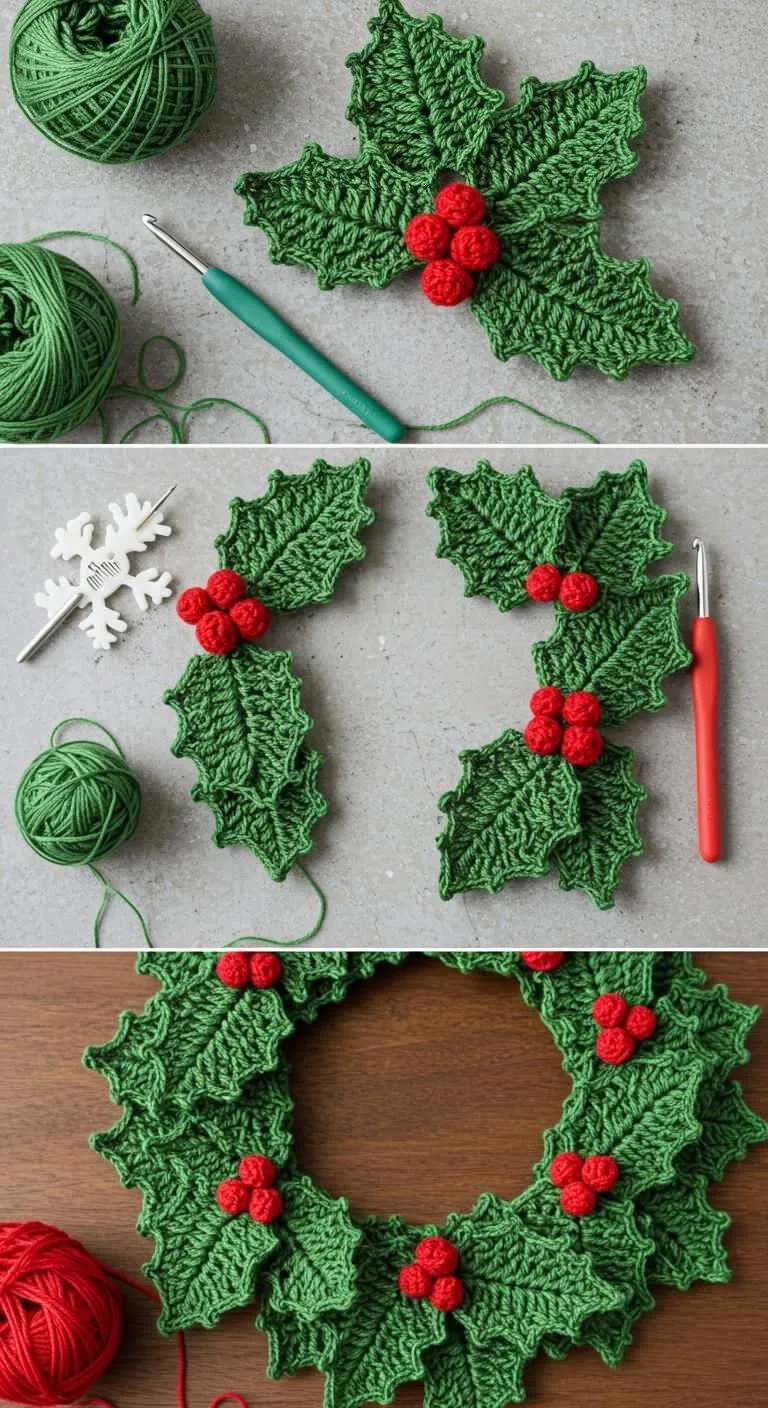
This holly leaves, sprig and wreath combines green and red with the form shown in the reference. The original construction below simplifies details that cannot be reliably recovered from a photograph; it does not promise an exact chart match.
Materials, gauge and size
Sport/DK cotton, approximately 100–250 g for a wreath or garland, or 20–50 g per ornament. Colors: green and red. Hook: 2.5–3 mm. These are estimates: weigh a sample, multiply by component count and add 15–20% for joining and adjustments.
Also use a yarn needle, scissors, stitch markers, measuring tape and blocking pins. Add a purchased wreath ring for the holly wreath and embroidery thread for small details.
Gauge and sizing: Make one leaf or spiral before multiplying supplies. Curl tightness and motif width depend on yarn and tension.
Holly leaf with stitched points
- Ch 13. Starting in second chain, work sc, hdc, 8 dc, hdc, 3 sc in last chain; along underside work hdc, 8 dc, hdc, sc [25 stitches]. Sl st to beginning. This is the same counted leaf base used elsewhere in the collection.
- Outline Round 2: sc in each old stitch. After every fourth sc, add a picot (ch 3, sl st in first of these chains), keeping all 25 base sc. Place the last partial repeat as plain sc near the stem. Embroider a central vein. Make eighteen leaves for a small wreath, plus three leaves for a separate sprig.
- Berry: 6 sc in magic ring, one plain 6-sc round, then three sc2tog [3]; close without stuffing. Make fifteen berries. Sew three leaves together at their stem bases and add three berries at their center for the sprig. For the wreath sew leaves in overlapping pairs around a purchased small ring, then add twelve berries in four clusters.
- Ring cover: ch 7, sc across [6] for enough rows to wrap the ring circumference; sew the strip lengthwise around the ring. Attach every leaf base and at least one outer point to the covered ring. Make a hanging loop ch 21 with 20 sl sts, sewn through the cover and around the purchased ring.
Assembly and finishing
- Check all counts before joining. Weave ends through several stitches in three directions. Sew point joins more than once and distribute tension evenly.
- Wash a sample using the yarn care instructions, block gently and allow it to dry completely. Recheck fit or motif size after washing. These original patterns are photo-inspired and physically untested; they do not reproduce a verified photographed chart.
2. Colorful Spiral Garland
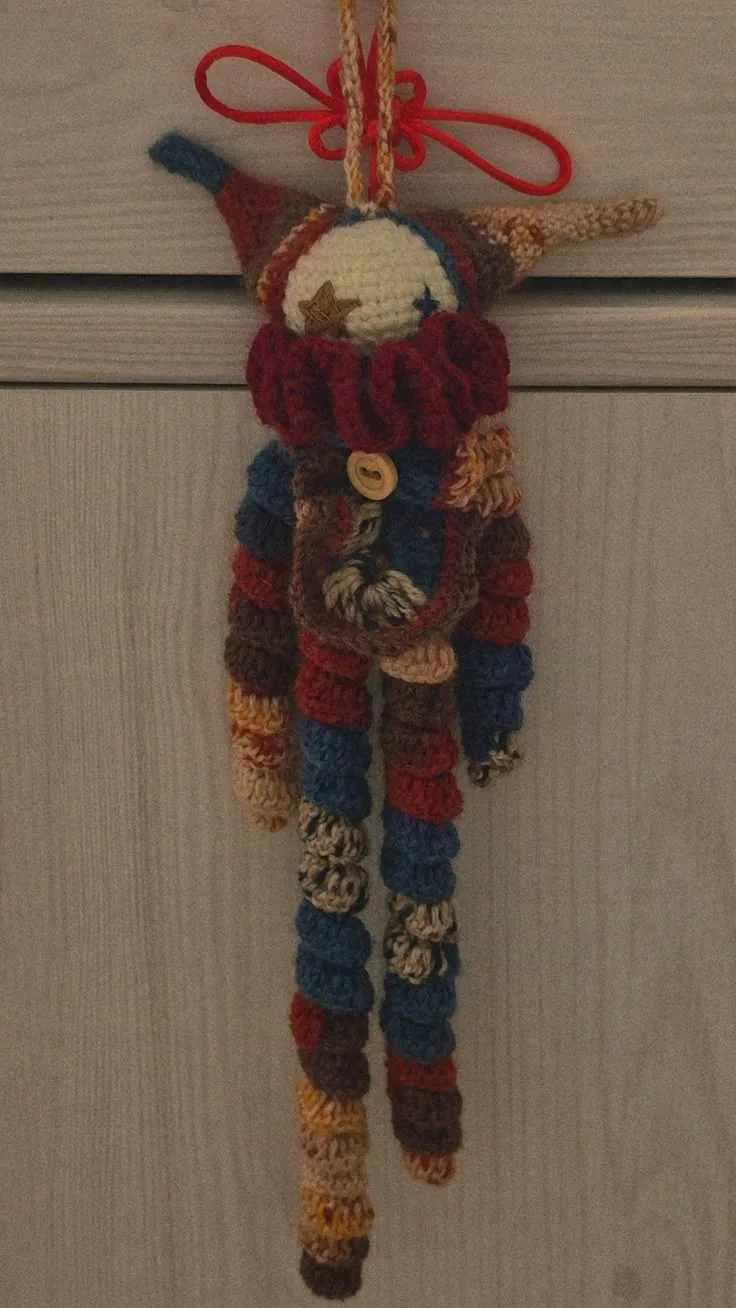
This colorful spiral garland combines red, gold, blue, green and brown with the form shown in the reference. The original construction below simplifies details that cannot be reliably recovered from a photograph; it does not promise an exact chart match.
Materials, gauge and size
Sport/DK cotton, approximately 100–250 g for a wreath or garland, or 20–50 g per ornament. Colors: red, gold, blue, green and brown. Hook: 2.5–3 mm. These are estimates: weigh a sample, multiply by component count and add 15–20% for joining and adjustments.
Also use a yarn needle, scissors, stitch markers, measuring tape and blocking pins. Add a purchased wreath ring for the holly wreath and embroidery thread for small details.
Gauge and sizing: Make one leaf or spiral before multiplying supplies. Curl tightness and motif width depend on yarn and tension.
Curled spiral strip
- Ch 31. Row 1: work 3 sc in second chain and in every remaining chain [90 sc]. Row 2: ch 1, turn; 2 sc in each stitch [180 sc]. Fasten off and let the strip curl naturally. Add one contrasting sl st in each Row-2 stitch [180], keeping the edging loose. The curl depends on yarn and tension; do not force it into a fixed photographed shape.
Garland with six curled drops
- Make six strips in the listed holiday colors. Top cord: ch 181, sl st along all 180 chains. Mark six equally spaced positions and sew one strip top securely to each. Add a second pass through both the strip foundation and cord.
- Optional end ball: 6 sc in magic ring, increase to 12, one 12-sc round, then six sc2tog [6]; stuff lightly and close. Make one per strip and sew to its bottom. Hang the garland from its top cord, keeping all parts clear of heat and moving doors.
Assembly and finishing
- Check all counts before joining. Weave ends through several stitches in three directions. Sew point joins more than once and distribute tension evenly.
- Wash a sample using the yarn care instructions, block gently and allow it to dry completely. Recheck fit or motif size after washing. These original patterns are photo-inspired and physically untested; they do not reproduce a verified photographed chart.
3. Spiral Christmas Tree Ornaments
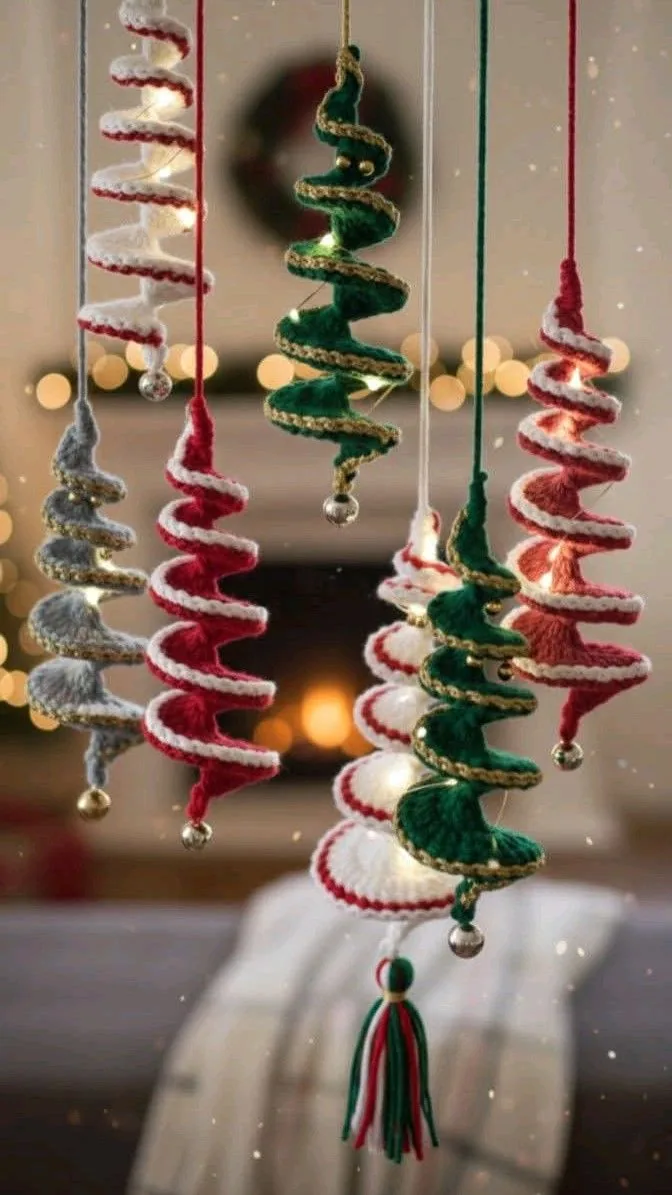
This spiral christmas tree ornaments combines green, red, ivory and gold with the form shown in the reference. The original construction below simplifies details that cannot be reliably recovered from a photograph; it does not promise an exact chart match.
Materials, gauge and size
Sport/DK cotton, approximately 100–250 g for a wreath or garland, or 20–50 g per ornament. Colors: green, red, ivory and gold. Hook: 2.5–3 mm. These are estimates: weigh a sample, multiply by component count and add 15–20% for joining and adjustments.
Also use a yarn needle, scissors, stitch markers, measuring tape and blocking pins. Add a purchased wreath ring for the holly wreath and embroidery thread for small details.
Gauge and sizing: Make one leaf or spiral before multiplying supplies. Curl tightness and motif width depend on yarn and tension.
Curled spiral strip
- Ch 41. Row 1: work 3 sc in second chain and in every remaining chain [120 sc]. Row 2: ch 1, turn; 2 sc in each stitch [240 sc]. Fasten off and let the strip curl naturally. Add one contrasting sl st in each Row-2 stitch [240], keeping the edging loose. The curl depends on yarn and tension; do not force it into a fixed photographed shape.
Three spiral tree ornaments
- Make three green or ivory spirals. Shape each into a tapered stack by arranging the upper coils tighter and lower coils wider; stitch through the inner edges at four vertical points so the spiral keeps a conical silhouette. This is a stitched spiral-tree interpretation, not a single uninterrupted graduated chart.
- Trunk: 6 sc in magic ring, two plain rounds of 6, fasten off and sew beneath the lowest coil. Star: 10 sc in magic ring, then (sc in next, ch 5; sl st in second chain, sc in next, hdc in next, dc in last; skip next base stitch) five times. Sew to the tree top.
- Hanging loop: ch 21, sl st along 20 chains, stitch both ends through the star base and top coil. Embroider small gold or red knots along the spiral instead of attaching loose beads. Reinforce every decorative attachment and block without crushing the curl.
Assembly and finishing
- Check all counts before joining. Weave ends through several stitches in three directions. Sew point joins more than once and distribute tension evenly.
- Wash a sample using the yarn care instructions, block gently and allow it to dry completely. Recheck fit or motif size after washing. These original patterns are photo-inspired and physically untested; they do not reproduce a verified photographed chart.