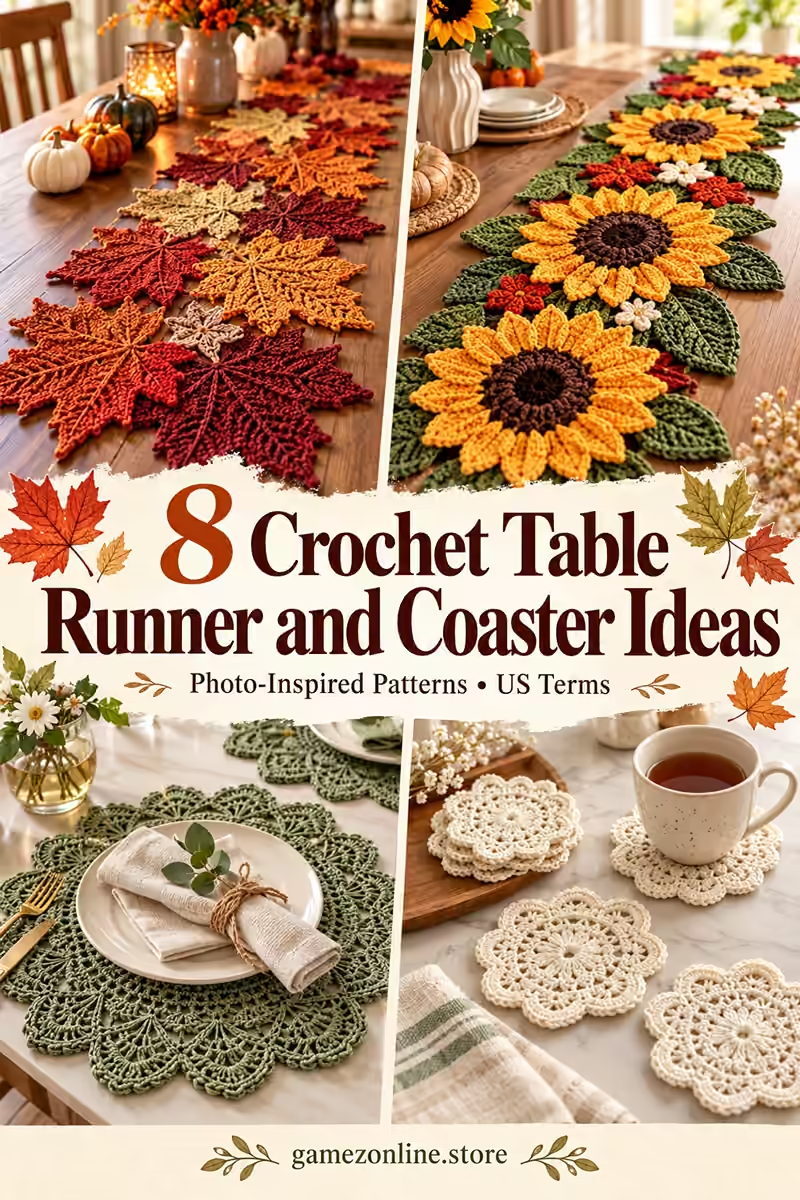
8 Crochet Table Runner and Coaster Ideas
Explore eight crochet table runner and coaster ideas with original counted patterns for leaves, sunflowers, gingerbread motifs and scalloped mats. Each image below has its own original written construction, materials, stitch counts, assembly and finishing notes.
US crochet terms and working rules
ch = chain; sl st = slip stitch; sc = single crochet; hdc = half double crochet; dc = double crochet; inc = 2 stitches in one stitch; sc2tog = single crochet two stitches together; st(s) = stitch(es); sp = space; RS = right side. A magic ring is an adjustable yarn loop. Numbers in brackets give end-of-round or end-of-row counts. Repeat instructions between parentheses the stated number of times.
Unless a step explicitly says otherwise, beginning chains do not count as stitches. For dc rounds, ch 2 to reach height, then work the first dc into the first stitch; join to the first real dc. For sc rounds, ch 1 and join to the first sc. For flat sc rows, ch 1 and turn. Flat dc rows explicitly use ch 3 as the first counted dc. Do not work into joining slip stitches. Change color by completing the last yarn-over of the preceding stitch with the new yarn.
To work sc2tog: insert hook into the next stitch and draw up a loop, repeat in the following stitch, yarn over and draw through all three loops. For a surface slip stitch, bring the yarn up from behind the fabric, insert the hook into the next chosen gap and pull the new loop through the loop already on the hook. Keep these stitches loose.
Additional US terms: inc = 2 stitches of the stated type in one stitch; sc2tog/dc2tog/dc3tog = work two or three stitches together as named; sc3tog = single crochet three together; BLO = back loop only; FPdc = front-post double crochet; BPdc = back-post double crochet; tr = treble crochet. Ch 3 counts as one dc unless stated otherwise; ch 1 for turning does not count. Close joined rounds with a sl st unless continuous rounds are specified. Photographed charts are visual references, not patterns verified or transcribed here.
1. Gingerbread Table Runner

This gingerbread table runner combines cream, cocoa and red with the form shown in the reference. The original construction below simplifies details that cannot be reliably recovered from a photograph; it does not promise an exact chart match.
Materials, gauge and size
Sport or DK cotton, approximately 250–600 g per runner, 80–160 g per placemat or 10–25 g per coaster. Colors: cream, cocoa and red. Hook: 2.5–3.5 mm. These are estimates: weigh a sample, multiply by component count and add 15–20% for joining and adjustments.
Also use a yarn needle, scissors, stitch markers, measuring tape and blocking pins.
Gauge and sizing: Wash one complete leaf, flower or circle and record its dimensions. Runner size follows measured motif width and gaps, not the scale of the photograph.
Cream runner ground
- Ch 38. Row 1: dc in fourth chain and across, skipped ch 3 counts as first dc [36]. Row 2: ch 3, turn; dc in every stitch [36]. Repeat Row 2 to Row 90. At 16 dc and 9 rows per 10 cm the sample is about 22.5 × 100 cm before edging; wash and measure.
- Border: sc around with three sc at corners, then (skip 1, 5 dc in next, skip 1, sl st in next) along each side, using plain sc near incomplete repeats. Work in cream and keep the outline flat.
Six gingerbread appliques
- Body: ch 9, sc across [8] for twelve rows. Head: 6 sc in magic ring, increase to 12, work one plain 12-sc round; fasten off flat. Arms: ch 7, sc across [6] for three rows; make two per figure. Legs: ch 6, sc across [5] for four rows; make two per figure.
- Sew head to body top, two arms near the upper sides and two legs at the lower corners, overlapping every attachment by two stitches. Make six figures. Embroider eyes, smile, two buttons and a loose cream icing line along each outline.
- Arrange figures alternately facing left and right along the runner, keeping all parts inside its border. Sew the full perimeter of every applique flat, including fingers and feet, so no part catches on tableware. Buttons and gingerbread details are embroidered rather than glued on.
Assembly and finishing
- Check all counts before joining. Weave ends through several stitches in three directions. Sew point joins more than once and distribute tension evenly.
- Wash a sample using the yarn care instructions, block gently and allow it to dry completely. Recheck fit or motif size after washing. These original patterns are photo-inspired and physically untested; they do not reproduce a verified photographed chart.
2. Autumn Maple Leaf Runner

This autumn maple leaf runner combines rust, gold, olive and brown with the form shown in the reference. The original construction below simplifies details that cannot be reliably recovered from a photograph; it does not promise an exact chart match.
Materials, gauge and size
Sport or DK cotton, approximately 250–600 g per runner, 80–160 g per placemat or 10–25 g per coaster. Colors: rust, gold, olive and brown. Hook: 2.5–3.5 mm. These are estimates: weigh a sample, multiply by component count and add 15–20% for joining and adjustments.
Also use a yarn needle, scissors, stitch markers, measuring tape and blocking pins.
Gauge and sizing: Wash one complete leaf, flower or circle and record its dimensions. Runner size follows measured motif width and gaps, not the scale of the photograph.
Five-lobed maple leaf interpretation
- Center: 10 sc in magic ring; join [10]. Round 2: (sc in next stitch, ch 9, skip next) five times [5 anchors, 5 loops]. Round 3: into each loop work (sc, hdc, 3 dc, 3 tr, 3 dc, hdc, sc), sl st in next anchor [5 lobes; 13 stitches per lobe plus 5 anchor sl sts].
- Outline: sc in each lobe stitch, with (sc, ch 3, sl st in first of those three chains, sc) replacing the middle tr’s ordinary sc [14 sc and one picot per lobe]. Sl st across old anchor joins. Stem: ch 11, sl st in second chain and along the remaining nine chains [10 sl sts], sl st at the leaf center base and fasten off.
- Embroider a central vein from stem to the middle lobe tip and two side veins to the neighboring lobe tips, using loose surface chains. Block the five tips into a maple-like outline. This open five-lobe motif is an original simplification rather than a transcription of the photographed seven-point chart.
Runner layout and joins
- Make 18 maple motifs in six rows of three, mixing the listed autumn or pink shades. Block every leaf to the same overall width before arranging them.
- For each touching motif pair, sew at two separate points with at least four small stitches per join. Add a third connection wherever a motif would otherwise pivot. If gaps are too large, bridge with ch 5–9, sl st to the next tip, then work one sc in each chain on the return. Use the same chain length at corresponding symmetrical gaps.
- Weave every joining tail into both neighboring motifs, block the entire runner on a straight center line and check it can be lifted without a single point carrying all the tension. Approximate size depends on the washed leaf width and chosen spacing; the arrangement is not a fixed photographic scale.
Assembly and finishing
- Check all counts before joining. Weave ends through several stitches in three directions. Sew point joins more than once and distribute tension evenly.
- Wash a sample using the yarn care instructions, block gently and allow it to dry completely. Recheck fit or motif size after washing. These original patterns are photo-inspired and physically untested; they do not reproduce a verified photographed chart.
3. Sage Lace Placemat

This sage lace placemat combines sage and gold with the form shown in the reference. The original construction below simplifies details that cannot be reliably recovered from a photograph; it does not promise an exact chart match.
Materials, gauge and size
Sport or DK cotton, approximately 250–600 g per runner, 80–160 g per placemat or 10–25 g per coaster. Colors: sage and gold. Hook: 2.5–3.5 mm. These are estimates: weigh a sample, multiply by component count and add 15–20% for joining and adjustments.
Also use a yarn needle, scissors, stitch markers, measuring tape and blocking pins.
Gauge and sizing: Wash one complete leaf, flower or circle and record its dimensions. Runner size follows measured motif width and gaps, not the scale of the photograph.
Round lace mat or coaster
- Round 1: Into a magic ring work 12 dc; join. [12 dc]
- Round 2: Work 2 dc in each stitch; join. [24 dc]
- Round 3: Repeat (1 dc, 2 dc in next stitch) 12 times; join. [36 dc]
- Round 4: Repeat (2 dc, 2 dc in next stitch) 12 times; join. [48 dc]
- Round 5: Repeat (3 dc, 2 dc in next stitch) 12 times; join. [60 dc]
- Round 6: Repeat (4 dc, 2 dc in next stitch) 12 times; join. [72 dc]
- Round 7: Repeat (5 dc, 2 dc in next stitch) 12 times; join. [84 dc]
- Round 8: Repeat (6 dc, 2 dc in next stitch) 12 times; join. [96 dc]
- Round 9: Repeat (7 dc, 2 dc in next stitch) 12 times; join. [108 dc]
- Round 10: Repeat (8 dc, 2 dc in next stitch) 12 times; join. [120 dc]
Measured size and scalloped edge
- Use the ten-round circle [120 dc] as the center. For a larger placemat keep adding twelve evenly spaced increases per round: Round 11 has 132, Round 12 has 144. Measure until the washed diameter is 30–35 cm; no size is guaranteed by the photograph.
- Border: (sc in next stitch, ch 3, skip 2) around [N/3 anchors and loops]. Next round: into each loop work (sc, hdc, 3 dc, hdc, sc), sl st in the next anchor. For the sage mat, use sage for the center and loops and gold for a final sc outline; for ivory coasters keep one color.
- Block all mats flat and keep bulky scallops outside the area supporting cups and plates. Use a suitable separate trivet for hot cookware; the yarn project has no claimed heat rating.
Assembly and finishing
- Check all counts before joining. Weave ends through several stitches in three directions. Sew point joins more than once and distribute tension evenly.
- Wash a sample using the yarn care instructions, block gently and allow it to dry completely. Recheck fit or motif size after washing. These original patterns are photo-inspired and physically untested; they do not reproduce a verified photographed chart.
4. Autumn Fan-Leaf Table Mat
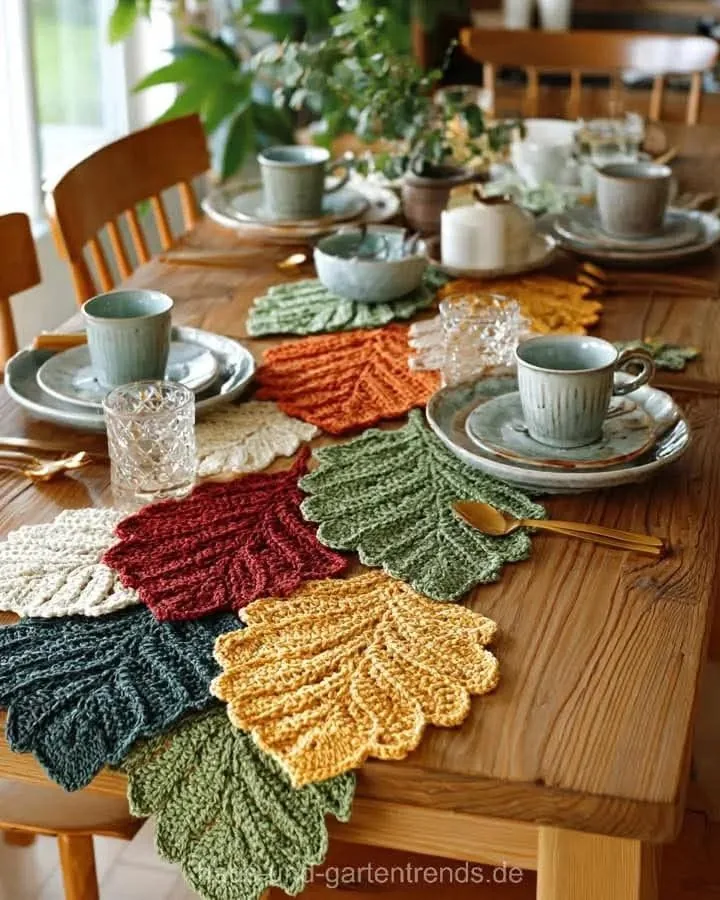
This autumn fan-leaf table mat combines rust, gold, sage and cream with the form shown in the reference. The original construction below simplifies details that cannot be reliably recovered from a photograph; it does not promise an exact chart match.
Materials, gauge and size
Sport or DK cotton, approximately 250–600 g per runner, 80–160 g per placemat or 10–25 g per coaster. Colors: rust, gold, sage and cream. Hook: 2.5–3.5 mm. These are estimates: weigh a sample, multiply by component count and add 15–20% for joining and adjustments.
Also use a yarn needle, scissors, stitch markers, measuring tape and blocking pins.
Gauge and sizing: Wash one complete leaf, flower or circle and record its dimensions. Runner size follows measured motif width and gaps, not the scale of the photograph.
Fan leaf motif
- Ch 4, join ring. Row 1: ch 3 counts as first dc and work 8 dc in ring [9]. Row 2: ch 3 counts as first dc, turn; dc in same stitch, 2 dc in every remaining stitch [18]. Row 3: ch 3 counts as first dc, turn; 2 dc in next stitch, then (dc in next, 2 dc in next) eight times [27].
- Row 4: sc in every stitch [27]. Stem: at the middle of the straight edge join yarn, ch 9, sl st along eight chains, fasten off. Embroider five loose veins from the stem base toward the curved edge. Make twelve fans in the listed autumn shades.
- Arrange three rows of four fans, rotating neighboring stems toward the center. Sew two points per touching curved edge and add ch-5 bridges with sc return where required. This modular fan arrangement interprets the reference’s joined leaf mat.
Assembly and finishing
- Check all counts before joining. Weave ends through several stitches in three directions. Sew point joins more than once and distribute tension evenly.
- Wash a sample using the yarn care instructions, block gently and allow it to dry completely. Recheck fit or motif size after washing. These original patterns are photo-inspired and physically untested; they do not reproduce a verified photographed chart.
5. Mixed Autumn Leaf Runner

This mixed autumn leaf runner combines rust, cream, olive and gold with the form shown in the reference. The original construction below simplifies details that cannot be reliably recovered from a photograph; it does not promise an exact chart match.
Materials, gauge and size
Sport or DK cotton, approximately 250–600 g per runner, 80–160 g per placemat or 10–25 g per coaster. Colors: rust, cream, olive and gold. Hook: 2.5–3.5 mm. These are estimates: weigh a sample, multiply by component count and add 15–20% for joining and adjustments.
Also use a yarn needle, scissors, stitch markers, measuring tape and blocking pins.
Gauge and sizing: Wash one complete leaf, flower or circle and record its dimensions. Runner size follows measured motif width and gaps, not the scale of the photograph.
Round 1 — counted oval leaf
- Ch 13. Starting in the second chain work sc, hdc, dc in each of the next 8 chains, hdc, then 3 sc in the last chain. Rotate; work into the unused chain loops: hdc, dc in each of the next 8 chains, hdc, sc. Join to the first sc. [25 stitches]
- Ch 1; sl st loosely into each stitch around. Fasten off with a long tail. Sew only through the underside of the leaf edge to attach, keeping the center flexible.
Runner layout and joins
- Make 24 elongated leaves using the counted leaf above, six each in rust, cream, olive and gold. Arrange twelve alternating pairs along a center line, turning the tips outward.
- For each touching motif pair, sew at two separate points with at least four small stitches per join. Add a third connection wherever a motif would otherwise pivot. If gaps are too large, bridge with ch 5–9, sl st to the next tip, then work one sc in each chain on the return. Use the same chain length at corresponding symmetrical gaps.
- Weave every joining tail into both neighboring motifs, block the entire runner on a straight center line and check it can be lifted without a single point carrying all the tension. Approximate size depends on the washed leaf width and chosen spacing; the arrangement is not a fixed photographic scale.
Assembly and finishing
- Check all counts before joining. Weave ends through several stitches in three directions. Sew point joins more than once and distribute tension evenly.
- Wash a sample using the yarn care instructions, block gently and allow it to dry completely. Recheck fit or motif size after washing. These original patterns are photo-inspired and physically untested; they do not reproduce a verified photographed chart.
6. Sunflower Table Runner
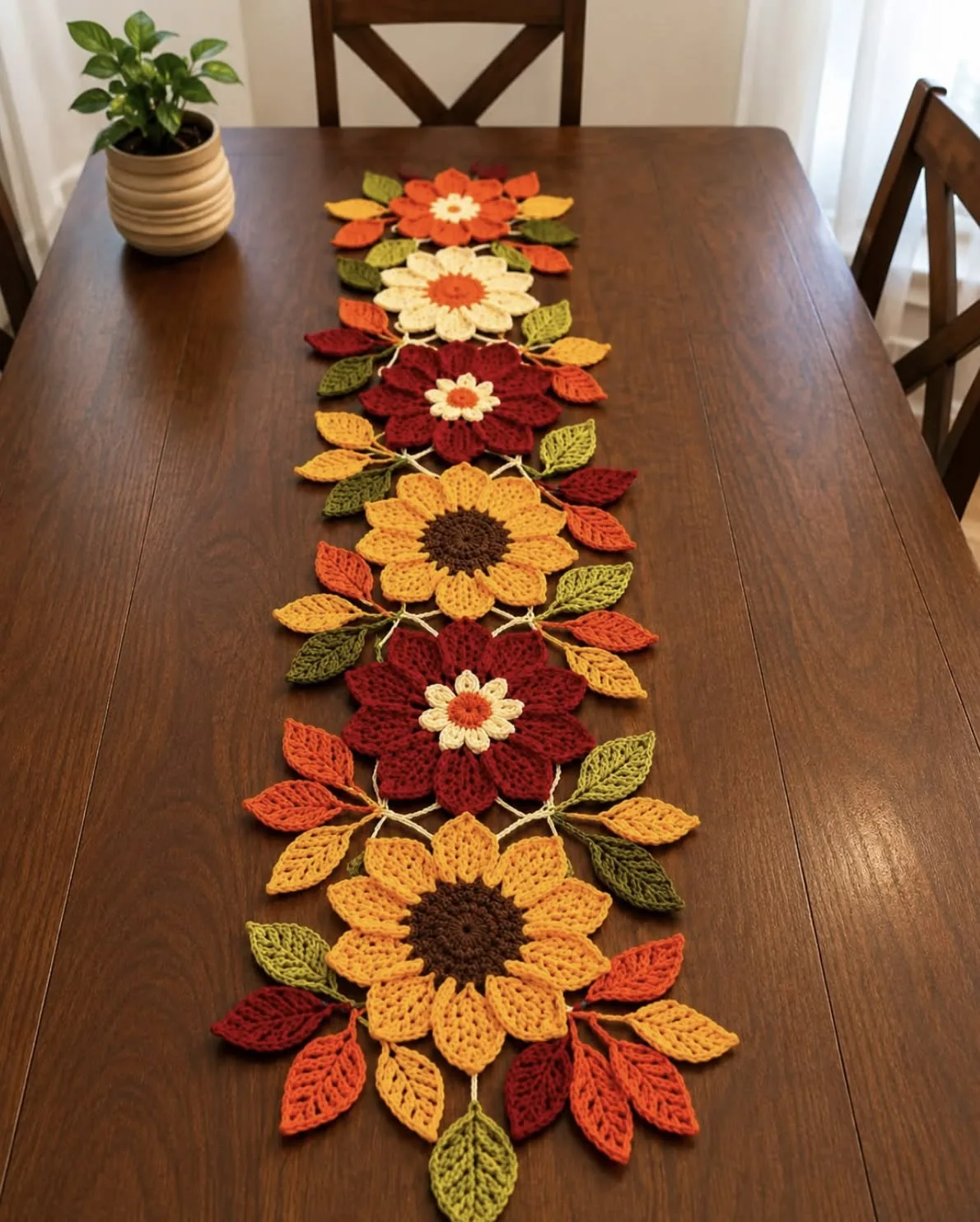
This sunflower table runner combines gold, brown, rust and green with the form shown in the reference. The original construction below simplifies details that cannot be reliably recovered from a photograph; it does not promise an exact chart match.
Materials, gauge and size
Sport or DK cotton, approximately 250–600 g per runner, 80–160 g per placemat or 10–25 g per coaster. Colors: gold, brown, rust and green. Hook: 2.5–3.5 mm. These are estimates: weigh a sample, multiply by component count and add 15–20% for joining and adjustments.
Also use a yarn needle, scissors, stitch markers, measuring tape and blocking pins.
Gauge and sizing: Wash one complete leaf, flower or circle and record its dimensions. Runner size follows measured motif width and gaps, not the scale of the photograph.
Sunflower center and twelve petals
- Brown center: 6 sc in magic ring [6], increase by six each round to 12, 18, 24, 30 and 36 at Round 6. Round 7: (sc in next 2, ch 7, skip next) twelve times [24 sc and 12 loops].
- Round 8: into each loop work (sc, hdc, 5 dc, hdc, sc); sl st in the next anchor area [12 nine-stitch petals]. Use gold or rust for petals. The old plain sc stitches remain behind the flower edge; do not add more petals there. Make five large flowers.
- Ch 13. Starting in the second chain work sc, hdc, dc in each of the next 8 chains, hdc, then 3 sc in the last chain. Rotate; work into the unused chain loops: hdc, dc in each of the next 8 chains, hdc, sc. Join to the first sc. [25 stitches]
- Ch 1; sl st loosely into each stitch around. Fasten off with a long tail. Sew only through the underside of the leaf edge to attach, keeping the center flexible.
- With the center color work 10 sc into a magic ring; join [10]. With the petal color repeat (sl st in next sc, 5 dc in next sc) five times. [Five petals] Fasten off with a sewing tail; weave or sew both ends securely.
Runner assembly
- Make ten large leaves, five small five-petal flowers and ten additional small leaves. Arrange five sunflower centers in a straight line with 2–4 cm between petals. Put a pair of large leaves beside each junction and one at each end. Sew neighboring units together at two or three touching tips, using short reinforced stitches.
- Use the small flowers to fill the five largest remaining gaps and attach their small leaves as pairs. Add ch-7 bridges only where a gap remains, working one sc back along each bridge. Block the complete runner and secure every join. The five-center count is a proposed arrangement; measure your own table before adding more flowers.
Assembly and finishing
- Check all counts before joining. Weave ends through several stitches in three directions. Sew point joins more than once and distribute tension evenly.
- Wash a sample using the yarn care instructions, block gently and allow it to dry completely. Recheck fit or motif size after washing. These original patterns are photo-inspired and physically untested; they do not reproduce a verified photographed chart.
7. Ivory Scalloped Coaster Set
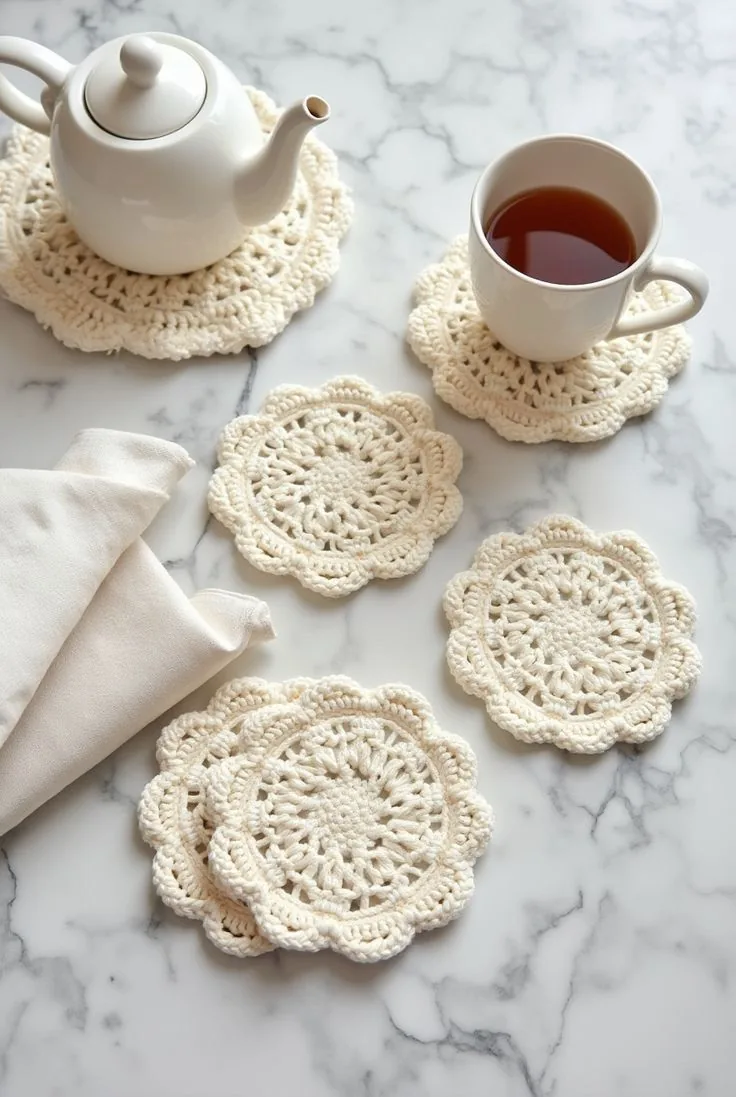
This ivory scalloped coaster set combines ivory with the form shown in the reference. The original construction below simplifies details that cannot be reliably recovered from a photograph; it does not promise an exact chart match.
Materials, gauge and size
Sport or DK cotton, approximately 250–600 g per runner, 80–160 g per placemat or 10–25 g per coaster. Colors: ivory. Hook: 2.5–3.5 mm. These are estimates: weigh a sample, multiply by component count and add 15–20% for joining and adjustments.
Also use a yarn needle, scissors, stitch markers, measuring tape and blocking pins.
Gauge and sizing: Wash one complete leaf, flower or circle and record its dimensions. Runner size follows measured motif width and gaps, not the scale of the photograph.
Round lace mat or coaster
- Round 1: Into a magic ring work 12 dc; join. [12 dc]
- Round 2: Work 2 dc in each stitch; join. [24 dc]
- Round 3: Repeat (1 dc, 2 dc in next stitch) 12 times; join. [36 dc]
- Round 4: Repeat (2 dc, 2 dc in next stitch) 12 times; join. [48 dc]
- Round 5: Repeat (3 dc, 2 dc in next stitch) 12 times; join. [60 dc]
- Round 6: Repeat (4 dc, 2 dc in next stitch) 12 times; join. [72 dc]
- Round 7: Repeat (5 dc, 2 dc in next stitch) 12 times; join. [84 dc]
- Round 8: Repeat (6 dc, 2 dc in next stitch) 12 times; join. [96 dc]
- Round 9: Repeat (7 dc, 2 dc in next stitch) 12 times; join. [108 dc]
- Round 10: Repeat (8 dc, 2 dc in next stitch) 12 times; join. [120 dc]
Measured size and scalloped edge
- For coasters stop the dc circle at Round 4 [48 dc]; make six. For a small teapot mat stop at Round 7 [84 dc], and for a larger mat use all ten rounds [120 dc]. Measure the actual cup base before deciding the stop round.
- Border: (sc in next stitch, ch 3, skip 2) around [N/3 anchors and loops]. Next round: into each loop work (sc, hdc, 3 dc, hdc, sc), sl st in the next anchor. For the sage mat, use sage for the center and loops and gold for a final sc outline; for ivory coasters keep one color.
- Block all mats flat and keep bulky scallops outside the area supporting cups and plates. Use a suitable separate trivet for hot cookware; the yarn project has no claimed heat rating.
Assembly and finishing
- Check all counts before joining. Weave ends through several stitches in three directions. Sew point joins more than once and distribute tension evenly.
- Wash a sample using the yarn care instructions, block gently and allow it to dry completely. Recheck fit or motif size after washing. These original patterns are photo-inspired and physically untested; they do not reproduce a verified photographed chart.
8. Pink and Burgundy Maple Runner
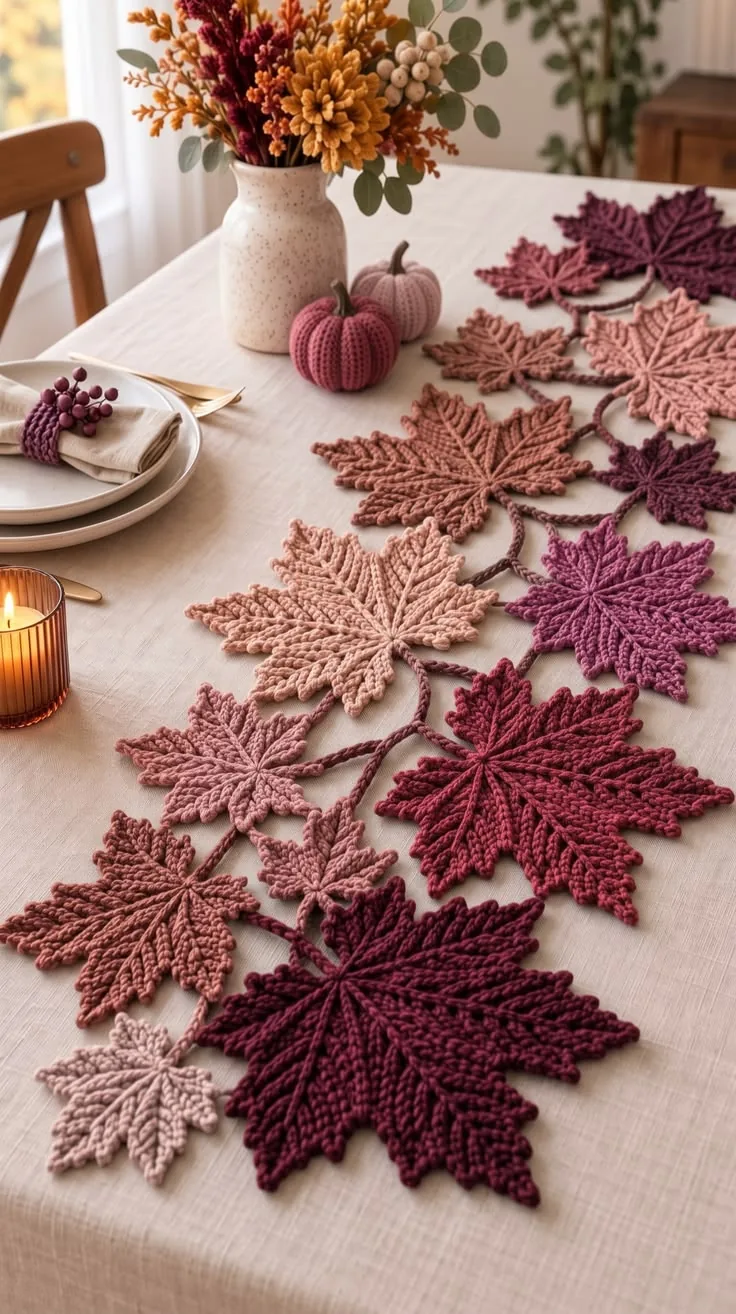
This pink and burgundy maple runner combines pink, blush, burgundy and cream with the form shown in the reference. The original construction below simplifies details that cannot be reliably recovered from a photograph; it does not promise an exact chart match.
Materials, gauge and size
Sport or DK cotton, approximately 250–600 g per runner, 80–160 g per placemat or 10–25 g per coaster. Colors: pink, blush, burgundy and cream. Hook: 2.5–3.5 mm. These are estimates: weigh a sample, multiply by component count and add 15–20% for joining and adjustments.
Also use a yarn needle, scissors, stitch markers, measuring tape and blocking pins.
Gauge and sizing: Wash one complete leaf, flower or circle and record its dimensions. Runner size follows measured motif width and gaps, not the scale of the photograph.
Five-lobed maple leaf interpretation
- Center: 10 sc in magic ring; join [10]. Round 2: (sc in next stitch, ch 9, skip next) five times [5 anchors, 5 loops]. Round 3: into each loop work (sc, hdc, 3 dc, 3 tr, 3 dc, hdc, sc), sl st in next anchor [5 lobes; 13 stitches per lobe plus 5 anchor sl sts].
- Outline: sc in each lobe stitch, with (sc, ch 3, sl st in first of those three chains, sc) replacing the middle tr’s ordinary sc [14 sc and one picot per lobe]. Sl st across old anchor joins. Stem: ch 11, sl st in second chain and along the remaining nine chains [10 sl sts], sl st at the leaf center base and fasten off.
- Embroider a central vein from stem to the middle lobe tip and two side veins to the neighboring lobe tips, using loose surface chains. Block the five tips into a maple-like outline. This open five-lobe motif is an original simplification rather than a transcription of the photographed seven-point chart.
Runner layout and joins
- Make 18 maple motifs in six rows of three, mixing the listed autumn or pink shades. Block every leaf to the same overall width before arranging them.
- For each touching motif pair, sew at two separate points with at least four small stitches per join. Add a third connection wherever a motif would otherwise pivot. If gaps are too large, bridge with ch 5–9, sl st to the next tip, then work one sc in each chain on the return. Use the same chain length at corresponding symmetrical gaps.
- Weave every joining tail into both neighboring motifs, block the entire runner on a straight center line and check it can be lifted without a single point carrying all the tension. Approximate size depends on the washed leaf width and chosen spacing; the arrangement is not a fixed photographic scale.
Assembly and finishing
- Check all counts before joining. Weave ends through several stitches in three directions. Sew point joins more than once and distribute tension evenly.
- Wash a sample using the yarn care instructions, block gently and allow it to dry completely. Recheck fit or motif size after washing. These original patterns are photo-inspired and physically untested; they do not reproduce a verified photographed chart.