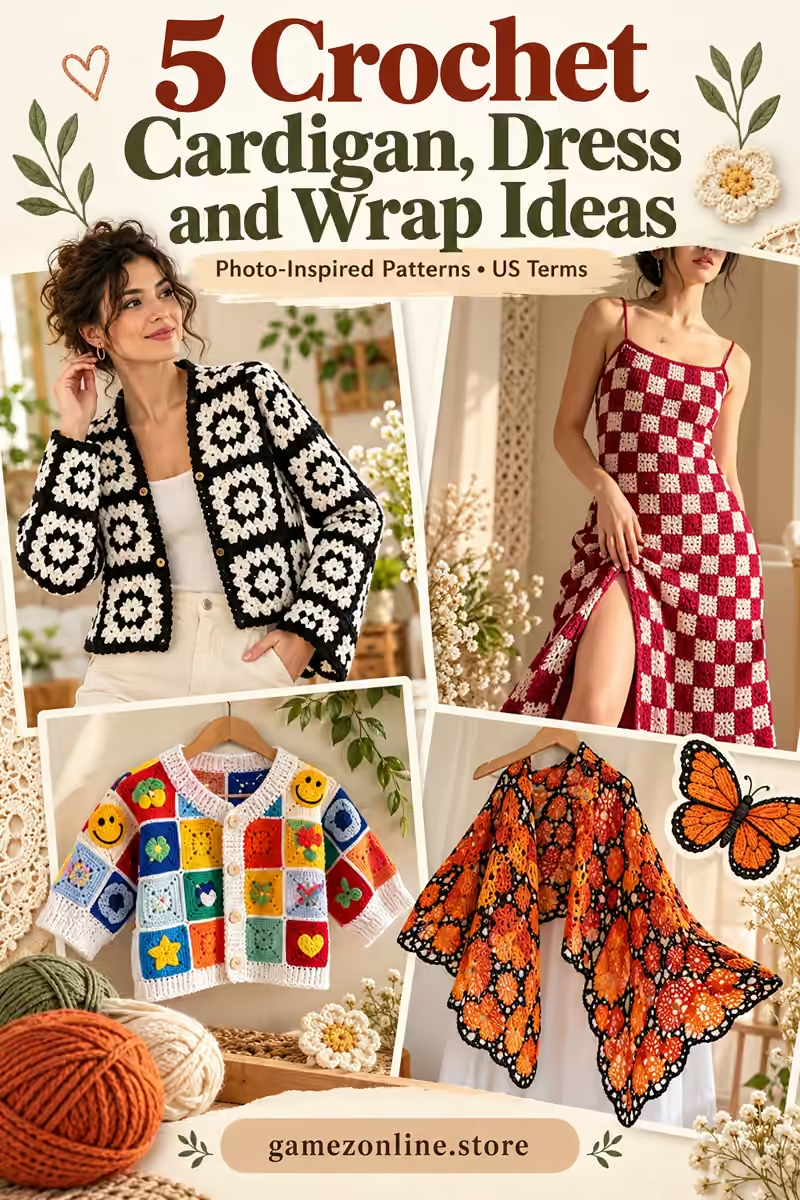
5 Crochet Cardigan, Dress and Wrap Ideas
Explore five crochet cardigan, dress and wrap ideas, including granny cardigans, a checked dress and butterfly-inspired layers with measured fit notes. Each image below has its own original written construction, materials, stitch counts, assembly and finishing notes.
US crochet terms and working rules
ch = chain; sl st = slip stitch; sc = single crochet; hdc = half double crochet; dc = double crochet; inc = 2 stitches in one stitch; sc2tog = single crochet two stitches together; st(s) = stitch(es); sp = space; RS = right side. A magic ring is an adjustable yarn loop. Numbers in brackets give end-of-round or end-of-row counts. Repeat instructions between parentheses the stated number of times.
Unless a step explicitly says otherwise, beginning chains do not count as stitches. For dc rounds, ch 2 to reach height, then work the first dc into the first stitch; join to the first real dc. For sc rounds, ch 1 and join to the first sc. For flat sc rows, ch 1 and turn. Flat dc rows explicitly use ch 3 as the first counted dc. Do not work into joining slip stitches. Change color by completing the last yarn-over of the preceding stitch with the new yarn.
To work sc2tog: insert hook into the next stitch and draw up a loop, repeat in the following stitch, yarn over and draw through all three loops. For a surface slip stitch, bring the yarn up from behind the fabric, insert the hook into the next chosen gap and pull the new loop through the loop already on the hook. Keep these stitches loose.
Additional US terms: inc = 2 stitches of the stated type in one stitch; sc2tog/dc2tog/dc3tog = work two or three stitches together as named; sc3tog = single crochet three together; BLO = back loop only; FPdc = front-post double crochet; BPdc = back-post double crochet; tr = treble crochet. Ch 3 counts as one dc unless stated otherwise; ch 1 for turning does not count. Close joined rounds with a sl st unless continuous rounds are specified. Photographed charts are visual references, not patterns verified or transcribed here.
1. Black and White Granny Cardigan
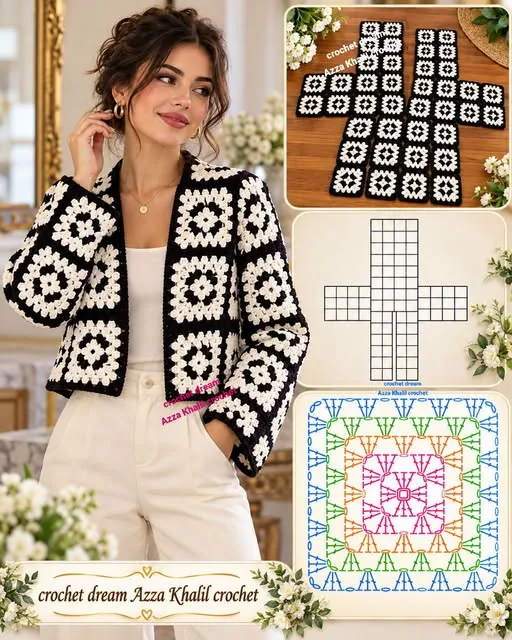
This black and white granny cardigan combines black and white with the form shown in the reference. The original construction below simplifies details that cannot be reliably recovered from a photograph; it does not promise an exact chart match.
Materials, gauge and size
Smooth DK clothing yarn, approximately 600–1,100 g for an adult cardigan or dress, 250–500 g for a small measured cardigan, or 350–700 g for a wrap. Colors: black and white. Hook: 3.5–4 mm. These are estimates: weigh a sample, multiply by component count and add 15–20% for joining and adjustments.
Also use a yarn needle, scissors, stitch markers, measuring tape and blocking pins. Add buttons or lining as specified. Appliques and chart references are independently interpreted.
Gauge and sizing: Use 16 dc × 9 rows per 10 cm as a provisional sample only. Measure a washed square or mesh panel and fit from actual chest/hip plus stated ease; examples are not professionally graded sizes.
Classic granny square
- Round 1: In a magic ring work (3 dc, ch 2) four times; join. [12 dc, four ch-2 corners]
- Round 2: In every corner work (3 dc, ch 2, 3 dc); ch 1 between corner groups. [24 dc, four ch-2 corners and four ch-1 side spaces]
- Round 3: Work (3 dc, ch 2, 3 dc) in each corner and 3 dc in each side ch-1 space, separating every group with ch 1 except within the ch-2 corners. [36 dc, four corners and eight side ch-1 spaces]
- Rounds 4–5: Repeat Round 3, placing one 3-dc group in each side space. Round 4 has 48 dc and twelve side spaces; Round 5 has 60 dc and sixteen side spaces. Both have four ch-2 corners.
- Round 6: Sc in each dc and 1 sc in each side ch-1 space; work (sc, ch 2, sc) in each corner. [84 sc and four ch-2 corners; 21 sc per side] Block square without pulling the holes out of shape.
Measured fifty-square cardigan
- Make and wash one square, measuring width W. This layout gives approximately 8W around the body before front bands. At W = 12 cm it is about 96 cm; at W = 8 cm it is about 64 cm. Choose W from actual chest plus 6–10 cm ease, then divide by eight. The smaller colorful reference is not assigned an age size.
- Make fifty squares: back sixteen in a 4 × 4 grid; two fronts eight each in 2 × 4 grids; two sleeves nine each in 3 × 3 grids. Whipstitch matching outer edges. Sew each front’s outside one-square top edge to the corresponding outside square of the back, leaving the middle two back squares for the neck.
- Sew each side from hem up, leaving the top 1.5W open as an armhole. Each sleeve top is 3W wide, matching the two 1.5W armhole edges; sew it around the opening, then sew the sleeve long edge. Pin and try on before permanent seams. At W = 12 cm the body is 48 cm long before bands and sleeve 36 cm long.
- Work four sc rows along both fronts and around the back neck, one sc per exposed stitch and adjusting at square corners to keep the band flat. On Row 3 of one front make three evenly spaced buttonholes by replacing three sc with ch 3; on Row 4 work three sc in each hole. Sew matching buttons opposite. Work three sc rounds around each cuff and two around the lower hem.
For the black-and-white version use white centers, black intermediate rounds and white outside rounds, reversing the palette on every other square.
Assembly and finishing
- Check all counts before joining. Weave ends through several stitches in three directions. Sew point joins more than once and distribute tension evenly.
- Wash a sample using the yarn care instructions, block gently and allow it to dry completely. Recheck fit or motif size after washing. These original patterns are photo-inspired and physically untested; they do not reproduce a verified photographed chart.
2. Red and White Checked Dress
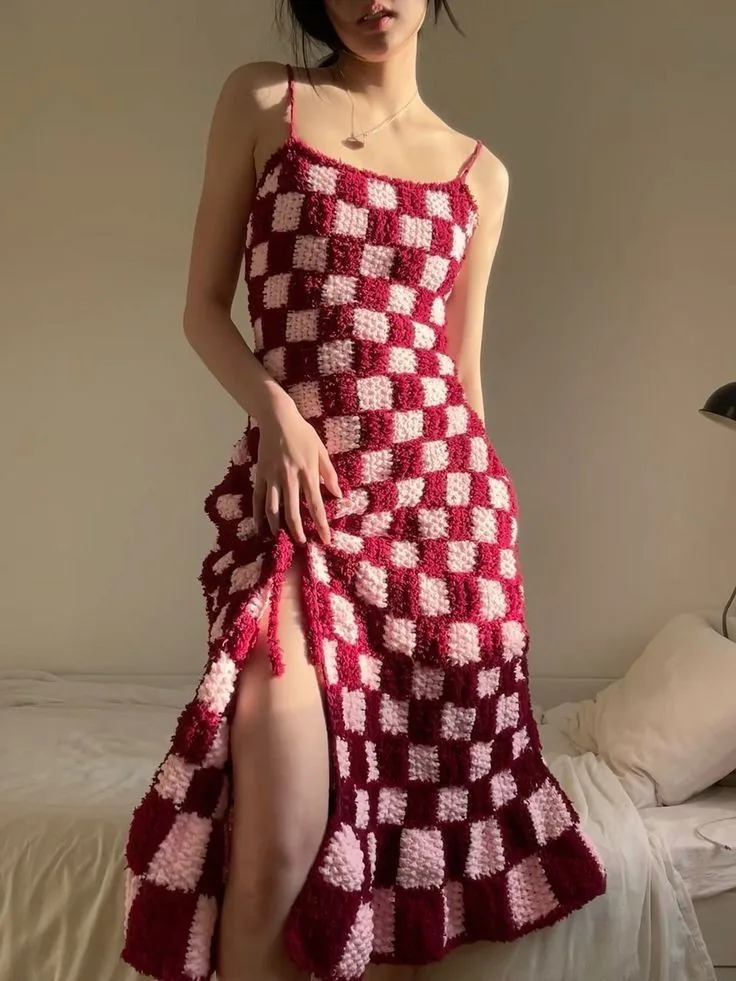
This red and white checked dress combines red and white with the form shown in the reference. The original construction below simplifies details that cannot be reliably recovered from a photograph; it does not promise an exact chart match.
Materials, gauge and size
Smooth DK clothing yarn, approximately 600–1,100 g for an adult cardigan or dress, 250–500 g for a small measured cardigan, or 350–700 g for a wrap. Colors: red and white. Hook: 3.5–4 mm. These are estimates: weigh a sample, multiply by component count and add 15–20% for joining and adjustments.
Also use a yarn needle, scissors, stitch markers, measuring tape and blocking pins. Add buttons or lining as specified. Appliques and chart references are independently interpreted.
Gauge and sizing: Use 16 dc × 9 rows per 10 cm as a provisional sample only. Measure a washed square or mesh panel and fit from actual chest/hip plus stated ease; examples are not professionally graded sizes.
Measured square-grid dress
- This is an untested straight crochet dress with a decorative checked layout, not an exact reconstruction of the photographed fitted dress. Make one washed granny square with width W. Example: W = 10 cm gives a body ring of ten squares and 100 cm circumference; use hip or bust, whichever is larger, plus 4–8 cm ease to choose the actual circumference.
- Make sixty granny squares, thirty red and thirty white, using the counted square below. Join six horizontal rings of ten squares, alternating colors in each ring and reversing them on adjacent rings. Join the rings vertically into a 60 cm-long tube at W = 10 cm. Keep the two front-center squares of the lowest two rings unjoined along their shared vertical edge to create a 20 cm slit; reinforce its top.
- Top bodice: choose the front five-square upper edge and back five-square upper edge. Pick up one sc per existing outside stitch, marking both side points. Work two sc rounds around the whole top, then make four straps, each 6 sc wide and 18 cm long. Sew front and back strap ends together over the shoulders after trying on; reposition from the example to suit actual shoulder spacing.
- For a firmer top edge thread a narrow fabric ribbon through the back of the sc band and sew its ends securely. Outline the slit with two sc rows and three sc at lower corners. Add a separately sewn lining, keeping it above or clear of the slit. The straight tube has no hidden waist shaping; use a removable belt if desired.
Classic granny square
- Round 1: In a magic ring work (3 dc, ch 2) four times; join. [12 dc, four ch-2 corners]
- Round 2: In every corner work (3 dc, ch 2, 3 dc); ch 1 between corner groups. [24 dc, four ch-2 corners and four ch-1 side spaces]
- Round 3: Work (3 dc, ch 2, 3 dc) in each corner and 3 dc in each side ch-1 space, separating every group with ch 1 except within the ch-2 corners. [36 dc, four corners and eight side ch-1 spaces]
- Rounds 4–5: Repeat Round 3, placing one 3-dc group in each side space. Round 4 has 48 dc and twelve side spaces; Round 5 has 60 dc and sixteen side spaces. Both have four ch-2 corners.
- Round 6: Sc in each dc and 1 sc in each side ch-1 space; work (sc, ch 2, sc) in each corner. [84 sc and four ch-2 corners; 21 sc per side] Block square without pulling the holes out of shape.
Assembly and finishing
- Check all counts before joining. Weave ends through several stitches in three directions. Sew point joins more than once and distribute tension evenly.
- Wash a sample using the yarn care instructions, block gently and allow it to dry completely. Recheck fit or motif size after washing. These original patterns are photo-inspired and physically untested; they do not reproduce a verified photographed chart.
3. Colorful Applique Granny Cardigan
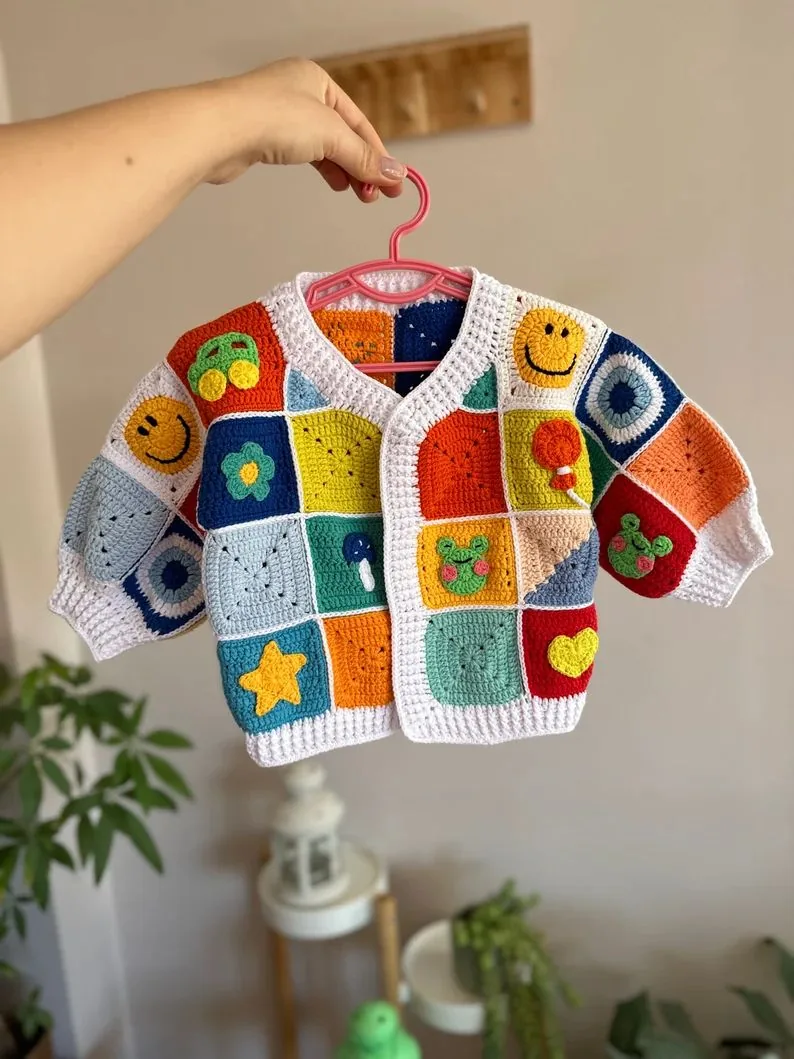
This colorful applique granny cardigan combines red, blue, gold, green and white with the form shown in the reference. The original construction below simplifies details that cannot be reliably recovered from a photograph; it does not promise an exact chart match.
Materials, gauge and size
Smooth DK clothing yarn, approximately 600–1,100 g for an adult cardigan or dress, 250–500 g for a small measured cardigan, or 350–700 g for a wrap. Colors: red, blue, gold, green and white. Hook: 3.5–4 mm. These are estimates: weigh a sample, multiply by component count and add 15–20% for joining and adjustments.
Also use a yarn needle, scissors, stitch markers, measuring tape and blocking pins. Add buttons or lining as specified. Appliques and chart references are independently interpreted.
Gauge and sizing: Use 16 dc × 9 rows per 10 cm as a provisional sample only. Measure a washed square or mesh panel and fit from actual chest/hip plus stated ease; examples are not professionally graded sizes.
Classic granny square
- Round 1: In a magic ring work (3 dc, ch 2) four times; join. [12 dc, four ch-2 corners]
- Round 2: In every corner work (3 dc, ch 2, 3 dc); ch 1 between corner groups. [24 dc, four ch-2 corners and four ch-1 side spaces]
- Round 3: Work (3 dc, ch 2, 3 dc) in each corner and 3 dc in each side ch-1 space, separating every group with ch 1 except within the ch-2 corners. [36 dc, four corners and eight side ch-1 spaces]
- Rounds 4–5: Repeat Round 3, placing one 3-dc group in each side space. Round 4 has 48 dc and twelve side spaces; Round 5 has 60 dc and sixteen side spaces. Both have four ch-2 corners.
- Round 6: Sc in each dc and 1 sc in each side ch-1 space; work (sc, ch 2, sc) in each corner. [84 sc and four ch-2 corners; 21 sc per side] Block square without pulling the holes out of shape.
Measured fifty-square cardigan
- Make and wash one square, measuring width W. This layout gives approximately 8W around the body before front bands. At W = 12 cm it is about 96 cm; at W = 8 cm it is about 64 cm. Choose W from actual chest plus 6–10 cm ease, then divide by eight. The smaller colorful reference is not assigned an age size.
- Make fifty squares: back sixteen in a 4 × 4 grid; two fronts eight each in 2 × 4 grids; two sleeves nine each in 3 × 3 grids. Whipstitch matching outer edges. Sew each front’s outside one-square top edge to the corresponding outside square of the back, leaving the middle two back squares for the neck.
- Sew each side from hem up, leaving the top 1.5W open as an armhole. Each sleeve top is 3W wide, matching the two 1.5W armhole edges; sew it around the opening, then sew the sleeve long edge. Pin and try on before permanent seams. At W = 12 cm the body is 48 cm long before bands and sleeve 36 cm long.
- Work four sc rows along both fronts and around the back neck, one sc per exposed stitch and adjusting at square corners to keep the band flat. On Row 3 of one front make three evenly spaced buttonholes by replacing three sc with ch 3; on Row 4 work three sc in each hole. Sew matching buttons opposite. Work three sc rounds around each cuff and two around the lower hem.
- With the center color work 10 sc into a magic ring; join [10]. With the petal color repeat (sl st in next sc, 5 dc in next sc) five times. [Five petals] Fasten off with a sewing tail; weave or sew both ends securely.
Colorful applique options
- Use a different bright center on each square, keeping the last round white. Make ten small five-petal flowers and sew one onto ten selected squares, securing every center and two petal tips. For a simple smile motif embroider two eyes and a curved mouth directly on the square. Do not use loose plastic eyes or unsewn felt shapes on a small-child garment.
Assembly and finishing
- Check all counts before joining. Weave ends through several stitches in three directions. Sew point joins more than once and distribute tension evenly.
- Wash a sample using the yarn care instructions, block gently and allow it to dry completely. Recheck fit or motif size after washing. These original patterns are photo-inspired and physically untested; they do not reproduce a verified photographed chart.
4. Orange Butterfly Motif Wrap
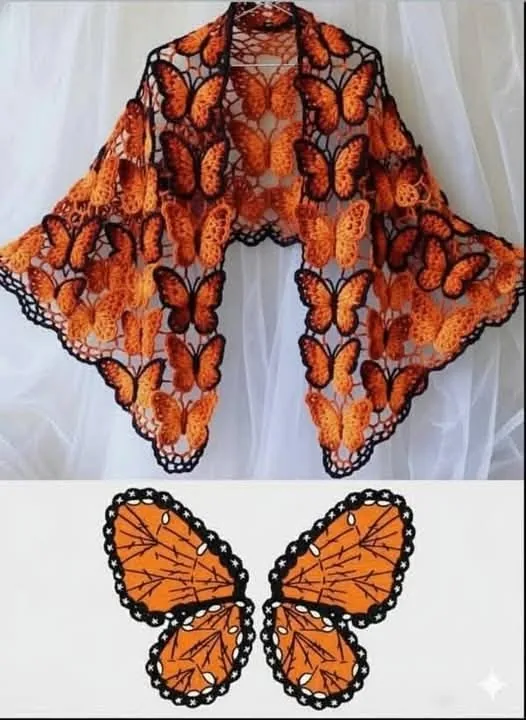
This orange butterfly motif wrap combines orange and black with the form shown in the reference. The original construction below simplifies details that cannot be reliably recovered from a photograph; it does not promise an exact chart match.
Materials, gauge and size
Smooth DK clothing yarn, approximately 600–1,100 g for an adult cardigan or dress, 250–500 g for a small measured cardigan, or 350–700 g for a wrap. Colors: orange and black. Hook: 3.5–4 mm. These are estimates: weigh a sample, multiply by component count and add 15–20% for joining and adjustments.
Also use a yarn needle, scissors, stitch markers, measuring tape and blocking pins. Add buttons or lining as specified. Appliques and chart references are independently interpreted.
Gauge and sizing: Use 16 dc × 9 rows per 10 cm as a provisional sample only. Measure a washed square or mesh panel and fit from actual chest/hip plus stated ease; examples are not professionally graded sizes.
Four-wing butterfly motif
- Ch 5 and join to form a ring. Round 1: (sc in ring, ch 7) four times; join to first sc [4 anchors, 4 loops]. Mark the first two loops as upper wings and the next two as lower wings.
- Round 2: in each of the two upper loops work (sc, hdc, 4 dc, 3 tr, 4 dc, hdc, sc); sl st in the following anchor [15 stitches per upper wing]. In each lower loop work (sc, hdc, 5 dc, hdc, sc); sl st in its following anchor [9 stitches per lower wing]. Fasten off [48 wing stitches plus 4 anchor sl sts].
- Round 3: join at an upper wing base. Sc in each of that wing’s 15 stitches, adding a ch-3 picot after its eighth stitch (ch 3, sl st in first of these chains). Repeat for the other upper wing. Sc in each lower wing’s nine stitches, adding a picot after its fifth stitch. Sl st across the four old anchor joins as you reach them; no extra stitches in those joins [48 sc, 4 picots and 4 anchor sl sts].
- Body: ch 13. Row 1: sc in second chain and across [12]. Row 2: sc across [12]. Fold the strip lengthwise, sew the long edges together without stuffing, and stitch it down the motif center. Arrange upper wings above lower wings before fixing it. Antennae: join at body top, ch 9, sl st along 8 chains, sl st in body; repeat once [two antennae]. Embroider a small knot at each tip.
Project variation and assembly
- Make one lilac motif. For a lighter second example use ch 9 for each wing loop but keep the Round-2 stitches unchanged, spreading them evenly. This enlarges the openings rather than producing an exact alternate-size pattern.
- Block with the two upper wings slightly higher than the body top and lower wings angled down. Sew onto fabric through the body and wing tips, or reinforce two tip connections per neighboring motif for a lace strip.
Assembly and finishing
- Check all counts before joining. Weave ends through several stitches in three directions. Sew point joins more than once and distribute tension evenly.
- Wash a sample using the yarn care instructions, block gently and allow it to dry completely. Recheck fit or motif size after washing. These original patterns are photo-inspired and physically untested; they do not reproduce a verified photographed chart.
Thirty-six-motif triangle wrap
- Make 36 butterfly motifs in orange with black outlines and bodies. Arrange eight in the top row, seven below, then six, five, four, three, two and one [36 total]. The upper wings face upward on every motif. Block them to equal width W; top wingspan is roughly 8W plus the chosen connecting gaps.
- Sew neighboring side wing tips at two points per horizontal join. Between rows, sew the lower tips of each upper butterfly to two upper tips of the butterfly beneath. Where a gap remains bridge with ch 5–9 and work one sc per chain on the return. Keep corresponding bridges equal and add a second securing thread at every structural join.
- Outline the complete triangle with a loose black sc edge, working one sc per chain or motif edge stitch and three sc at outward points. For a neckline tie make two cords ch 51 with 50 sl sts, sewing them to the top corners. This triangular motif wrap interprets the butterfly reference as a shawl rather than promising the exact photographed cape construction.
Assembly and finishing
- Check all counts before joining. Weave ends through several stitches in three directions. Sew point joins more than once and distribute tension evenly.
- Wash a sample using the yarn care instructions, block gently and allow it to dry completely. Recheck fit or motif size after washing. These original patterns are photo-inspired and physically untested; they do not reproduce a verified photographed chart.
5. Butterfly-Wing Capelet
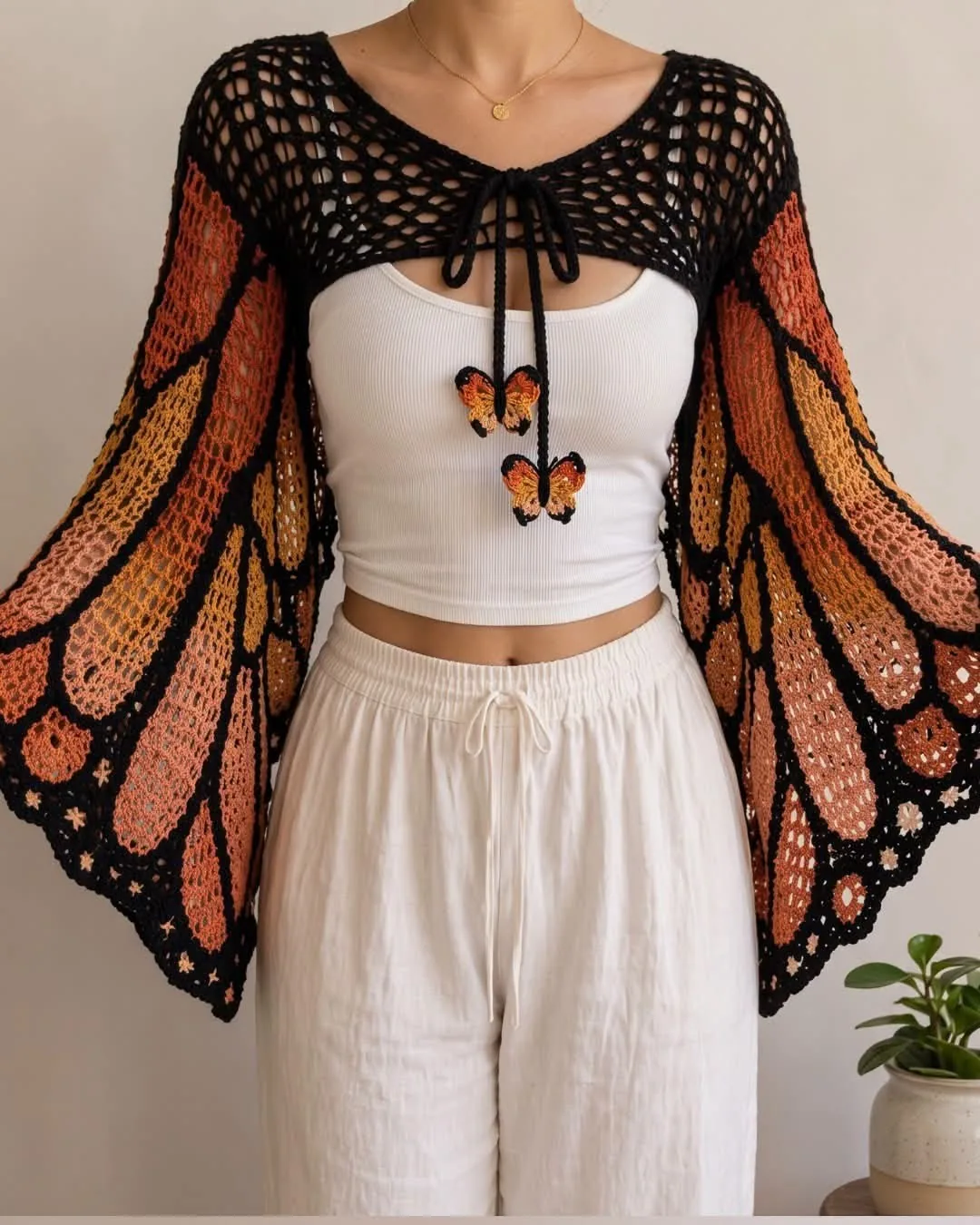
This butterfly-wing capelet combines orange and black with the form shown in the reference. The original construction below simplifies details that cannot be reliably recovered from a photograph; it does not promise an exact chart match.
Materials, gauge and size
Smooth DK clothing yarn, approximately 600–1,100 g for an adult cardigan or dress, 250–500 g for a small measured cardigan, or 350–700 g for a wrap. Colors: orange and black. Hook: 3.5–4 mm. These are estimates: weigh a sample, multiply by component count and add 15–20% for joining and adjustments.
Also use a yarn needle, scissors, stitch markers, measuring tape and blocking pins. Add buttons or lining as specified. Appliques and chart references are independently interpreted.
Gauge and sizing: Use 16 dc × 9 rows per 10 cm as a provisional sample only. Measure a washed square or mesh panel and fit from actual chest/hip plus stated ease; examples are not professionally graded sizes.
Black shoulder band
- Swatch first; at 16 dc per 10 cm, 81 positions are about 50 cm long. Ch 83; Row 1 dc in fourth chain and across [81 including skipped ch 3]. Row 2: ch 3 counts as first dc, turn; (ch 1, skip 1, dc in next) forty times [81 positions]. Row 3: dc in each stitch and hole [81]. Repeat Rows 2–3 through Row 9.
- This band lies across the upper back and around the shoulders, with the ends meeting at the front. Fit it before adding wing panels; add complete pairs of mesh/solid rows for a deeper collar, or alter the odd foundation position count for shoulder length.
Two orange wing triangles
- For each wing ch 4, join ring. Row 1: (3 dc, ch 2, 3 dc) in ring [6 dc]. Every following row: work 3 dc in first stitch, dc across to center, (2 dc, ch 2, 2 dc) in center, dc to last and 3 dc in last. Turning ch 3 counts as the first of the three beginning dc. Counts rise by eight: Rows 2–14 have 14, 22, 30, 38, 46, 54, 62, 70, 78, 86, 94, 102 and 110 dc.
- Work one black sc outline with three sc at each outward point. Embroider five loose black surface-chain veins from the inner top corner toward separated points on the lower edge. The veins are sewn decoration and must not shorten the fabric. Make two matching wings.
- Pin one wing’s top sloping edge to each end-half of the shoulder band, leaving the band center free across the back neck. Distribute any extra wing width as a gentle gather, then sew with reinforced stitches. Add a black tie at each front end: ch 41, sl st along 40 chains. This removable capelet is an original butterfly-wing interpretation, not a tested fitted sleeve pattern.
Assembly and finishing
- Check all counts before joining. Weave ends through several stitches in three directions. Sew point joins more than once and distribute tension evenly.
- Wash a sample using the yarn care instructions, block gently and allow it to dry completely. Recheck fit or motif size after washing. These original patterns are photo-inspired and physically untested; they do not reproduce a verified photographed chart.