84 Crochet Bedspread Color Ideas: Floral, Lace and Texture
43. Teal, Blue, Gold, White Floral Granny-Square Bedspread
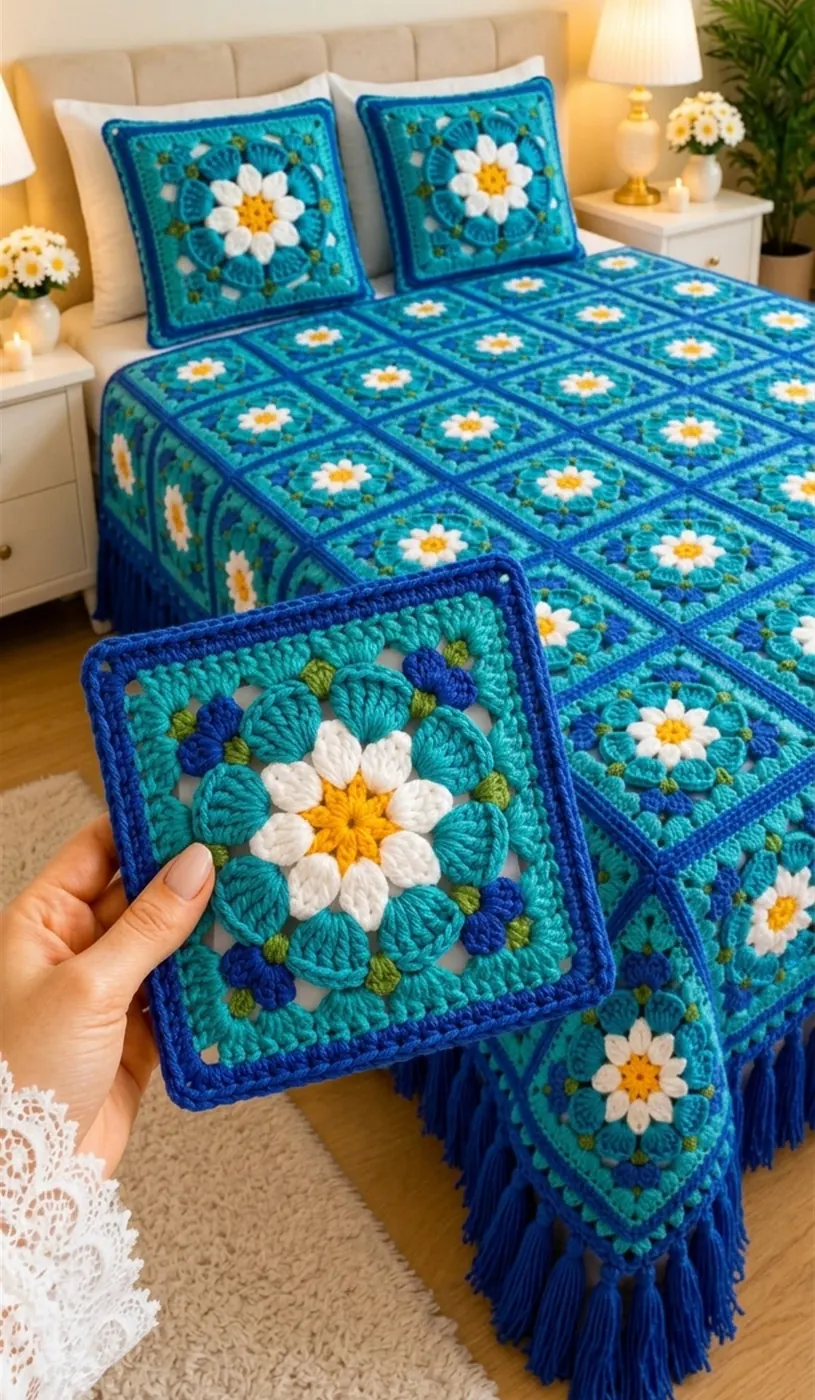
This layered flower squares reference uses teal, blue, gold, white. The palette changes the visual rhythm while the written family construction remains independent of the photograph.
Materials, palette and measured size
Palette: teal, blue, gold, white. Smooth DK cotton or washable wool; 3.5-4.5 mm hook, yarn needle, markers and blocking pins. Allow roughly 1,800-3,500 g for a full cover, confirmed by weighing a washed sample. Gauge, component sizes and full materials planning follow the linked family pattern.
Counted color variation
- Keep the complete family construction: 8-sc center; 8 small petals; 8 outer petals; square frame ends with 60 sc and 4 corners, 15 sc per side.
- Use teal for the main motif or texture and white for the ground or outside frame. In a single-color version both remain the same shade. Change colors at the row or round boundaries in the full pattern, without adding stitches.
- Example plan: 12 columns by 14 rows; 168 main components. Wash and measure the first complete unit, then recalculate coverage from the actual bed instead of treating this example as a guaranteed size.
Complete Layered Flower Squares pattern: counted steps, assembly and finishing
Follow the linked joining method, secure appliques flat and block gently. The photo changes the color reference; it does not establish a new physically tested construction.
44. Pink, Rose, Gold, White Floral Granny-Square Bedspread
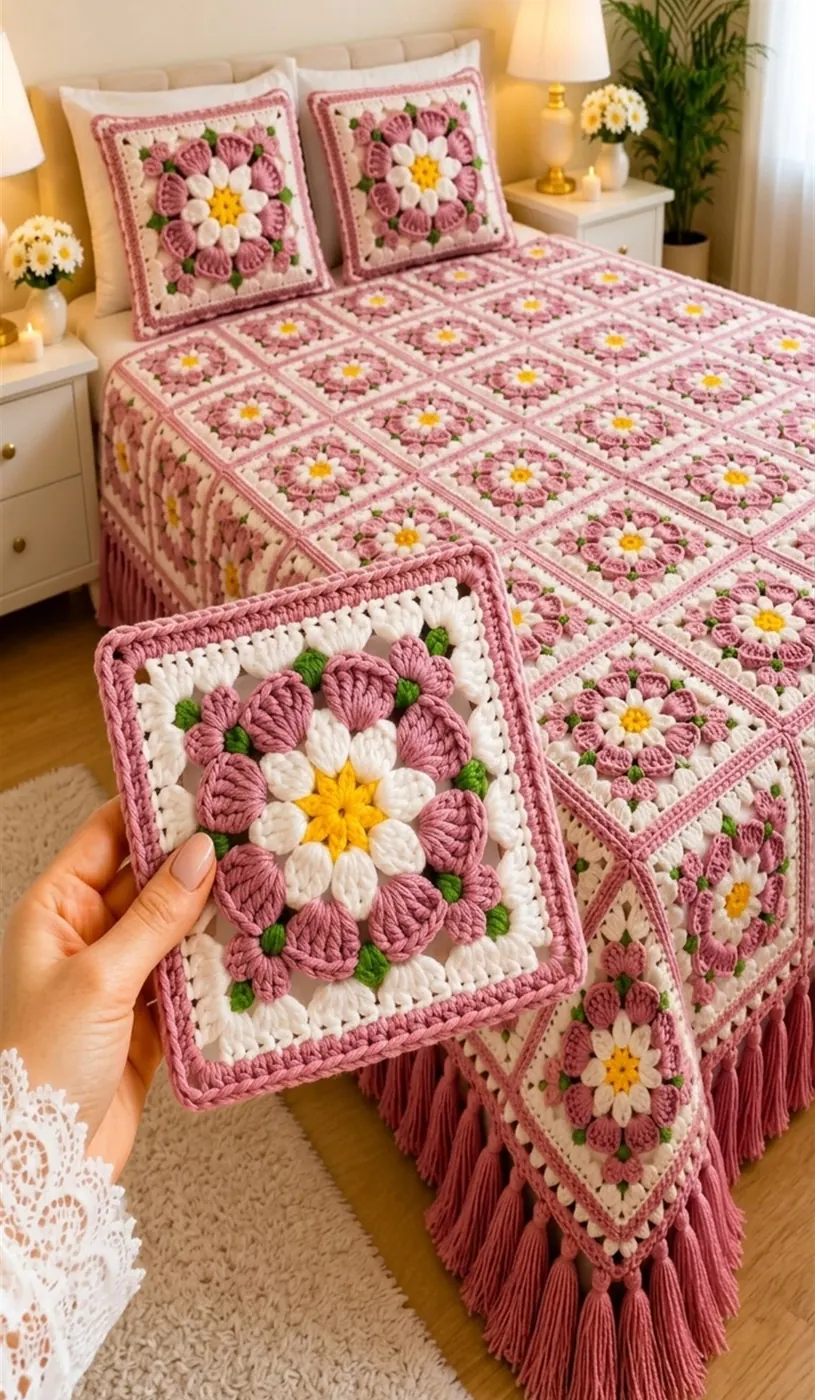
This layered flower squares reference uses pink, rose, gold, white. The palette changes the visual rhythm while the written family construction remains independent of the photograph.
Materials, palette and measured size
Palette: pink, rose, gold, white. Smooth DK cotton or washable wool; 3.5-4.5 mm hook, yarn needle, markers and blocking pins. Allow roughly 1,800-3,500 g for a full cover, confirmed by weighing a washed sample. Gauge, component sizes and full materials planning follow the linked family pattern.
Counted color variation
- Keep the complete family construction: 8-sc center; 8 small petals; 8 outer petals; square frame ends with 60 sc and 4 corners, 15 sc per side.
- Use pink for the main motif or texture and white for the ground or outside frame. In a single-color version both remain the same shade. Change colors at the row or round boundaries in the full pattern, without adding stitches.
- Example plan: 12 columns by 14 rows; 168 main components. Wash and measure the first complete unit, then recalculate coverage from the actual bed instead of treating this example as a guaranteed size.
Complete Layered Flower Squares pattern: counted steps, assembly and finishing
Follow the linked joining method, secure appliques flat and block gently. The photo changes the color reference; it does not establish a new physically tested construction.
45. Royal Blue, Gold, White Floral Granny-Square Bedspread
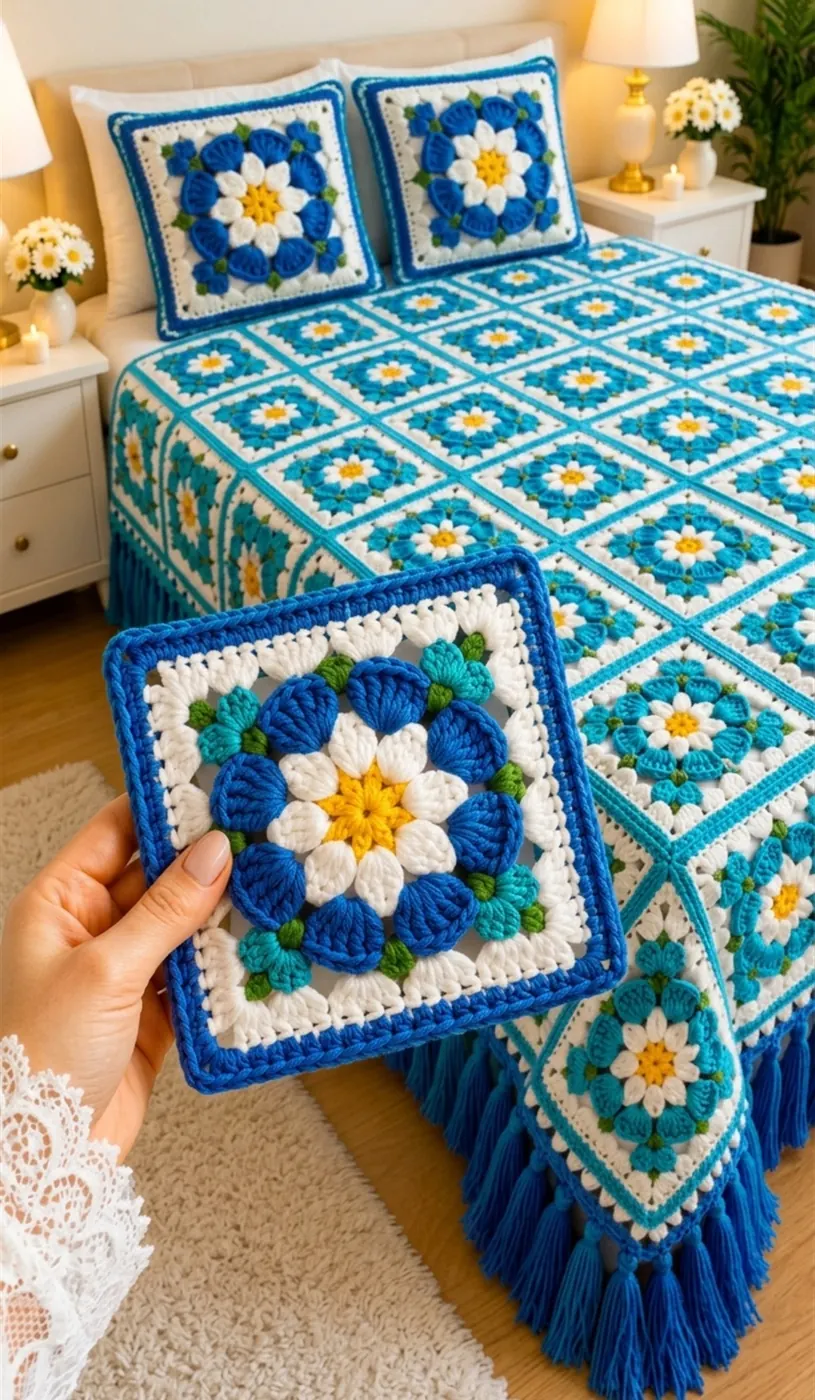
This layered flower squares reference uses royal blue, gold, white. The palette changes the visual rhythm while the written family construction remains independent of the photograph.
Materials, palette and measured size
Palette: royal blue, gold, white. Smooth DK cotton or washable wool; 3.5-4.5 mm hook, yarn needle, markers and blocking pins. Allow roughly 1,800-3,500 g for a full cover, confirmed by weighing a washed sample. Gauge, component sizes and full materials planning follow the linked family pattern.
Counted color variation
- Keep the complete family construction: 8-sc center; 8 small petals; 8 outer petals; square frame ends with 60 sc and 4 corners, 15 sc per side.
- Use royal blue for the main motif or texture and white for the ground or outside frame. In a single-color version both remain the same shade. Change colors at the row or round boundaries in the full pattern, without adding stitches.
- Example plan: 12 columns by 14 rows; 168 main components. Wash and measure the first complete unit, then recalculate coverage from the actual bed instead of treating this example as a guaranteed size.
Complete Layered Flower Squares pattern: counted steps, assembly and finishing
Follow the linked joining method, secure appliques flat and block gently. The photo changes the color reference; it does not establish a new physically tested construction.
46. Sage, Pink, Cream Flower-Border Bedspread
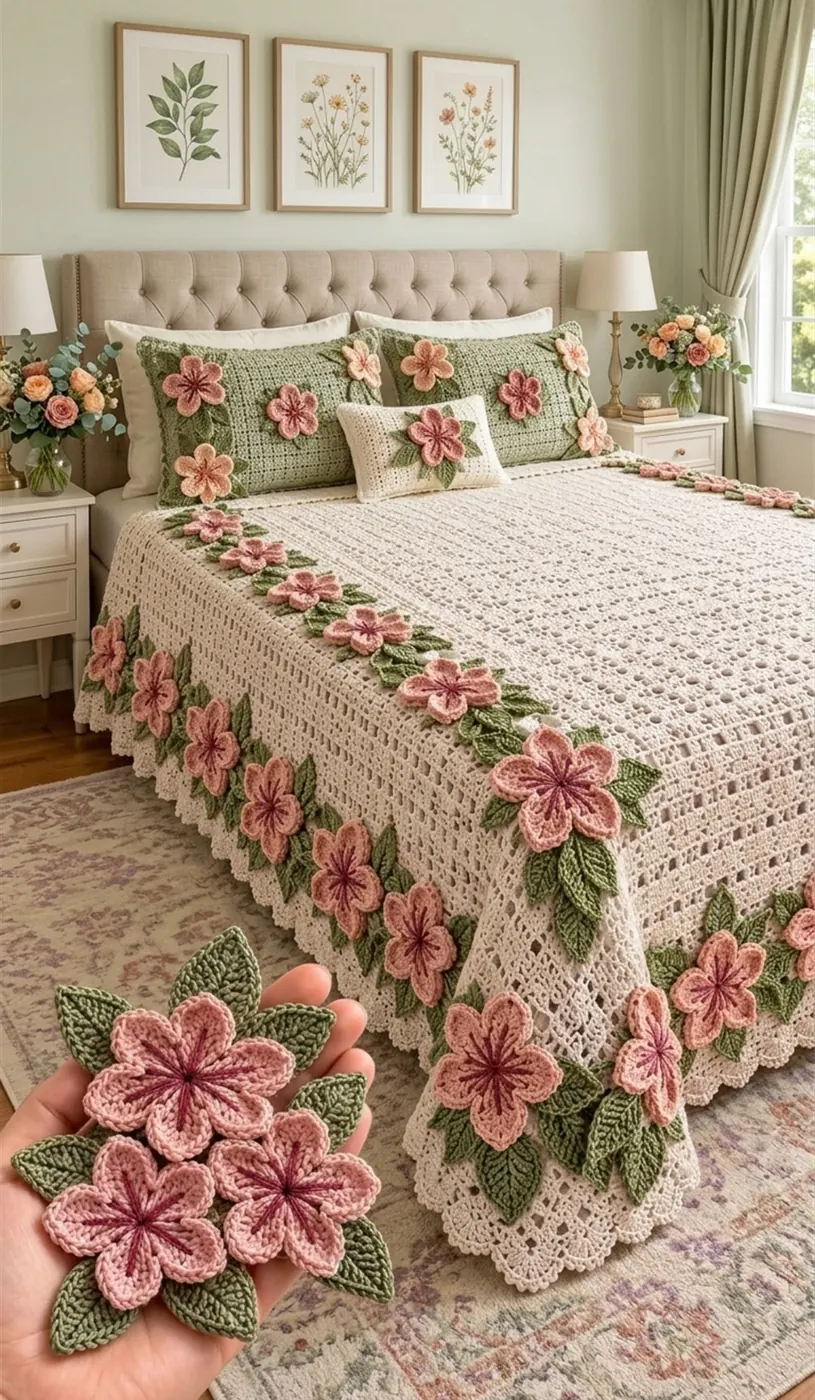
This textured ground with floral border reference uses sage, pink, cream. The palette changes the visual rhythm while the written family construction remains independent of the photograph.
Materials, palette and measured size
Palette: sage, pink, cream. Smooth DK cotton or washable wool; 3.5-4.5 mm hook, yarn needle, markers and blocking pins. Allow roughly 1,800-3,500 g for a full cover, confirmed by weighing a washed sample. Gauge, component sizes and full materials planning follow the linked family pattern.
Counted color variation
- Keep the complete family construction: The trial ground has 121 positions and 150 rows. Full-cover width is recalculated to an odd count. Trim example: 36 six-petal flowers and 72 leaves.
- Use sage for the main motif or texture and cream for the ground or outside frame. In a single-color version both remain the same shade. Change colors at the row or round boundaries in the full pattern, without adding stitches.
- Example plan: one measured rectangular ground, 9 flower clusters on each of 4 sides; 36 main components. Wash and measure the first complete unit, then recalculate coverage from the actual bed instead of treating this example as a guaranteed size.
Complete Textured Ground with Floral Border pattern: counted steps, assembly and finishing
Follow the linked joining method, secure appliques flat and block gently. The photo changes the color reference; it does not establish a new physically tested construction.
47. Forest Green Raised-Rose Bedspread
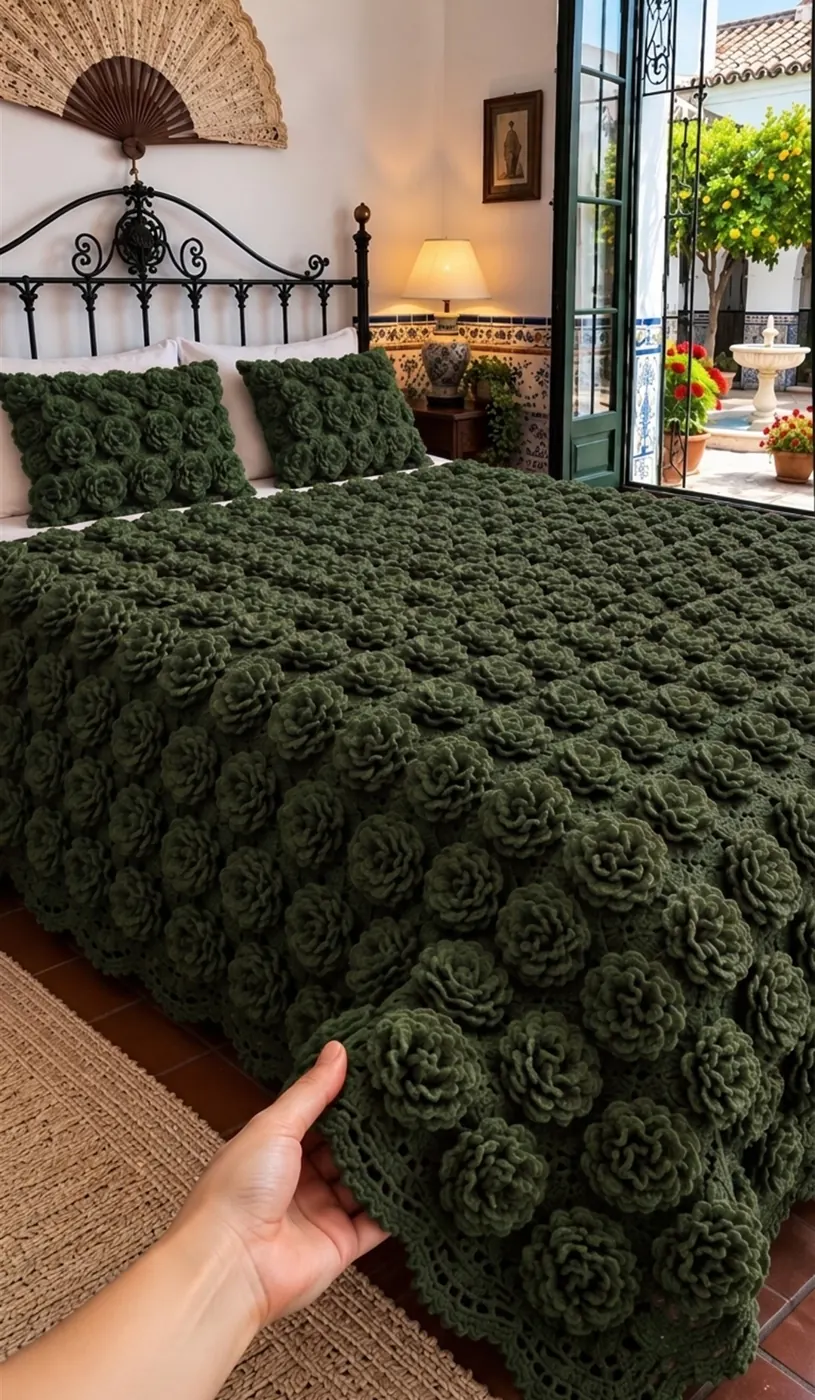
This raised roses on solid squares reference uses forest green. The palette changes the visual rhythm while the written family construction remains independent of the photograph.
Materials, palette and measured size
Palette: forest green. Smooth DK cotton or washable wool; 3.5-4.5 mm hook, yarn needle, markers and blocking pins. Allow roughly 2,500-4,500 g for a full cover, confirmed by weighing a washed sample. Gauge, component sizes and full materials planning follow the linked family pattern.
Counted color variation
- Keep the complete family construction: Ground ends with 76 dc and 4 corners. Each rolled rose starts with 40 sc and ends with 20 petals: 140 dc and 20 sl sts.
- Use forest green for the main motif or texture and forest green for the ground or outside frame. In a single-color version both remain the same shade. Change colors at the row or round boundaries in the full pattern, without adding stitches.
- Example plan: 12 columns by 14 rose-covered squares; 168 main components. Wash and measure the first complete unit, then recalculate coverage from the actual bed instead of treating this example as a guaranteed size.
Complete Raised Roses on Solid Squares pattern: counted steps, assembly and finishing
Follow the linked joining method, secure appliques flat and block gently. The photo changes the color reference; it does not establish a new physically tested construction.
48. Royal Blue Raised-Rose Bedspread
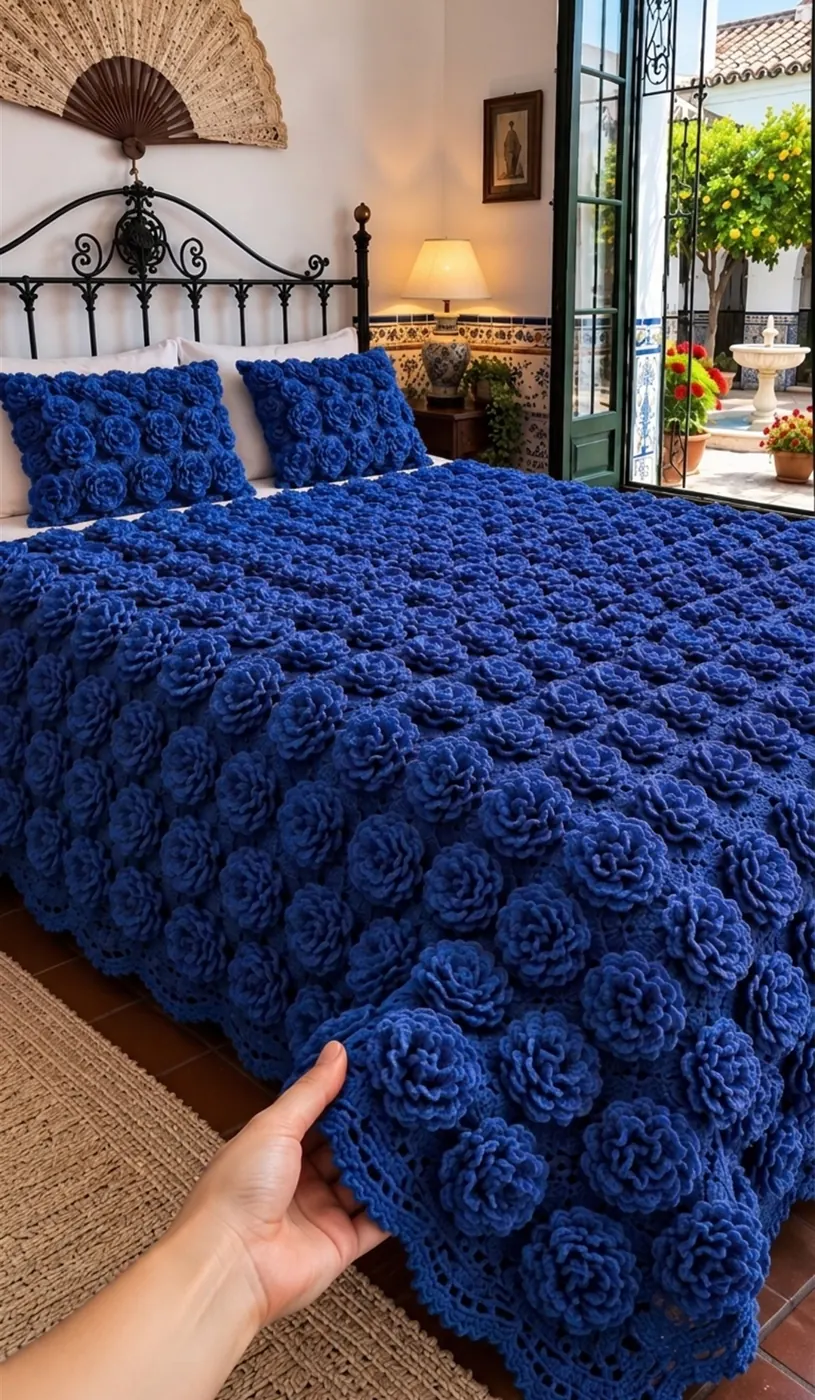
This raised roses on solid squares reference uses royal blue. The palette changes the visual rhythm while the written family construction remains independent of the photograph.
Materials, palette and measured size
Palette: royal blue. Smooth DK cotton or washable wool; 3.5-4.5 mm hook, yarn needle, markers and blocking pins. Allow roughly 2,500-4,500 g for a full cover, confirmed by weighing a washed sample. Gauge, component sizes and full materials planning follow the linked family pattern.
Counted color variation
- Keep the complete family construction: Ground ends with 76 dc and 4 corners. Each rolled rose starts with 40 sc and ends with 20 petals: 140 dc and 20 sl sts.
- Use royal blue for the main motif or texture and royal blue for the ground or outside frame. In a single-color version both remain the same shade. Change colors at the row or round boundaries in the full pattern, without adding stitches.
- Example plan: 12 columns by 14 rose-covered squares; 168 main components. Wash and measure the first complete unit, then recalculate coverage from the actual bed instead of treating this example as a guaranteed size.
Complete Raised Roses on Solid Squares pattern: counted steps, assembly and finishing
Follow the linked joining method, secure appliques flat and block gently. The photo changes the color reference; it does not establish a new physically tested construction.
49. Sage Raised Diamond-Lattice Bedspread
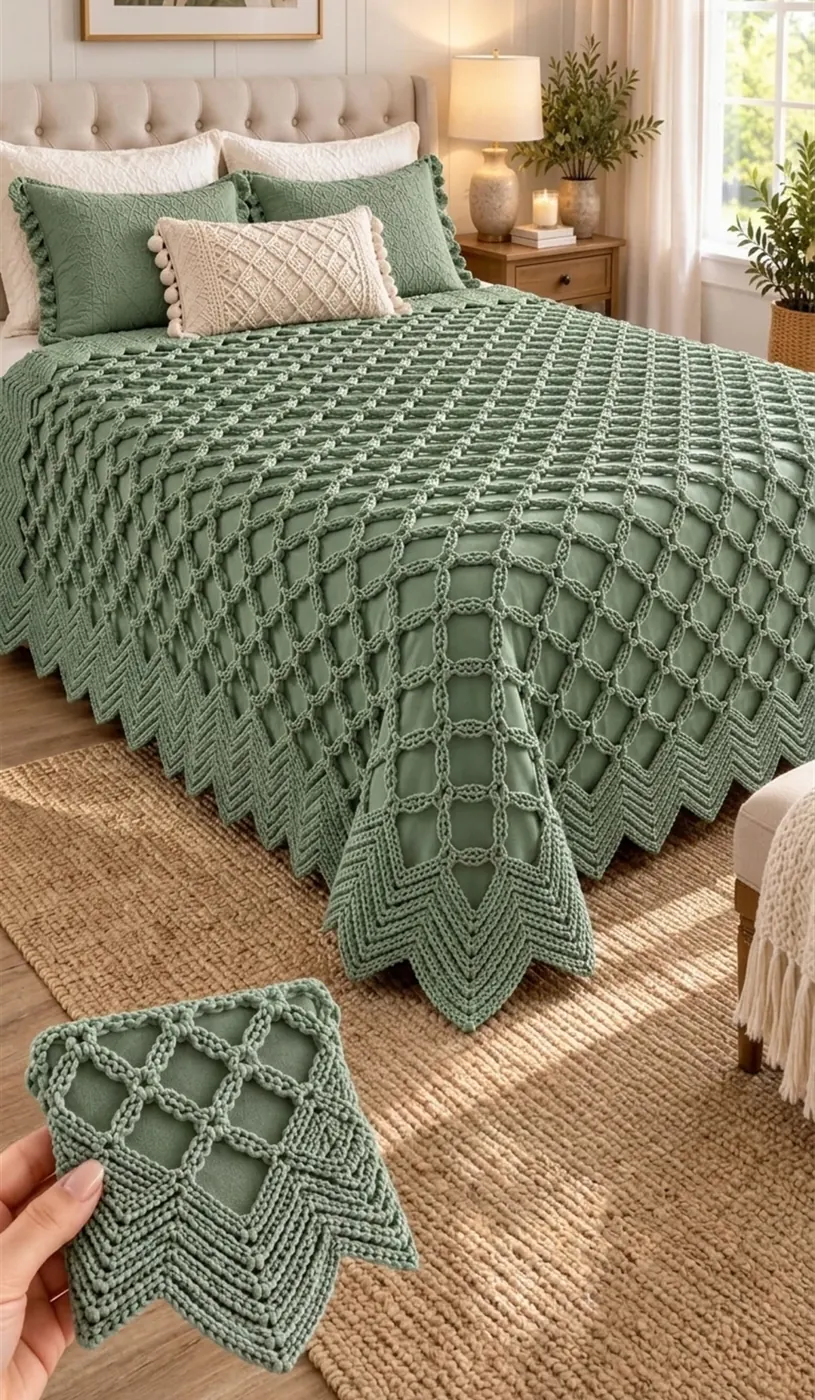
This surface diamond-lattice cover reference uses sage. The palette changes the visual rhythm while the written family construction remains independent of the photograph.
Materials, palette and measured size
Palette: sage. Smooth DK cotton or washable wool; 3.5-4.5 mm hook, yarn needle, markers and blocking pins. Allow roughly 1,800-3,500 g for a full cover, confirmed by weighing a washed sample. Gauge, component sizes and full materials planning follow the linked family pattern.
Complete pattern: Surface Diamond-Lattice Cover
Solid cover ground
- Use a washed sc gauge near 20 stitches by 22 rows per 10 cm. Full-cover example: ch 402. Row 1 sc in second chain and across [401]. Rows 2-440: ch 1, turn; sc across [401]. At the planning gauge this is about 200.5 by 200 cm before edging; measure the actual fabric.
- For a smaller trial use ch 202 and 201 sc across for 220 rows. Keep the same surface-grid spacing below. To resize multiply required width by stitches per cm and required length by rows per cm; a plain-sc ground may use any positive stitch and row counts.
Raised diagonal overlay
- With removable markers mark a grid every twelve stitches across and twelve rows down, leaving about six stitches or rows unmarked at the outer edges where possible. Join the overlay yarn at a grid intersection and surface sl st diagonally to the next intersection, moving one base stitch across and one row down for each step [12 surface sl sts per complete segment].
- Continue parallel diagonals across the ground, then add a second set running in the opposite direction to form diamonds. Keep each surface loop loose so it sits above the ground rather than shortening it. Stitch through the crossing points to secure them. Partial edge segments stop at the border and may have fewer than twelve sl sts.
- Work two sc outline rounds, three sc at corners, and optionally a final edge (skip 1, 5 dc in next, skip 1, sl st in next), using plain sc for incomplete corner repeats. This surface-chain version is a counted crochet interpretation of raised diamond texture; it is not the exact post-stitch fabric visible in the photo.
Assembly and finishing
- Check all counts before joining. Weave ends through several stitches in three directions. Sew point joins more than once and distribute tension evenly.
- Wash a sample using the yarn care instructions, block gently and allow it to dry completely. Recheck fit or motif size after washing. These original patterns are photo-inspired and physically untested; they do not reproduce a verified photographed chart.
50. Rust, Cream Butterfly-Applique Bedspread
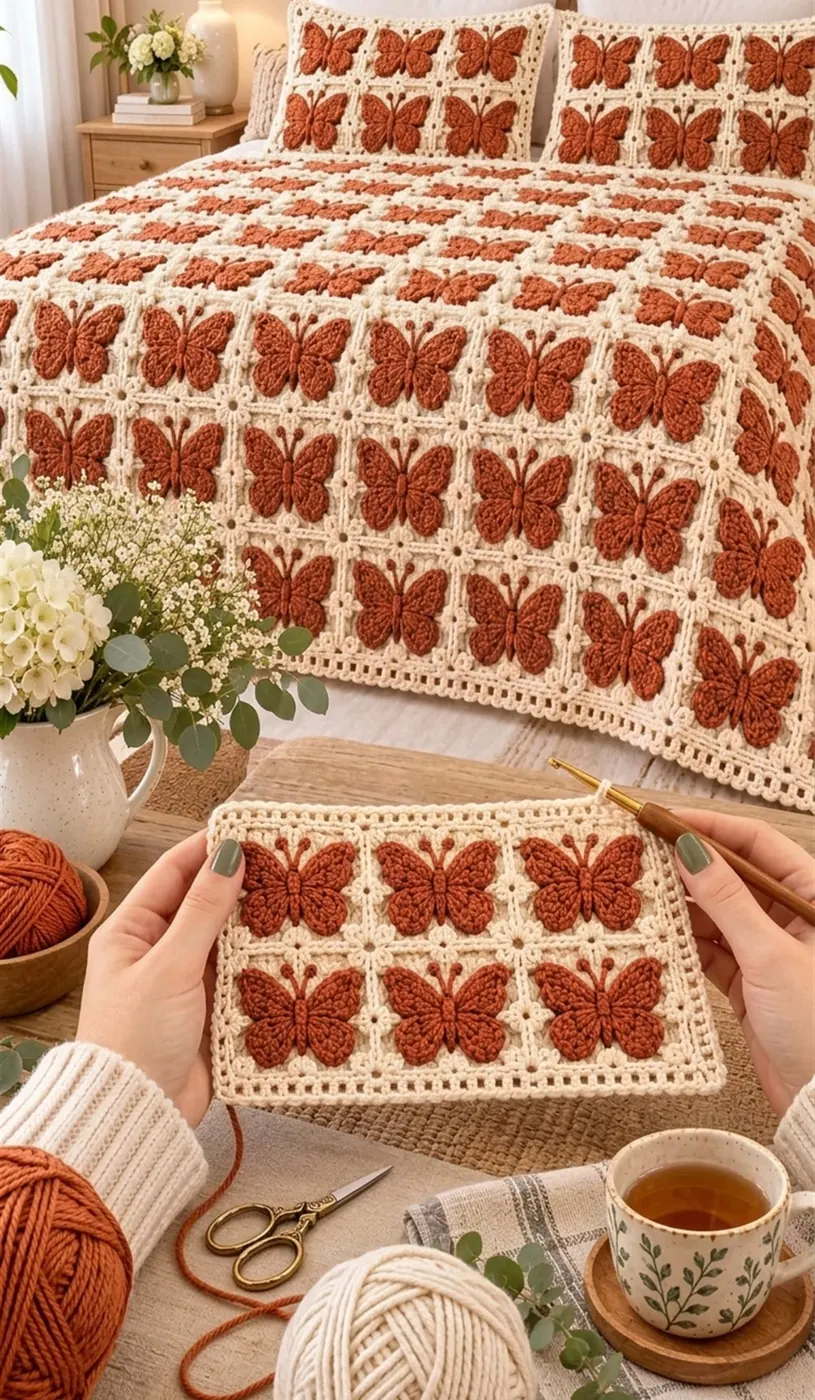
This butterfly appliques on framed squares reference uses rust, cream. The palette changes the visual rhythm while the written family construction remains independent of the photograph.
Materials, palette and measured size
Palette: rust, cream. Smooth DK cotton or washable wool; 3.5-4.5 mm hook, yarn needle, markers and blocking pins. Allow roughly 1,800-3,500 g for a full cover, confirmed by weighing a washed sample. Gauge, component sizes and full materials planning follow the linked family pattern.
Complete pattern: Butterfly Appliques on Framed Squares
Solid framed square
- Round 1: In a magic ring work (3 dc, ch 2) four times; join to the first dc. [12 dc, four ch-2 corners]
- Round 2: Join the second color in a corner. Work (2 dc, ch 2, 2 dc) in each corner and 1 dc in each of the three side stitches; join. [28 dc, four ch-2 corners; seven dc per side]
- Round 3: With the third color, work 1 dc in each dc and (2 dc, ch 2, 2 dc) in each corner; join. [44 dc; 11 per side]
- Round 4: Repeat Round 3. [60 dc; 15 per side]
- Round 5: Repeat Round 3. [76 dc; 19 per side] Block to approximately 12 cm; change hook size if necessary. Each contrasting frame creates a geometric outline.
Four-wing butterfly motif
- Ch 5 and join to form a ring. Round 1: (sc in ring, ch 7) four times; join to first sc [4 anchors, 4 loops]. Mark the first two loops as upper wings and the next two as lower wings.
- Round 2: in each of the two upper loops work (sc, hdc, 4 dc, 3 tr, 4 dc, hdc, sc); sl st in the following anchor [15 stitches per upper wing]. In each lower loop work (sc, hdc, 5 dc, hdc, sc); sl st in its following anchor [9 stitches per lower wing]. Fasten off [48 wing stitches plus 4 anchor sl sts].
- Round 3: join at an upper wing base. Sc in each of that wing’s 15 stitches, adding a ch-3 picot after its eighth stitch (ch 3, sl st in first of these chains). Repeat for the other upper wing. Sc in each lower wing’s nine stitches, adding a picot after its fifth stitch. Sl st across the four old anchor joins as you reach them; no extra stitches in those joins [48 sc, 4 picots and 4 anchor sl sts].
- Body: ch 13. Row 1: sc in second chain and across [12]. Row 2: sc across [12]. Fold the strip lengthwise, sew the long edges together without stuffing, and stitch it down the motif center. Arrange upper wings above lower wings before fixing it. Antennae: join at body top, ch 9, sl st along 8 chains, sl st in body; repeat once [two antennae]. Embroider a small knot at each tip.
Project variation and assembly
- Make one contrast-color motif. For a lighter second example use ch 9 for each wing loop but keep the Round-2 stitches unchanged, spreading them evenly. This enlarges the openings rather than producing an exact alternate-size pattern.
- Block with the two upper wings slightly higher than the body top and lower wings angled down. Sew onto fabric through the body and wing tips, or reinforce two tip connections per neighboring motif for a lace strip.
Assembly and finishing
- Check all counts before joining. Weave ends through several stitches in three directions. Sew point joins more than once and distribute tension evenly.
- Wash a sample using the yarn care instructions, block gently and allow it to dry completely. Recheck fit or motif size after washing. These original patterns are photo-inspired and physically untested; they do not reproduce a verified photographed chart.
One butterfly per bedspread square
- Make 168 complete butterflies and 168 framed grounds for the twelve-column by fourteen-row example. Use rust for butterfly wings and cream for the frame, or select another contrasting pair. If the butterfly covers the joining border, use a finer hook or thread for that component before making the full set.
- Place each body vertically in the square center. Sew the body and the full outer wing outlines flat, leaving the frame loops free. Embroider antenna tips instead of attaching loose beads. Whipstitch matching square edges and work two sc outline rounds with (sc, ch 2, sc) at the four outside corners. A cushion front needs its own matching panel and fabric backing.
Assembly and finishing
- Check all counts before joining. Weave ends through several stitches in three directions. Sew point joins more than once and distribute tension evenly.
- Wash a sample using the yarn care instructions, block gently and allow it to dry completely. Recheck fit or motif size after washing. These original patterns are photo-inspired and physically untested; they do not reproduce a verified photographed chart.
51. Sage, Ivory Floral Granny-Square Bedspread
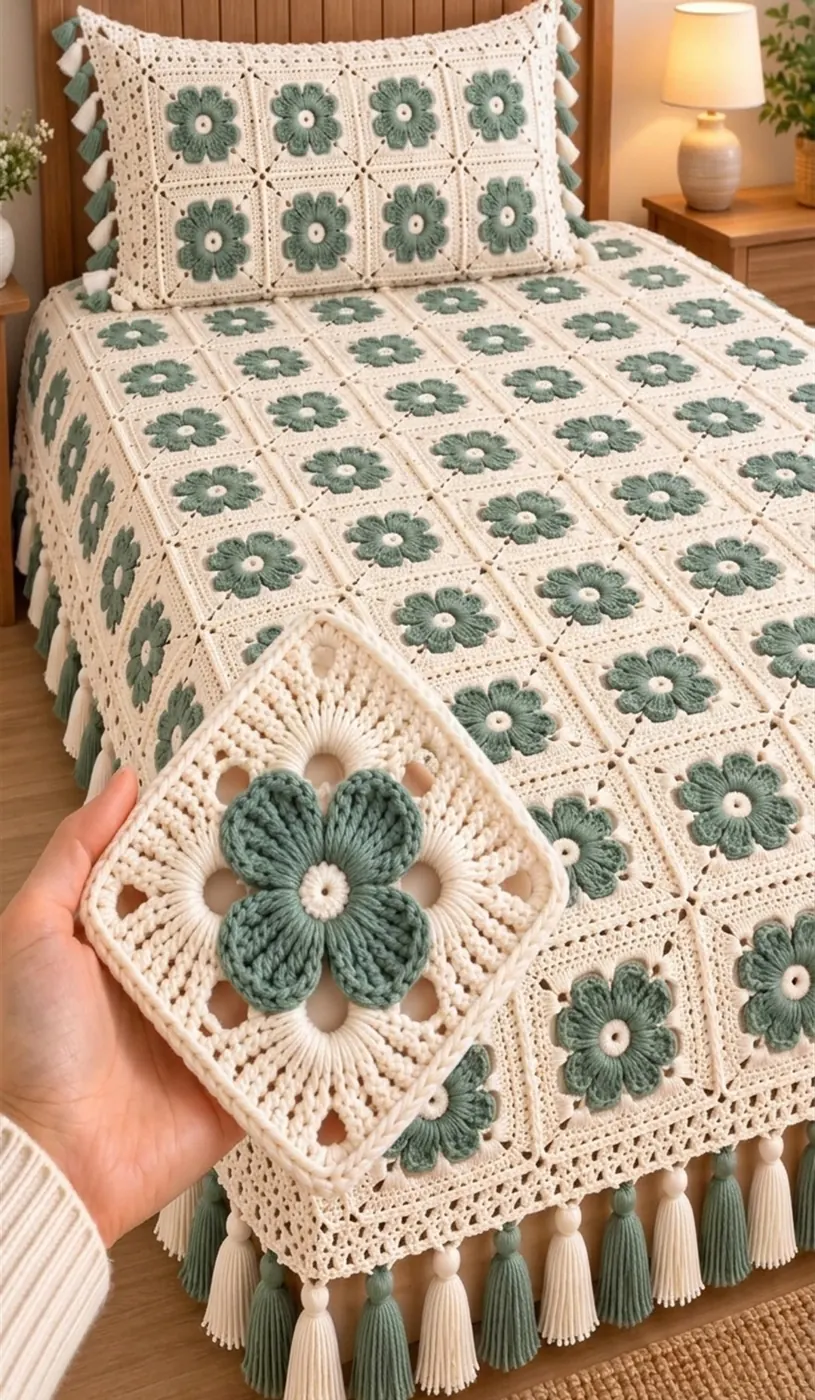
This layered flower squares reference uses sage, ivory. The palette changes the visual rhythm while the written family construction remains independent of the photograph.
Materials, palette and measured size
Palette: sage, ivory. Smooth DK cotton or washable wool; 3.5-4.5 mm hook, yarn needle, markers and blocking pins. Allow roughly 1,800-3,500 g for a full cover, confirmed by weighing a washed sample. Gauge, component sizes and full materials planning follow the linked family pattern.
Counted color variation
- Keep the complete family construction: 8-sc center; 8 small petals; 8 outer petals; square frame ends with 60 sc and 4 corners, 15 sc per side.
- Use sage for the main motif or texture and ivory for the ground or outside frame. In a single-color version both remain the same shade. Change colors at the row or round boundaries in the full pattern, without adding stitches.
- Example plan: 12 columns by 14 rows; 168 main components. Wash and measure the first complete unit, then recalculate coverage from the actual bed instead of treating this example as a guaranteed size.
Complete Layered Flower Squares pattern: counted steps, assembly and finishing
Follow the linked joining method, secure appliques flat and block gently. The photo changes the color reference; it does not establish a new physically tested construction.
52. Rust, Ivory Floral Granny-Square Bedspread
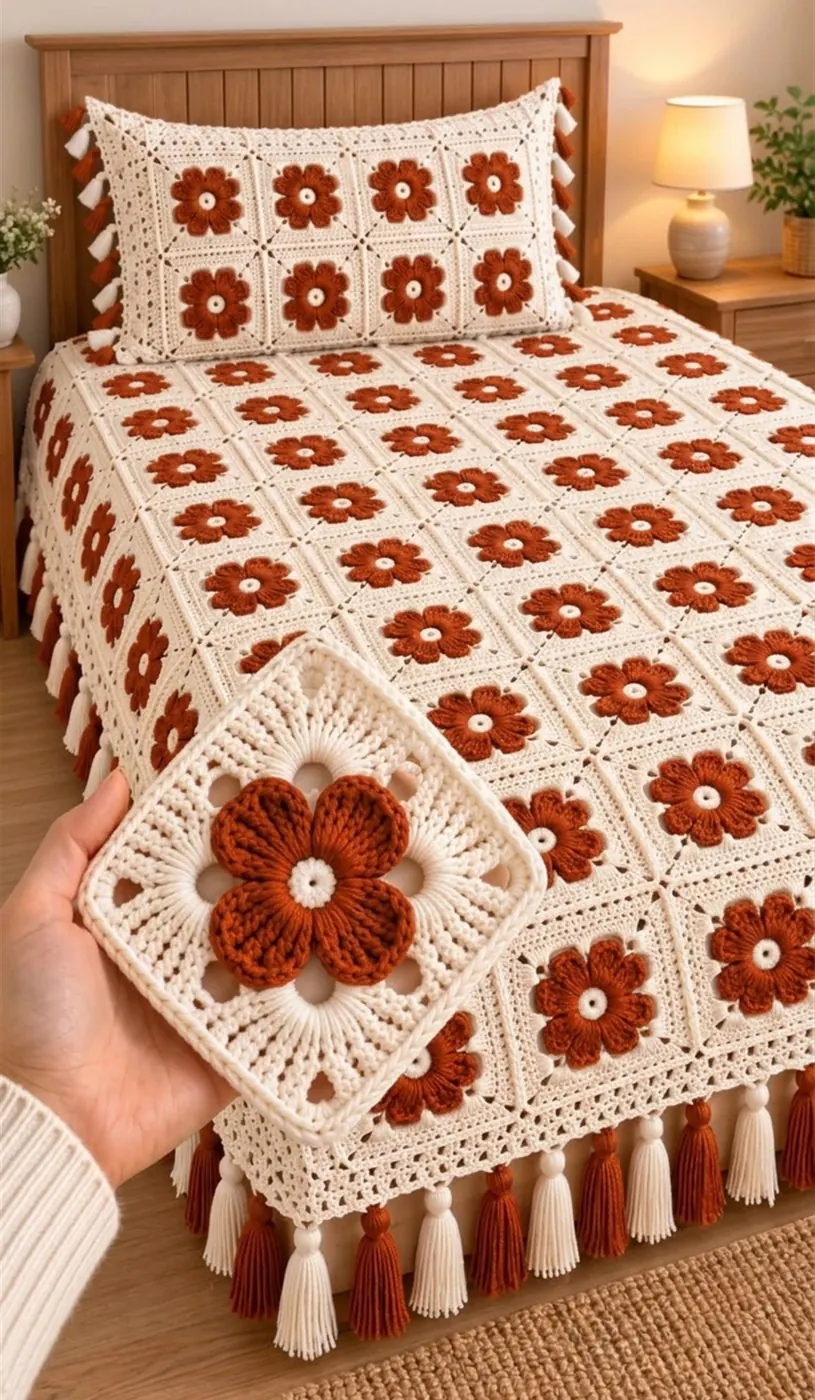
This layered flower squares reference uses rust, ivory. The palette changes the visual rhythm while the written family construction remains independent of the photograph.
Materials, palette and measured size
Palette: rust, ivory. Smooth DK cotton or washable wool; 3.5-4.5 mm hook, yarn needle, markers and blocking pins. Allow roughly 1,800-3,500 g for a full cover, confirmed by weighing a washed sample. Gauge, component sizes and full materials planning follow the linked family pattern.
Counted color variation
- Keep the complete family construction: 8-sc center; 8 small petals; 8 outer petals; square frame ends with 60 sc and 4 corners, 15 sc per side.
- Use rust for the main motif or texture and ivory for the ground or outside frame. In a single-color version both remain the same shade. Change colors at the row or round boundaries in the full pattern, without adding stitches.
- Example plan: 12 columns by 14 rows; 168 main components. Wash and measure the first complete unit, then recalculate coverage from the actual bed instead of treating this example as a guaranteed size.
Complete Layered Flower Squares pattern: counted steps, assembly and finishing
Follow the linked joining method, secure appliques flat and block gently. The photo changes the color reference; it does not establish a new physically tested construction.
53. Navy, Blue, Cream Classic Granny-Square Bedspread
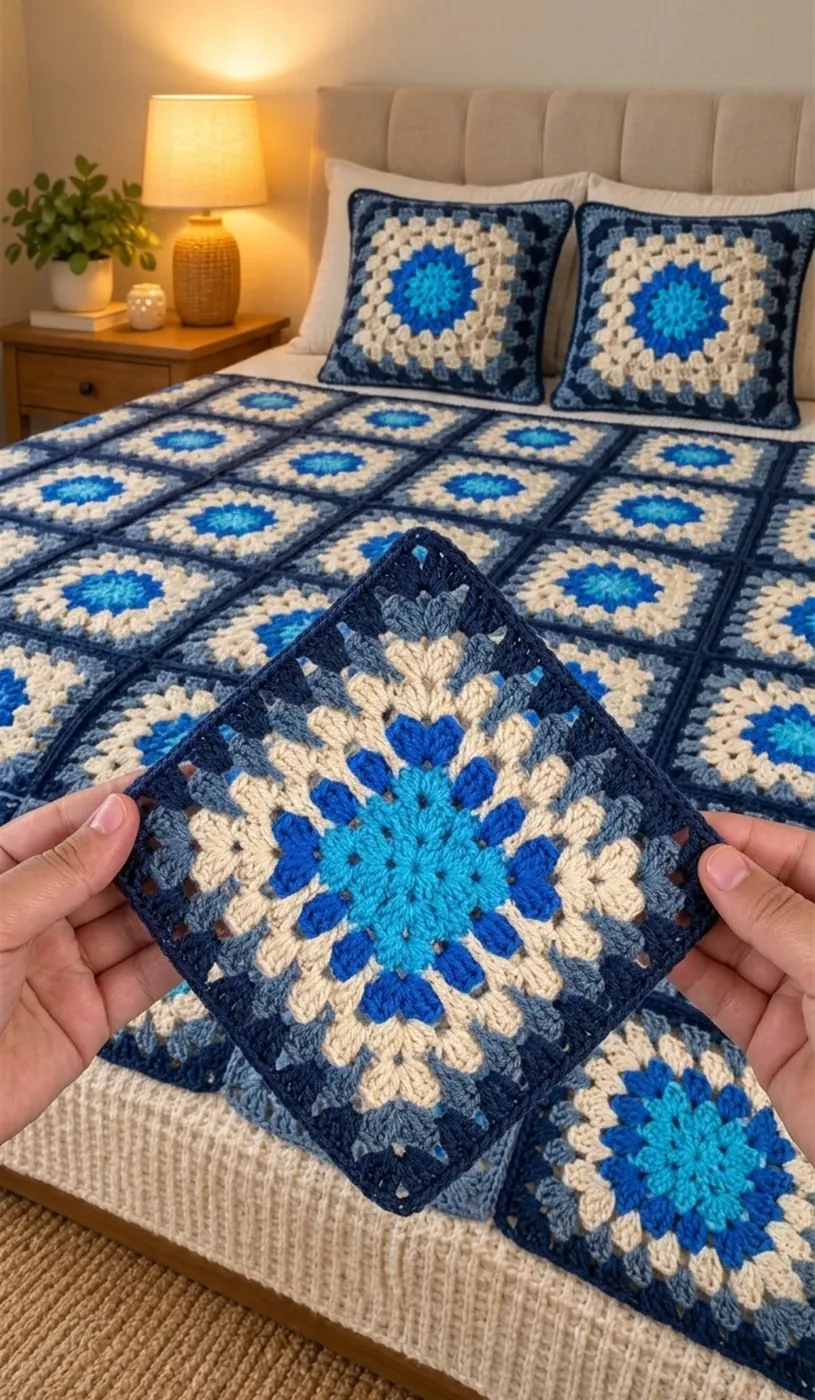
This classic granny squares reference uses navy, blue, cream. The palette changes the visual rhythm while the written family construction remains independent of the photograph.
Materials, palette and measured size
Palette: navy, blue, cream. Smooth DK cotton or washable wool; 3.5-4.5 mm hook, yarn needle, markers and blocking pins. Allow roughly 1,800-3,500 g for a full cover, confirmed by weighing a washed sample. Gauge, component sizes and full materials planning follow the linked family pattern.
Counted color variation
- Keep the complete family construction: Rounds 1-5 have 12, 24, 36, 48 and 60 dc. Round 6 ends with 84 sc and 4 corners, 21 sc per side.
- Use navy for the main motif or texture and cream for the ground or outside frame. In a single-color version both remain the same shade. Change colors at the row or round boundaries in the full pattern, without adding stitches.
- Example plan: 12 columns by 14 rows; 168 main components. Wash and measure the first complete unit, then recalculate coverage from the actual bed instead of treating this example as a guaranteed size.
Complete Classic Granny Squares pattern: counted steps, assembly and finishing
Follow the linked joining method, secure appliques flat and block gently. The photo changes the color reference; it does not establish a new physically tested construction.
54. Navy, Sage, Ivory Classic Granny-Square Bedspread
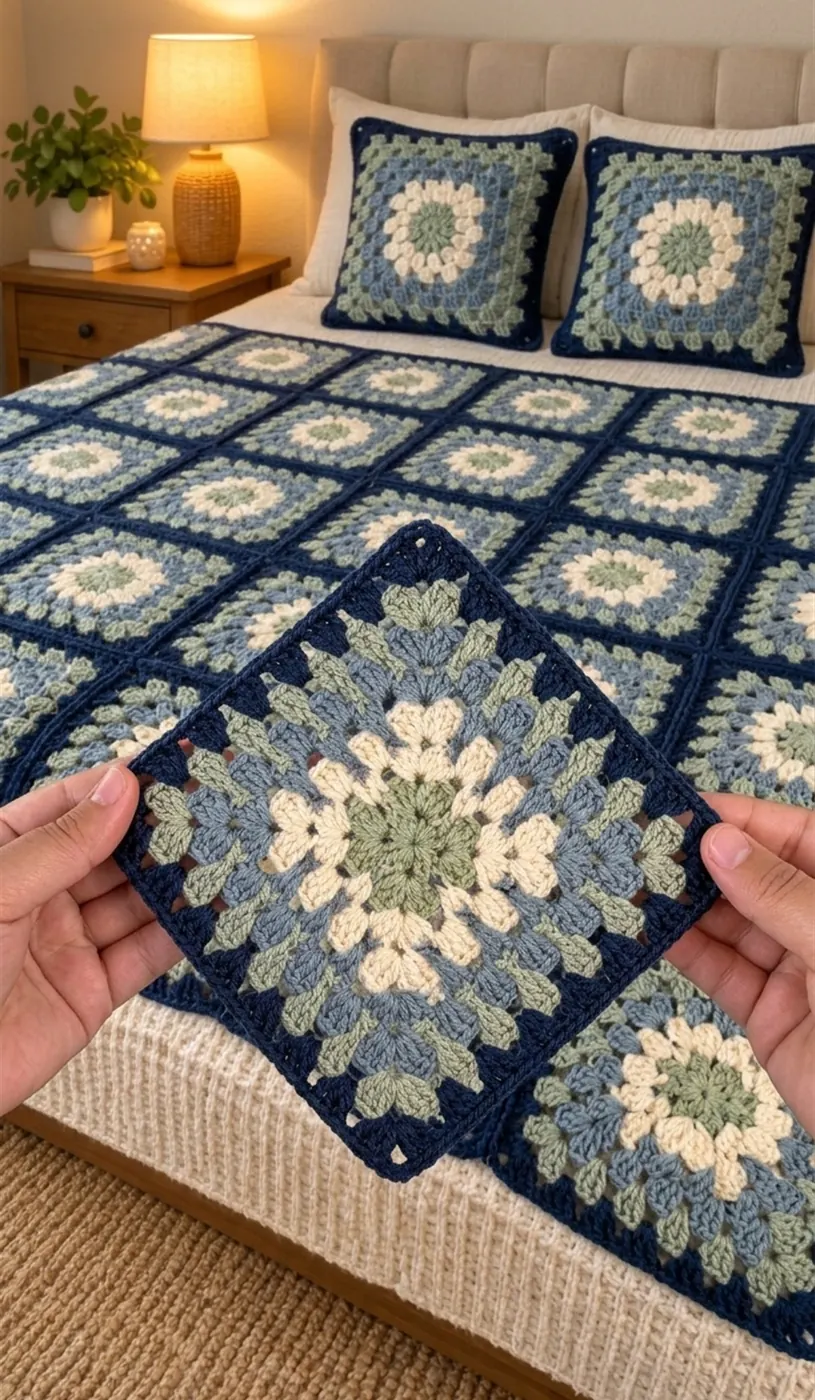
This classic granny squares reference uses navy, sage, ivory. The palette changes the visual rhythm while the written family construction remains independent of the photograph.
Materials, palette and measured size
Palette: navy, sage, ivory. Smooth DK cotton or washable wool; 3.5-4.5 mm hook, yarn needle, markers and blocking pins. Allow roughly 1,800-3,500 g for a full cover, confirmed by weighing a washed sample. Gauge, component sizes and full materials planning follow the linked family pattern.
Counted color variation
- Keep the complete family construction: Rounds 1-5 have 12, 24, 36, 48 and 60 dc. Round 6 ends with 84 sc and 4 corners, 21 sc per side.
- Use navy for the main motif or texture and ivory for the ground or outside frame. In a single-color version both remain the same shade. Change colors at the row or round boundaries in the full pattern, without adding stitches.
- Example plan: 12 columns by 14 rows; 168 main components. Wash and measure the first complete unit, then recalculate coverage from the actual bed instead of treating this example as a guaranteed size.
Complete Classic Granny Squares pattern: counted steps, assembly and finishing
Follow the linked joining method, secure appliques flat and block gently. The photo changes the color reference; it does not establish a new physically tested construction.
55. Royal Blue, Turquoise, Ivory Classic Granny-Square Bedspread
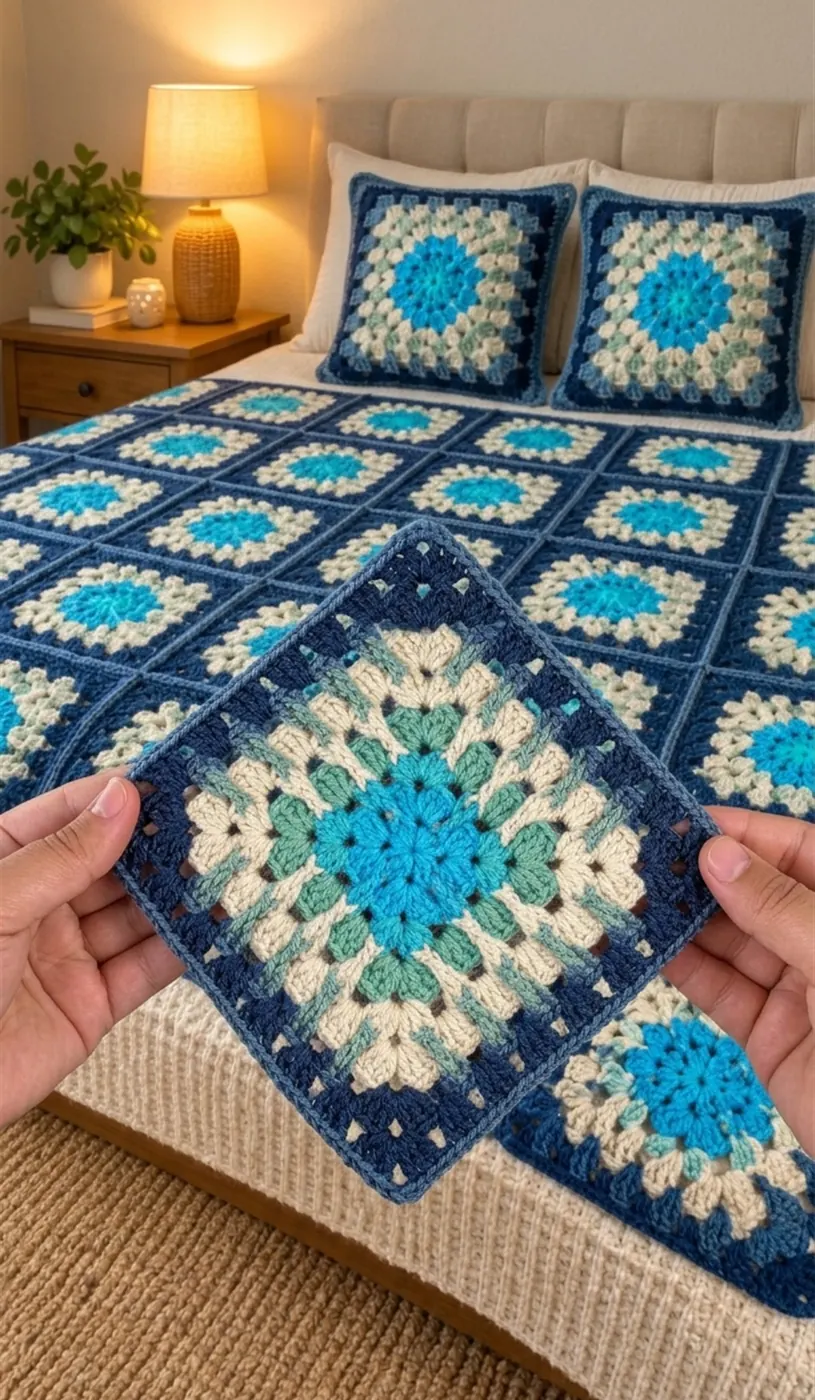
This classic granny squares reference uses royal blue, turquoise, ivory. The palette changes the visual rhythm while the written family construction remains independent of the photograph.
Materials, palette and measured size
Palette: royal blue, turquoise, ivory. Smooth DK cotton or washable wool; 3.5-4.5 mm hook, yarn needle, markers and blocking pins. Allow roughly 1,800-3,500 g for a full cover, confirmed by weighing a washed sample. Gauge, component sizes and full materials planning follow the linked family pattern.
Counted color variation
- Keep the complete family construction: Rounds 1-5 have 12, 24, 36, 48 and 60 dc. Round 6 ends with 84 sc and 4 corners, 21 sc per side.
- Use royal blue for the main motif or texture and ivory for the ground or outside frame. In a single-color version both remain the same shade. Change colors at the row or round boundaries in the full pattern, without adding stitches.
- Example plan: 12 columns by 14 rows; 168 main components. Wash and measure the first complete unit, then recalculate coverage from the actual bed instead of treating this example as a guaranteed size.
Complete Classic Granny Squares pattern: counted steps, assembly and finishing
Follow the linked joining method, secure appliques flat and block gently. The photo changes the color reference; it does not establish a new physically tested construction.
56. Denim, Teal, Sage, Cream Floral Granny-Square Bedspread
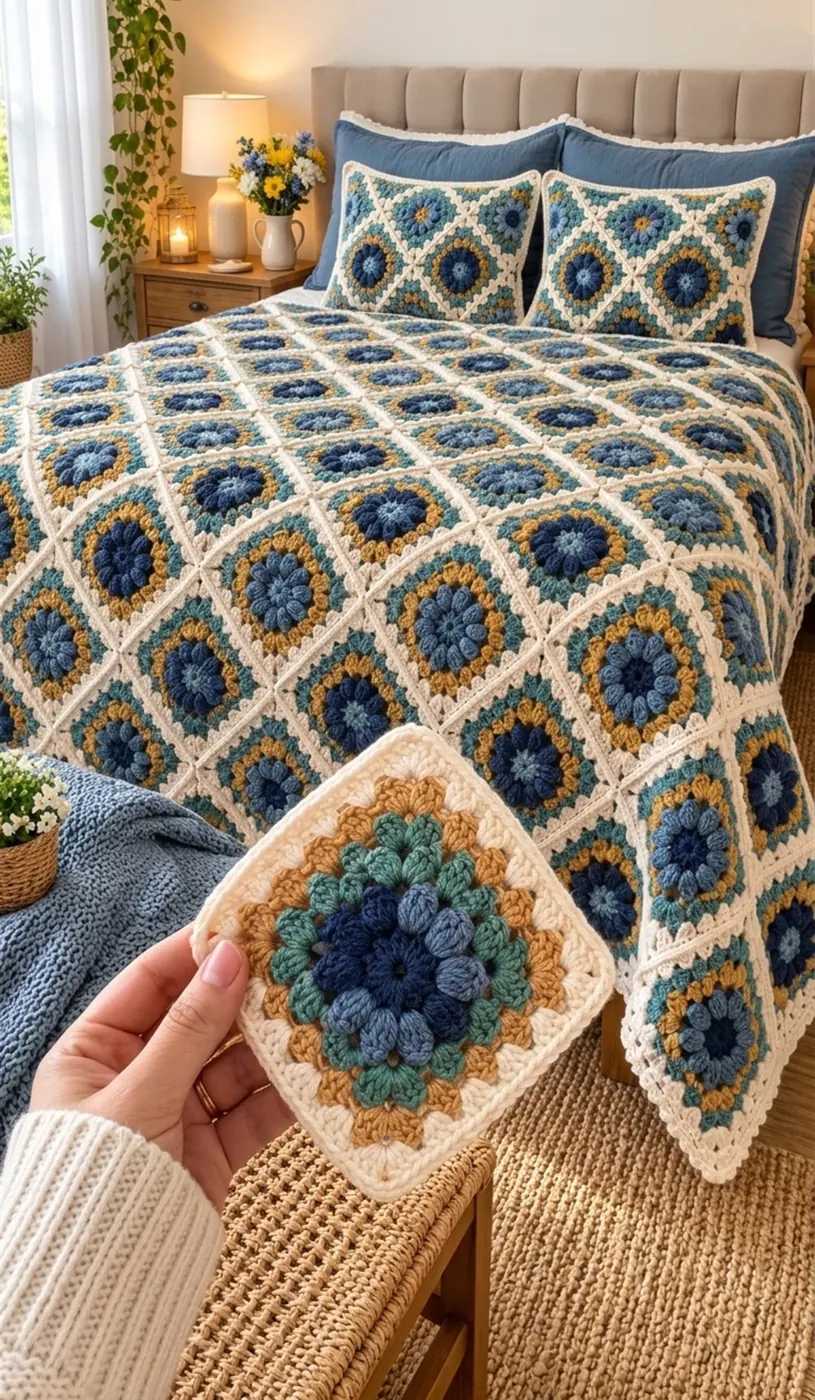
This layered flower squares reference uses denim, teal, sage, cream. The palette changes the visual rhythm while the written family construction remains independent of the photograph.
Materials, palette and measured size
Palette: denim, teal, sage, cream. Smooth DK cotton or washable wool; 3.5-4.5 mm hook, yarn needle, markers and blocking pins. Allow roughly 1,800-3,500 g for a full cover, confirmed by weighing a washed sample. Gauge, component sizes and full materials planning follow the linked family pattern.
Counted color variation
- Keep the complete family construction: 8-sc center; 8 small petals; 8 outer petals; square frame ends with 60 sc and 4 corners, 15 sc per side.
- Use denim for the main motif or texture and cream for the ground or outside frame. In a single-color version both remain the same shade. Change colors at the row or round boundaries in the full pattern, without adding stitches.
- Example plan: 12 columns by 14 rows; 168 main components. Wash and measure the first complete unit, then recalculate coverage from the actual bed instead of treating this example as a guaranteed size.
Complete Layered Flower Squares pattern: counted steps, assembly and finishing
Follow the linked joining method, secure appliques flat and block gently. The photo changes the color reference; it does not establish a new physically tested construction.
57. Rust, Sage, Cream Floral Granny-Square Bedspread
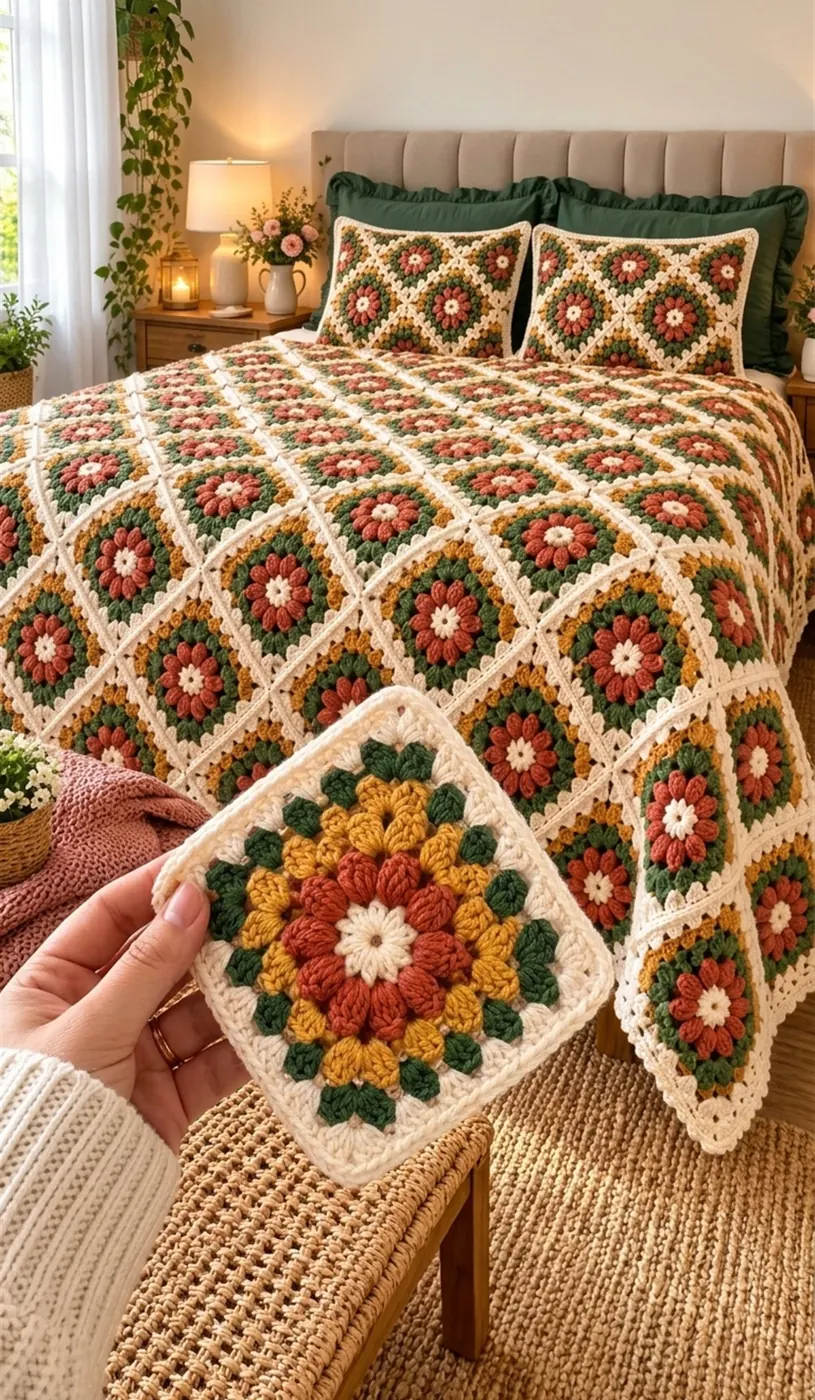
This layered flower squares reference uses rust, sage, cream. The palette changes the visual rhythm while the written family construction remains independent of the photograph.
Materials, palette and measured size
Palette: rust, sage, cream. Smooth DK cotton or washable wool; 3.5-4.5 mm hook, yarn needle, markers and blocking pins. Allow roughly 1,800-3,500 g for a full cover, confirmed by weighing a washed sample. Gauge, component sizes and full materials planning follow the linked family pattern.
Counted color variation
- Keep the complete family construction: 8-sc center; 8 small petals; 8 outer petals; square frame ends with 60 sc and 4 corners, 15 sc per side.
- Use rust for the main motif or texture and cream for the ground or outside frame. In a single-color version both remain the same shade. Change colors at the row or round boundaries in the full pattern, without adding stitches.
- Example plan: 12 columns by 14 rows; 168 main components. Wash and measure the first complete unit, then recalculate coverage from the actual bed instead of treating this example as a guaranteed size.
Complete Layered Flower Squares pattern: counted steps, assembly and finishing
Follow the linked joining method, secure appliques flat and block gently. The photo changes the color reference; it does not establish a new physically tested construction.
58. Denim, Sage, Cream Floral Granny-Square Bedspread
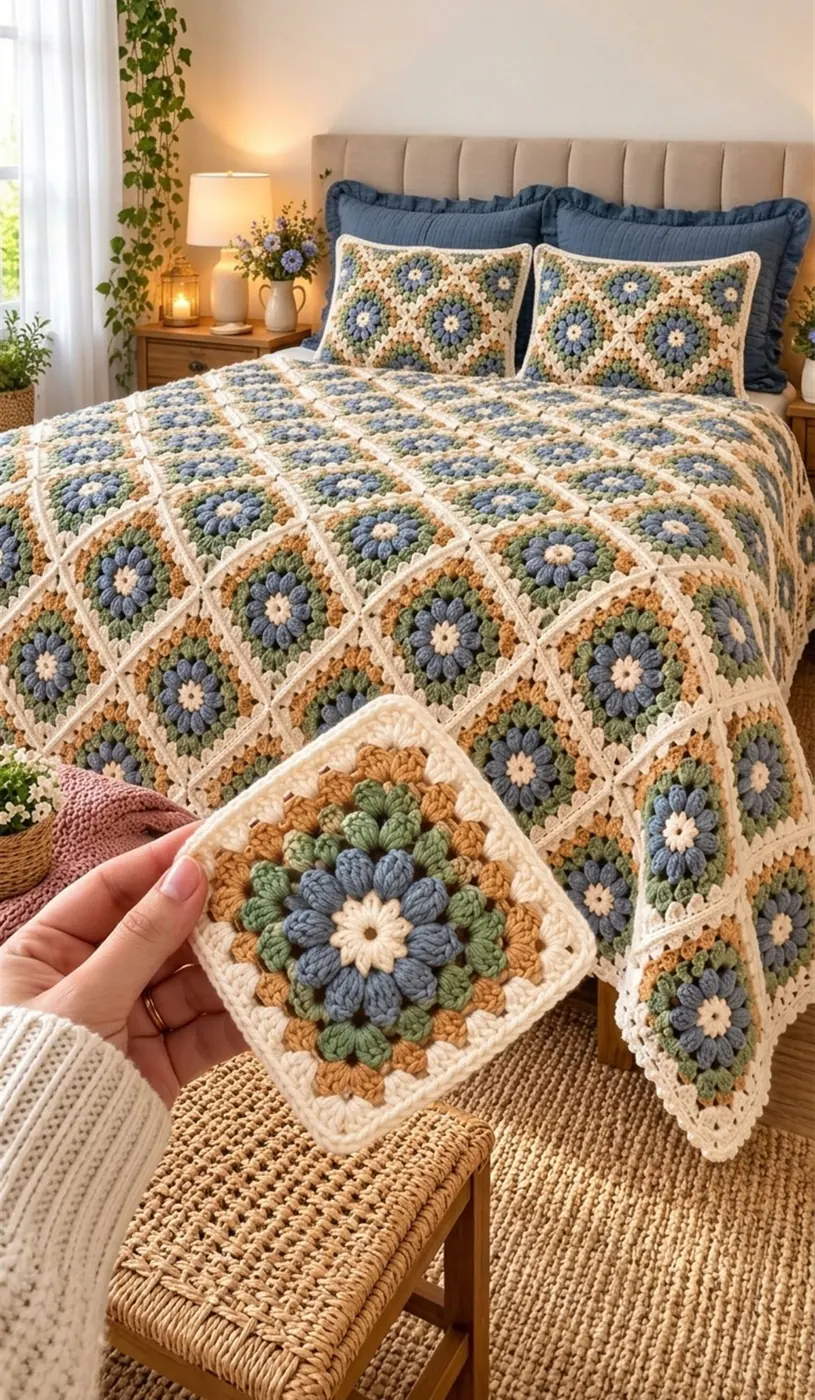
This layered flower squares reference uses denim, sage, cream. The palette changes the visual rhythm while the written family construction remains independent of the photograph.
Materials, palette and measured size
Palette: denim, sage, cream. Smooth DK cotton or washable wool; 3.5-4.5 mm hook, yarn needle, markers and blocking pins. Allow roughly 1,800-3,500 g for a full cover, confirmed by weighing a washed sample. Gauge, component sizes and full materials planning follow the linked family pattern.
Counted color variation
- Keep the complete family construction: 8-sc center; 8 small petals; 8 outer petals; square frame ends with 60 sc and 4 corners, 15 sc per side.
- Use denim for the main motif or texture and cream for the ground or outside frame. In a single-color version both remain the same shade. Change colors at the row or round boundaries in the full pattern, without adding stitches.
- Example plan: 12 columns by 14 rows; 168 main components. Wash and measure the first complete unit, then recalculate coverage from the actual bed instead of treating this example as a guaranteed size.
Complete Layered Flower Squares pattern: counted steps, assembly and finishing
Follow the linked joining method, secure appliques flat and block gently. The photo changes the color reference; it does not establish a new physically tested construction.
59. Navy, Cream, Gold Floral Granny-Square Bedspread
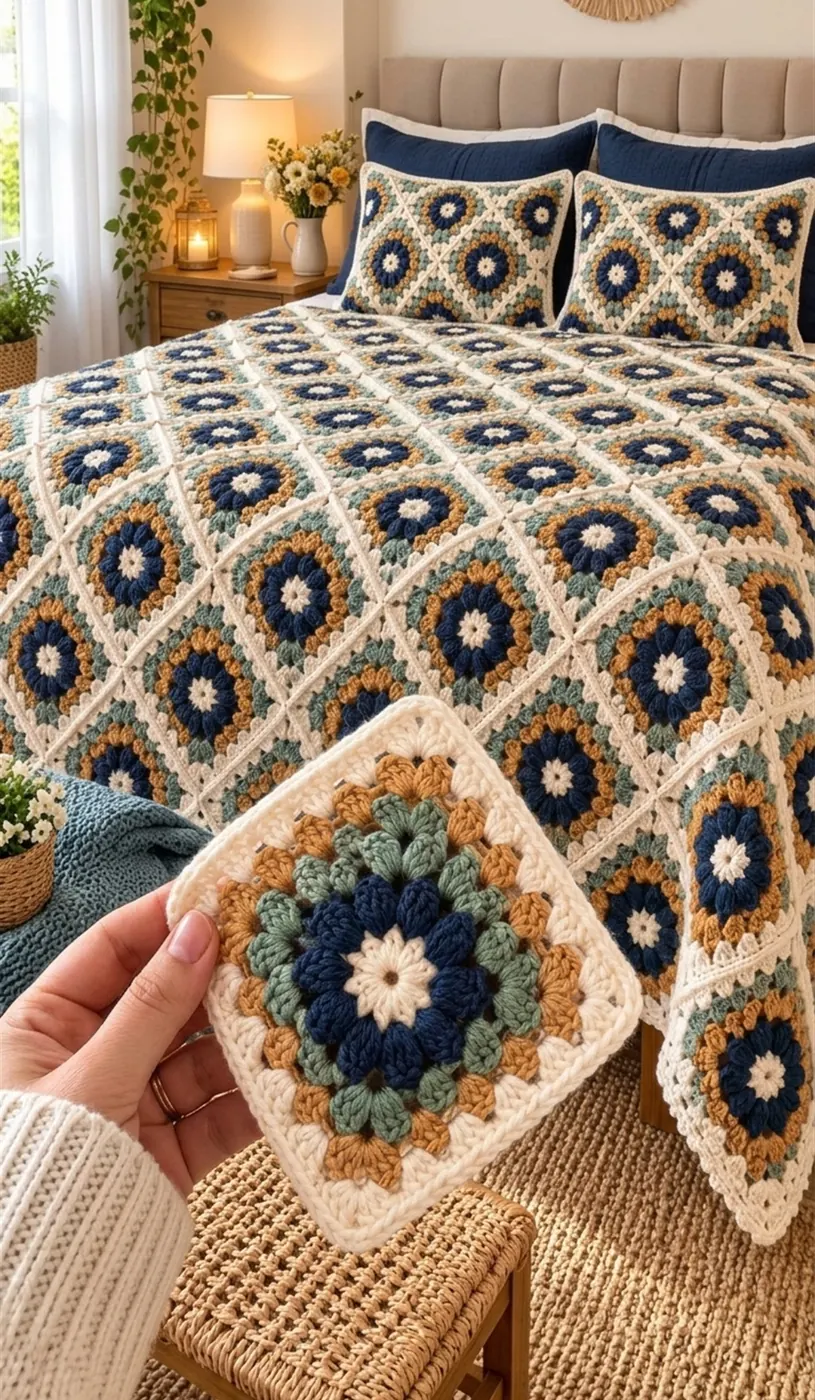
This layered flower squares reference uses navy, cream, gold. The palette changes the visual rhythm while the written family construction remains independent of the photograph.
Materials, palette and measured size
Palette: navy, cream, gold. Smooth DK cotton or washable wool; 3.5-4.5 mm hook, yarn needle, markers and blocking pins. Allow roughly 1,800-3,500 g for a full cover, confirmed by weighing a washed sample. Gauge, component sizes and full materials planning follow the linked family pattern.
Counted color variation
- Keep the complete family construction: 8-sc center; 8 small petals; 8 outer petals; square frame ends with 60 sc and 4 corners, 15 sc per side.
- Use navy for the main motif or texture and cream for the ground or outside frame. In a single-color version both remain the same shade. Change colors at the row or round boundaries in the full pattern, without adding stitches.
- Example plan: 12 columns by 14 rows; 168 main components. Wash and measure the first complete unit, then recalculate coverage from the actual bed instead of treating this example as a guaranteed size.
Complete Layered Flower Squares pattern: counted steps, assembly and finishing
Follow the linked joining method, secure appliques flat and block gently. The photo changes the color reference; it does not establish a new physically tested construction.
60. Sage Filet Window-Square Bedspread
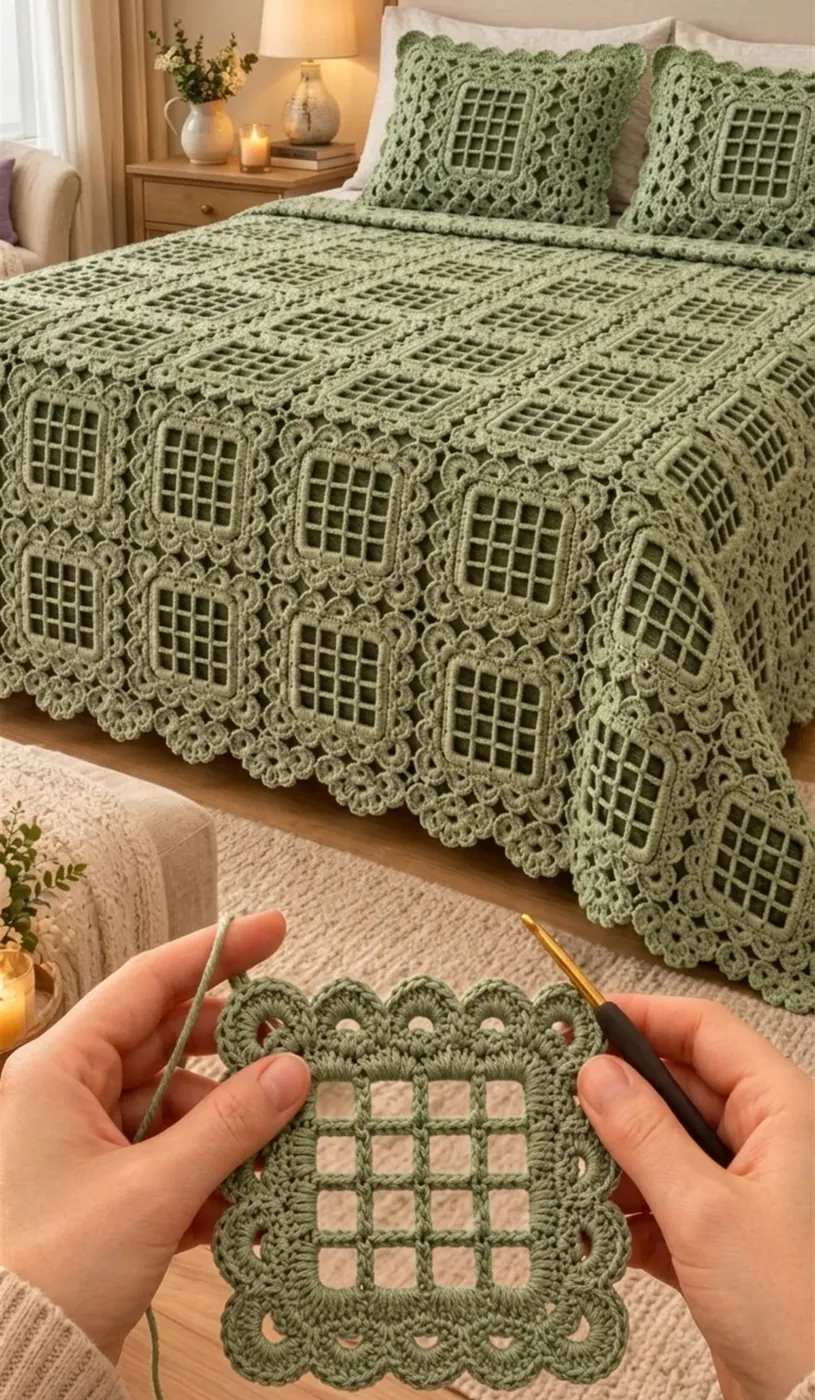
This filet window squares reference uses sage. The palette changes the visual rhythm while the written family construction remains independent of the photograph.
Materials, palette and measured size
Palette: sage. Smooth DK cotton or washable wool; 3.5-4.5 mm hook, yarn needle, markers and blocking pins. Allow roughly 1,800-3,500 g for a full cover, confirmed by weighing a washed sample. Gauge, component sizes and full materials planning follow the linked family pattern.
Counted color variation
- Keep the complete family construction: 25 positions per row: 8 three-position filet cells plus the first boundary dc; 14 rows per sample before edging.
- Use sage for the main motif or texture and sage for the ground or outside frame. In a single-color version both remain the same shade. Change colors at the row or round boundaries in the full pattern, without adding stitches.
- Example plan: 12 columns by 14 rows; 168 main components. Wash and measure the first complete unit, then recalculate coverage from the actual bed instead of treating this example as a guaranteed size.
Complete Filet Window Squares pattern: counted steps, assembly and finishing
Follow the linked joining method, secure appliques flat and block gently. The photo changes the color reference; it does not establish a new physically tested construction.
61. Navy, Cream Checked Mesh-and-Solid Bedspread
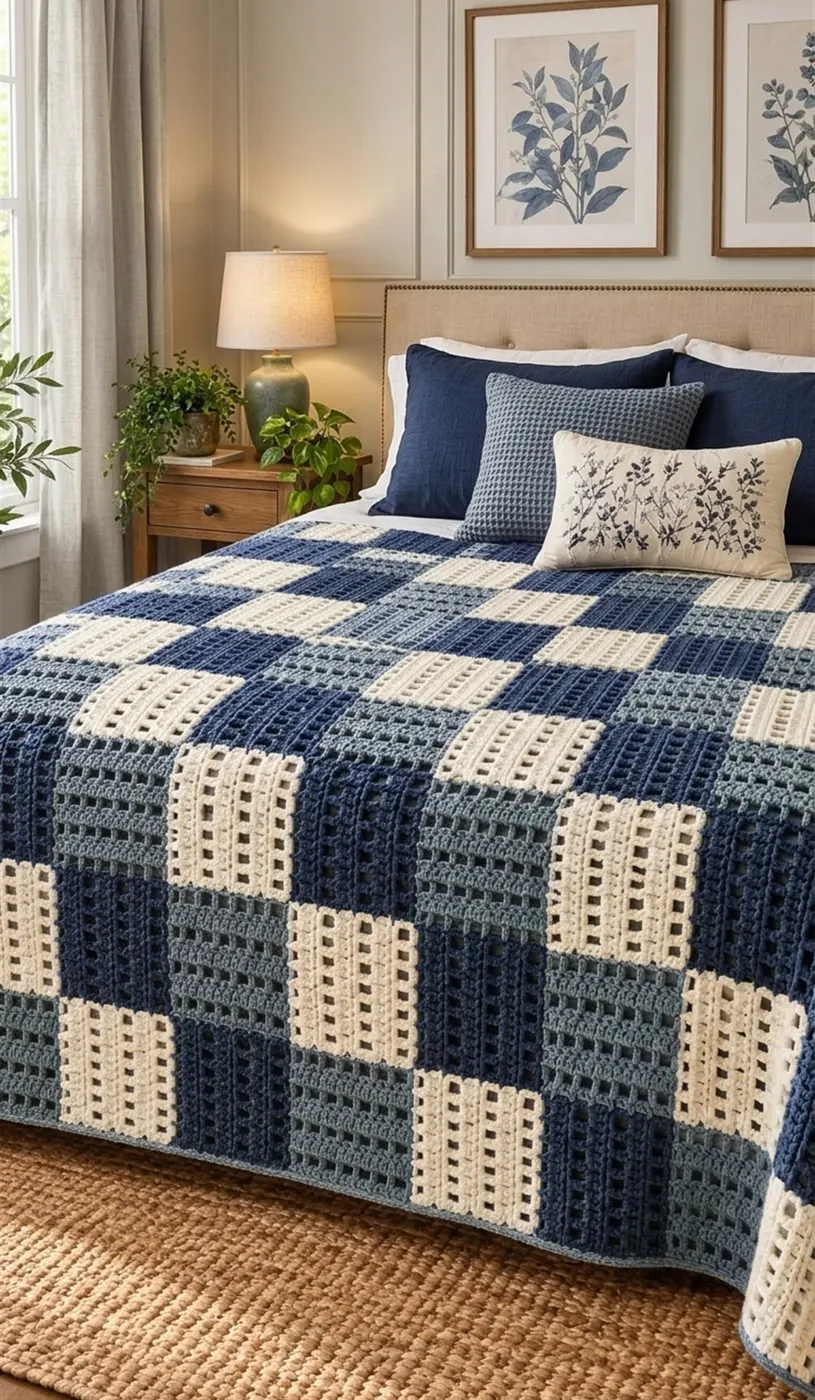
This checked solid-and-mesh squares reference uses navy, cream. The palette changes the visual rhythm while the written family construction remains independent of the photograph.
Materials, palette and measured size
Palette: navy, cream. Smooth DK cotton or washable wool; 3.5-4.5 mm hook, yarn needle, markers and blocking pins. Allow roughly 1,800-3,500 g for a full cover, confirmed by weighing a washed sample. Gauge, component sizes and full materials planning follow the linked family pattern.
Counted color variation
- Keep the complete family construction: Both panel types have 25 positions and 14 rows. Make 84 solid panels and 84 mesh panels for the sample.
- Use navy for the main motif or texture and cream for the ground or outside frame. In a single-color version both remain the same shade. Change colors at the row or round boundaries in the full pattern, without adding stitches.
- Example plan: 12 columns by 14 rows in a checkerboard; 168 main components. Wash and measure the first complete unit, then recalculate coverage from the actual bed instead of treating this example as a guaranteed size.
Complete Checked Solid-and-Mesh Squares pattern: counted steps, assembly and finishing
Follow the linked joining method, secure appliques flat and block gently. The photo changes the color reference; it does not establish a new physically tested construction.
62. Denim, Cream Checked Mesh-and-Solid Bedspread
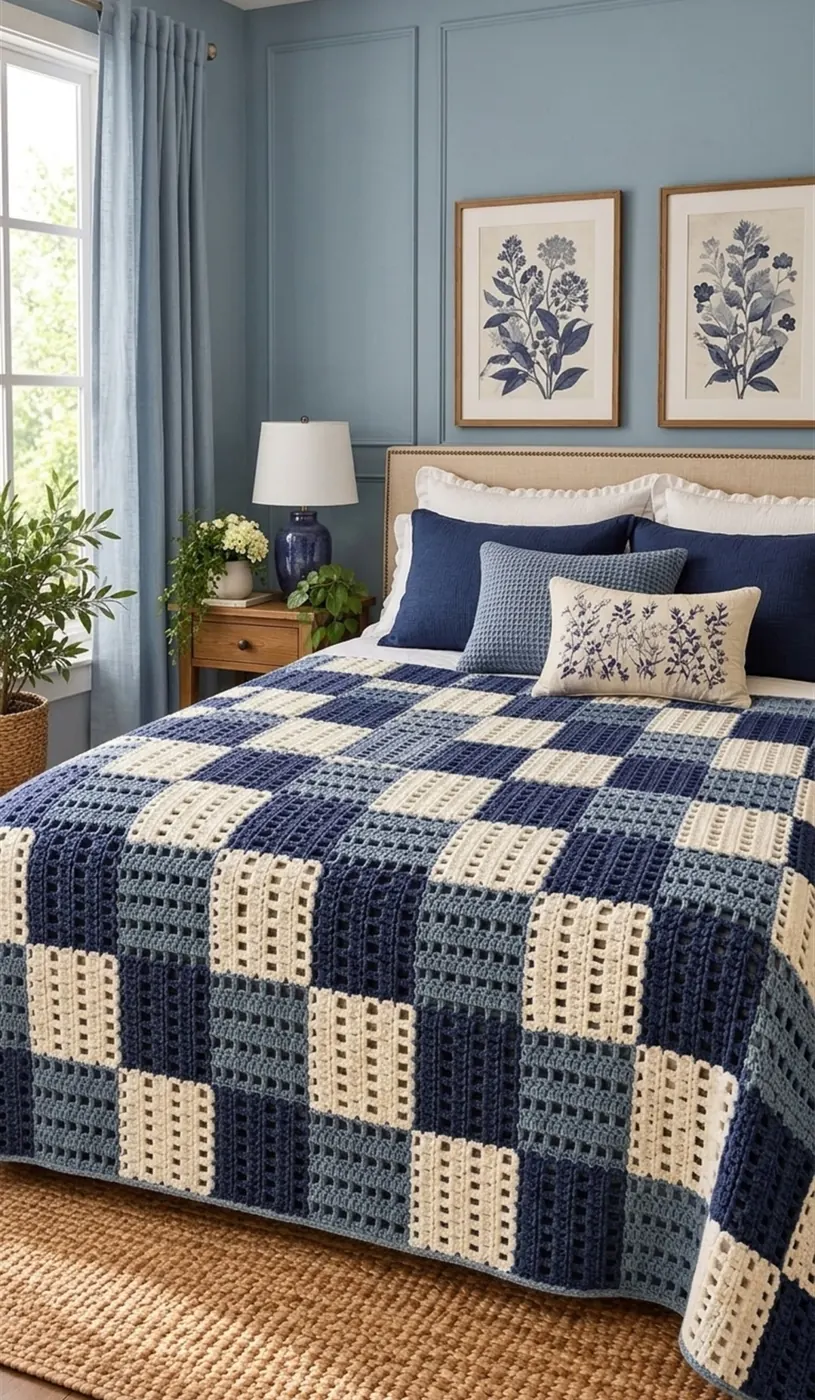
This checked solid-and-mesh squares reference uses denim, cream. The palette changes the visual rhythm while the written family construction remains independent of the photograph.
Materials, palette and measured size
Palette: denim, cream. Smooth DK cotton or washable wool; 3.5-4.5 mm hook, yarn needle, markers and blocking pins. Allow roughly 1,800-3,500 g for a full cover, confirmed by weighing a washed sample. Gauge, component sizes and full materials planning follow the linked family pattern.
Counted color variation
- Keep the complete family construction: Both panel types have 25 positions and 14 rows. Make 84 solid panels and 84 mesh panels for the sample.
- Use denim for the main motif or texture and cream for the ground or outside frame. In a single-color version both remain the same shade. Change colors at the row or round boundaries in the full pattern, without adding stitches.
- Example plan: 12 columns by 14 rows in a checkerboard; 168 main components. Wash and measure the first complete unit, then recalculate coverage from the actual bed instead of treating this example as a guaranteed size.
Complete Checked Solid-and-Mesh Squares pattern: counted steps, assembly and finishing
Follow the linked joining method, secure appliques flat and block gently. The photo changes the color reference; it does not establish a new physically tested construction.
63. Rust Raised Diamond-Lattice Bedspread
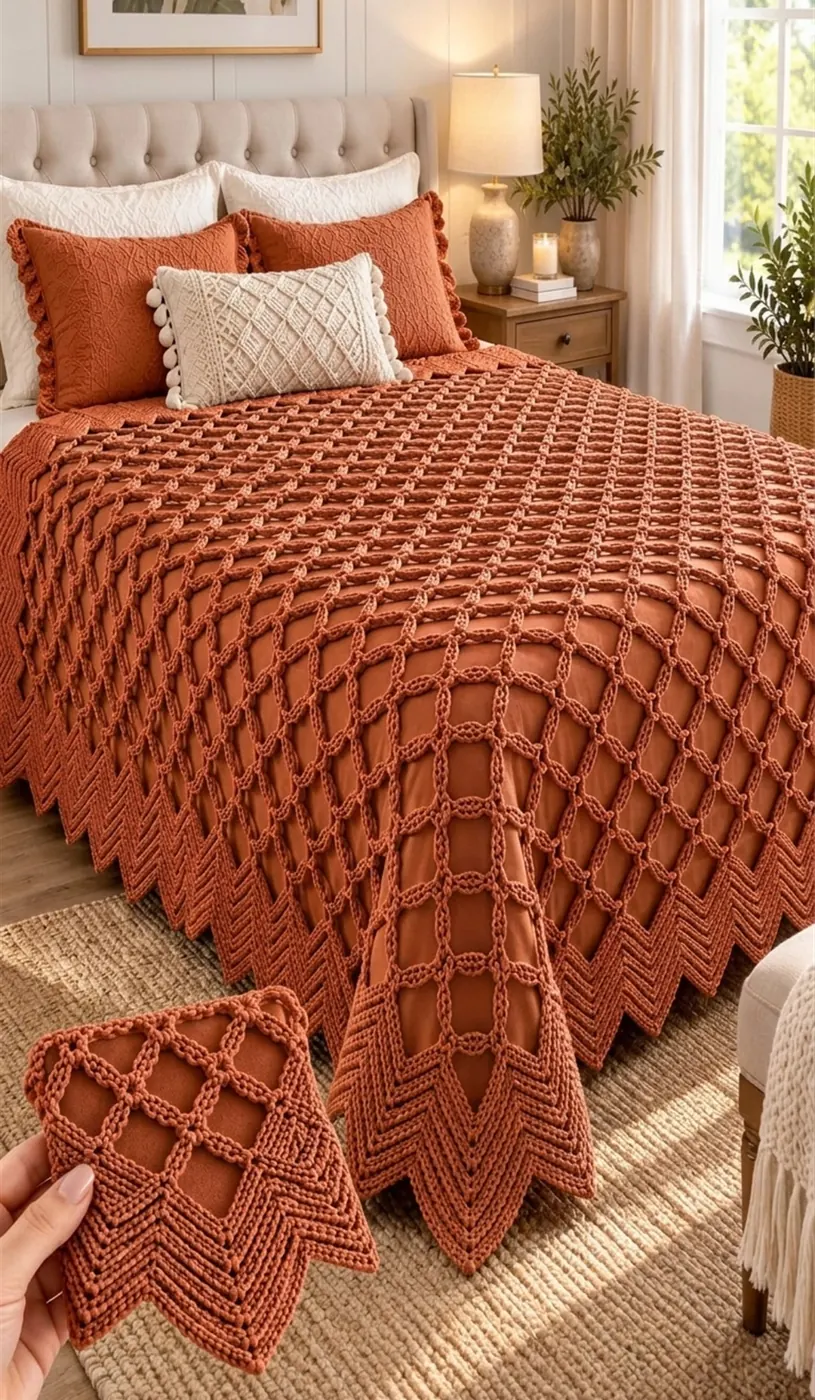
This surface diamond-lattice cover reference uses rust. The palette changes the visual rhythm while the written family construction remains independent of the photograph.
Materials, palette and measured size
Palette: rust. Smooth DK cotton or washable wool; 3.5-4.5 mm hook, yarn needle, markers and blocking pins. Allow roughly 1,800-3,500 g for a full cover, confirmed by weighing a washed sample. Gauge, component sizes and full materials planning follow the linked family pattern.
Counted color variation
- Keep the complete family construction: Full-cover worked example: 401 sc by 440 rows; each diagonal overlay segment has 12 surface sl sts across 12 positions and 12 rows.
- Use rust for the main motif or texture and rust for the ground or outside frame. In a single-color version both remain the same shade. Change colors at the row or round boundaries in the full pattern, without adding stitches.
- Example plan: one measured rectangle with two crossing directions of surface chains; 1 main components. Wash and measure the first complete unit, then recalculate coverage from the actual bed instead of treating this example as a guaranteed size.
Complete Surface Diamond-Lattice Cover pattern: counted steps, assembly and finishing
Follow the linked joining method, secure appliques flat and block gently. The photo changes the color reference; it does not establish a new physically tested construction.