17 Crochet Table Runners and Coasters: Dahlia, Rosette and Lace Doilies
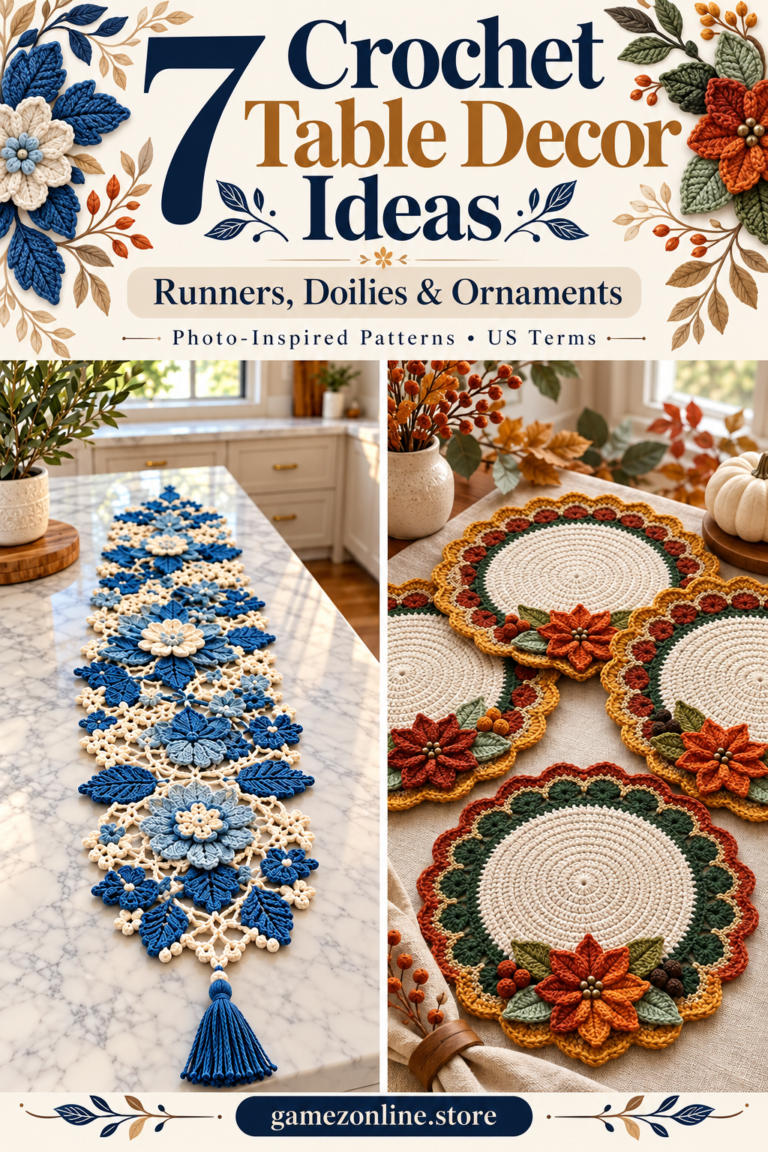
This collection brings together seventeen crochet table runners, coasters, placemats and doilies that share dahlia-style flowers, rosette squares, lace medallions and textured leaves. The photos vary in colour, from royal blue and cream to sage, rust and oatmeal, but many use layered petals, scalloped edges and open mesh grounds that link the pieces into matching table sets.
Each reference maps onto a practice-pattern family with counted starting points, and every related reference links back to the same full instructions. Sample a motif before committing to a full runner, then adjust colour and count to suit your table and your own measurements.
Before You Start: Materials and Measurements
Choose yarn for the intended project rather than assuming the photographs identify a particular fiber. Smooth cotton is a useful material to sample for defined lace and table pieces; a cotton blend or another washable yarn may suit larger decorative pieces and blankets. Start with the hook range on the yarn label and change it until the fabric looks right for the project.
Prepare a yarn needle, scissors, stitch markers, a tape measure and paper for planning layouts. Make one whole component, finish it using the intended care method and measure it after drying. Record width, height, weight and any changes to the written instructions before multiplying it into a larger piece.
US Crochet Terms and Working Rules
Ch = chain; sl st = slip stitch; sc = single crochet; hdc = half double crochet; dc = double crochet; tr = treble crochet; inc = 2 stitches in one stitch; sc2tog / dc2tog = work two stitches together; st = stitch; sp = space. An adjustable ring is a yarn loop that can be tightened after the first round is worked. Repeats in parentheses are worked the stated number of times, and numbers in brackets give the count at the end of a row or round.
Unless a pattern explicitly counts the starting chain, it is only a height chain: use ch 1 before sc rounds and ch 2 before dc rounds, then work the first real stitch in the first indicated stitch or space. Join rounds to the first real stitch. Do not add stitches when changing colors.
For terminology, see the Craft Yarn Council pattern-reading reference. If using a separate chart, check its own key as well as the standard crochet chart symbols.
Browse the 17 Photo References
- Blue, Green and Ivory Dahlia Table Runner Set
- Cream and Burgundy Raised Leaf Table Runner with Tassels
- Rust, Gold, Sage and Ivory Autumn Flower Table Runner
- Blush and Rose Maple Leaf Table Runner — Crochet Adaptation
- Royal Blue and Cream Flower Table Runner
- Pink and Green Swirled Coaster Medallion
- Red, White and Green Flower Table Runner Set
- Orange and White Flower Table Runner
- Blue and Cream Flower Square Round Tablecloth Set
- Lilac Round Lace Doily with Picot Scallops
- Sage and Ivory Round Flower Medallion Tablecloth
- Cream, Red and Green Christmas Tree Panel with Gold Trim
- Navy and Gold Scalloped Placemat with Pastel Flowers and Bows
- Sage and Gold Round Lace Placemat
- Dusty Pink, Cream and Sage Flower Table Runner
- Red and Gold Poinsettia Star Coaster with Green Leaves
- Oatmeal Beige Grid Lattice Square
1. Blue, Green and Ivory Dahlia Table Runner Set
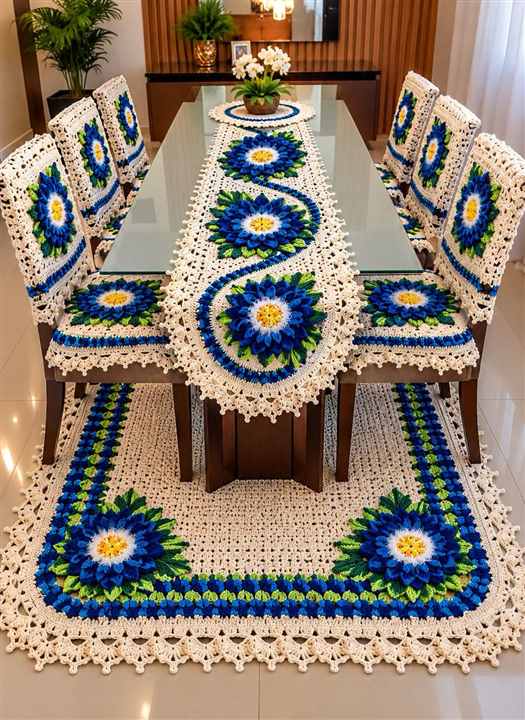
A centre line of large layered flower medallions in blue and green, each with a yellow and white centre, links into an S-shaped runner on a cream ground. Matching chair covers and a rectangular rug repeat the stacked, pointed petals and the scalloped ivory edge.
Construction and Pattern Direction
Start by sampling one layered flower square, then decide how many motifs the runner length needs. Use the layered five-petal flower practice family, alternate blue and green petals, and add yellow centres as a colour change in the last round.
Layout and Finishing
Arrange the motifs in a gentle S-curve, joining each to the next through the ch-2 spaces. The photo does not give table dimensions, so block the runner to your own measurement.
Complete Practice Pattern: Layered Five-Petal Flower Square Practice Motif
Materials: A cotton or cotton-blend sport weight yarn with a 3.0 to 3.5 mm hook as one option, not a photographed specification.
Scope: Counted original practice component, physically untested; see the adaptation notes before scaling up.
- Foundation: Ch 6, join with sl st to form a ring [6 ch].
- Round 1: Ch 3 (counts as first dc), 15 dc in ring, join to top of ch 3 [16 dc].
- Round 2: Ch 5 (counts as dc and ch 2), dc in next dc, ch 2, repeat that unit 15 more times, join to third ch of ch 5 [16 dc, 16 ch-2 spaces].
- Round 3: Ch 1, 5 dc in next ch-2 space, ch 1, skip next ch-2 space, repeat that unit 7 more times, join to first ch 1 [8 five-dc petals, 8 ch-1 spaces].
- Round 4: Sl st into next ch-1 space, ch 3, sc in next ch-1 space, repeat that unit 7 more times, join [8 ch-3 loops].
- Finish: Fasten off and weave in ends. Check that the square lies flat before measuring.
Assembly and Adaptation
Measure the finished sample across two opposite points so you know its true size. To join squares, work slip stitches through the ch-3 loops of adjoining motifs, or sew them edge to edge with the same yarn. The photo does not show exact dimensions, pillow sham edging or how the flowers are attached to the ground mesh.
2. Cream and Burgundy Raised Leaf Table Runner with Tassels
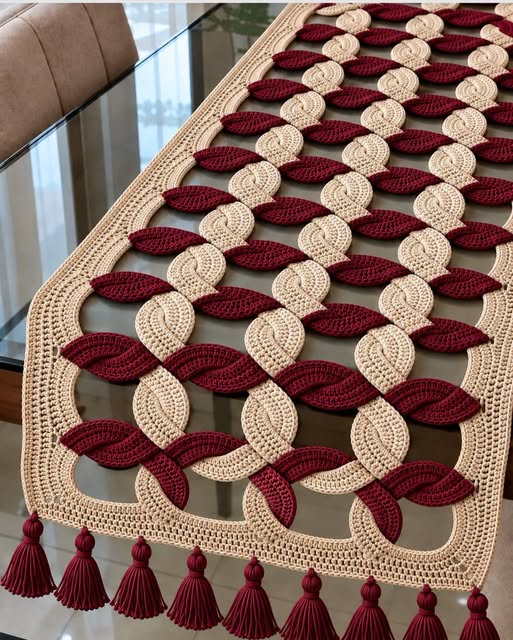
Burgundy oval leaves sit in a diagonal lattice against a dense cream field, with cream ribbed braided units interlocking between them. Burgundy tassels hang from the short end and lower edge, and the cream border gives a scalloped-looking finish on the long sides.
Construction and Pattern Direction
Sample a ribbed raised leaf first, then use the diagonal raised leaf lattice practice panel to set the leaf rhythm. Work the cream ground in back-loop ridges, switch to burgundy for the leaves, and keep the braided units in cream.
Layout and Finishing
Place the leaves in a diagonal lattice and join the panels edge to edge along the runner’s length. Measure your table for the runner width, since the photo does not show the tassel length or the exact leaf count.
Complete Practice Pattern: Diagonal Raised Leaf Lattice Practice Panel
Materials: Use a cotton or cotton-blend sport-weight yarn as one suggestion, with a 2.25 to 3.5 mm hook as one option, not a photographed specification.
Scope: Counted original practice component, physically untested; see the adaptation notes before scaling up.
- Foundation: Ch 26. Sc in second ch from hook and each remaining chain [25 sc].
- Row 2: Ch 1, turn, sc in each sc across [25 sc].
- Row 3 (ribbed band): Ch 1, turn, working in back loops only, sc in each sc across [25 sc].
- Row 4 (leaf point, increase): Ch 1, turn, sc in next 10 sc, 3 sc in next sc, sc in last 14 sc [27 sc].
- Row 5 (leaf point, close): Ch 1, turn, sc in next 10 sc, sc3tog over next 3 sc, sc in last 14 sc [25 sc].
- Row 6 (ridge): Ch 1, turn, working in front loops only, sc in each sc across [25 sc].
- Row 7 (lattice windows): Ch 1, turn, sc in next 4 sc, ch 3, skip next 3 sc, sc in next 4 sc, ch 3, skip next 3 sc, sc in last 11 sc [19 sc, two ch-3 spaces].
- Row 8 (solid band): Ch 1, turn, sc in each sc and 3 sc in each ch-3 space across [19 sc + 6 sc = 25 sc].
- Row 9: Ch 1, turn, sc in each sc across [25 sc]. Fasten off.
Assembly and Adaptation
Measure the finished sample across the row and along the length after blocking, which also opens the lattice windows. For a wider panel, add 7 foundation chains for each extra window, add one more sc 4, ch 3, skip 3 cycle in row 7 before the final sc run, and make the sc run after the leaf point in rows 4 and 5 equal to the stitches left over (14 sc in the sample, plus 7 for each added window). Join panels edge to edge through the back loops of the row 9 sc. The photo does not show the yarn, the leaf count or the tassel length.
3. Rust, Gold, Sage and Ivory Autumn Flower Table Runner
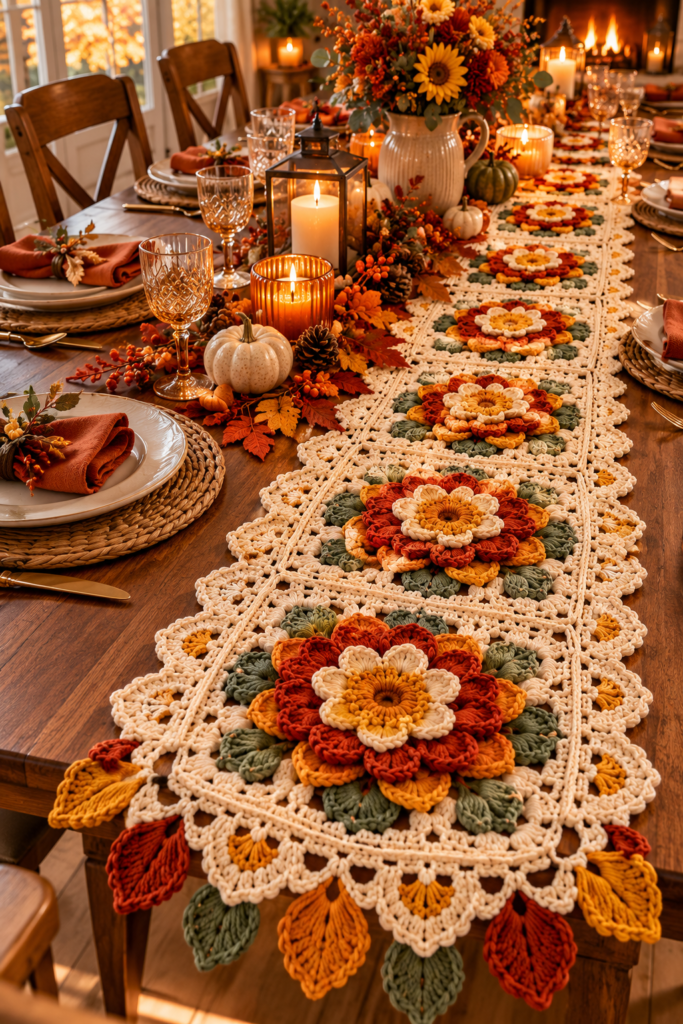
Square units each carry a layered rosette in graded rust, orange and gold with a cream ring, sitting on a cream open mesh. Sage rounded petals fill the corners between flowers, and crochet leaves hang from the ends and lower edge.
Construction and Pattern Direction
Start with the rosette square practice pattern and sample one unit in rust and cream, then add the gold and orange petals in the same round sequence. Use sage for the corner petals and work the mesh joins in cream.
Layout and Finishing
Repeat one flower per unit along a narrow, long runner, joining the units at the mesh. Measure the table before adding hanging leaves at the ends, since the photo does not state the number of units.
Complete Practice Pattern: Layered Rosette Square with Stand-Up Petals
Materials: A cotton or cotton-blend sport weight yarn with a 3.0 to 3.5 mm hook as one option, not a photographed specification.
Scope: Counted original practice component, physically untested; see the adaptation notes before scaling up.
- Foundation: Ch 6, join with sl st to form a ring [6 ch].
- Round 1: Ch 1, 12 sc in ring, join [12 sc].
- Round 2: Ch 3 (counts as first dc), 1 dc in same st, 2 dc in each remaining st around, join [24 dc].
- Round 3: Ch 4 (counts as dc and ch 1), dc in next dc, ch 1, repeat that unit 23 more times, join [24 dc, 24 ch-1 spaces].
- Round 4 (petals): (sc, hdc, 3 dc, hdc, sc) in next ch-1 space, skip next ch-1 space, repeat that unit around, join [12 petals of 7 sts each, 12 ch-1 spaces left].
- Round 5 (back): Ch 1, sc in each of the 12 remaining ch-1 spaces, join [12 sc].
- Finish: Fasten off and weave in ends.
Assembly and Adaptation
Measure the finished rosette across the petal tips and record the number. Join rosettes by working through the back sc round or sewing each rosette to a mesh base. The photo does not show the base mesh or whether the rosettes are sewn or worked directly onto the ground.
4. Blush and Rose Maple Leaf Table Runner — Crochet Adaptation
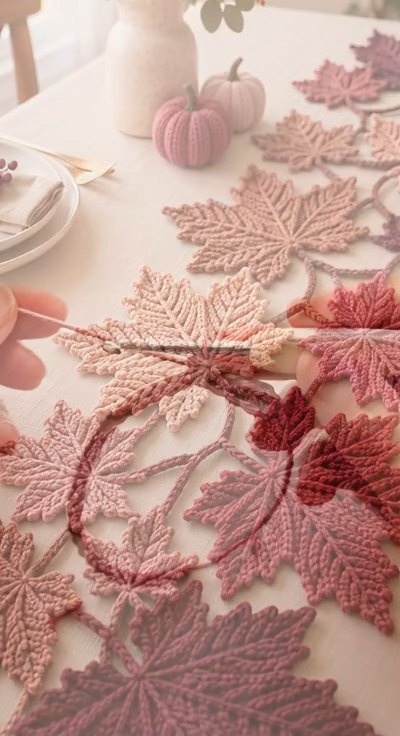
Separate lobed maple leaves with visible stems run along the runner, linked by thin strands between them. The surface has raised ridges and scalloped lobe tips, shifting from pale blush to deep red across the length.
Construction and Pattern Direction
Sample one maple leaf in the lighter blush first, then work the dusty rose and red leaves with the same counts. Use the flat lobed maple leaf practice pattern and change colour at each leaf to create the gradient.
Layout and Finishing
Scatter the leaves loosely along the runner and link them with chain strands. The photo does not state a leaf size, so scale the leaves to your sample and your table.
Complete Practice Pattern: Flat Lobed Maple Leaf with Stem
Materials: A fine cotton or worsted-weight acrylic suits the leaf; a 3.5 mm hook is one option for a sample, not a photographed specification.
Scope: Counted original practice component, physically untested; see the adaptation notes before scaling up.
- Foundation: Ch 9. Sc in second ch from hook and each chain across [8 sc].
- Row 2: Ch 1, turn, sc in each sc across [8 sc].
- Row 3: Ch 1, turn, 2 sc in first sc, sc in next 6 sc, 2 sc in last sc [10 sc].
- Row 4: Ch 1, turn, 2 sc in first sc, sc in next 8 sc, 2 sc in last sc [12 sc].
- Row 5: Ch 1, turn, 3 sc in first sc, sc in next 10 sc, 3 sc in last sc [16 sc, lobe tips at each end].
- Row 6: Ch 1, turn, sc2tog, sc in next 12 sc, sc2tog [14 sc].
- Row 7: Ch 1, turn, sc in each sc across [14 sc].
- Stem: Ch 7. Sc in second ch from hook and each chain across [6 sc]. Fasten off and sew the stem to the base of the leaf.
Assembly and Adaptation
Measure the finished sample width and length, then scale it by adding 2 chains to the foundation for each extra 2 middle sc in rows 4 and 6 so the increase pattern stays balanced. Sew the leaf to the cream ground or join it to a square with the stem tucked under the edge. The photo does not show the exact lobe depth, yarn weight or leaf size, so keep the sample as your guide.
5. Royal Blue and Cream Flower Table Runner
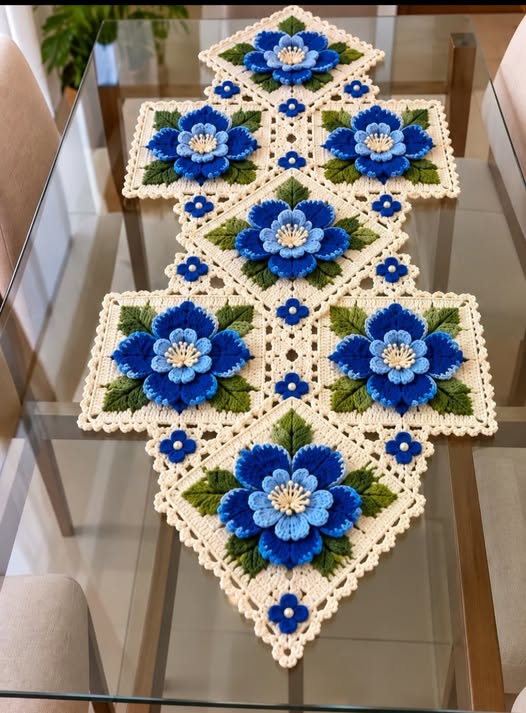
Layered three-dimensional blue flowers with pale blue centres sit in a diamond-and-square runner, with green stacked leaves at the square corners. Small blue five-petal flowers fill the gaps, and a picot-edged cream lace outline frames the tapering ends.
Construction and Pattern Direction
Start with the layered five-petal flower square and sample one motif in royal blue with a pale blue centre. Add the green leaves as corner accents and use a small five-petal flower in the gaps, then reduce the motifs at each end to shape the diamond.
Layout and Finishing
Arrange the flowers in a diamond sequence that narrows at top and bottom, and finish with a cream picot edging. The photo gives no finished dimensions, so size the runner by measuring your table.
Practice pattern: Layered Five-Petal Flower Square Practice Motif (full counted steps with photo 1).
6. Pink and Green Swirled Coaster Medallion
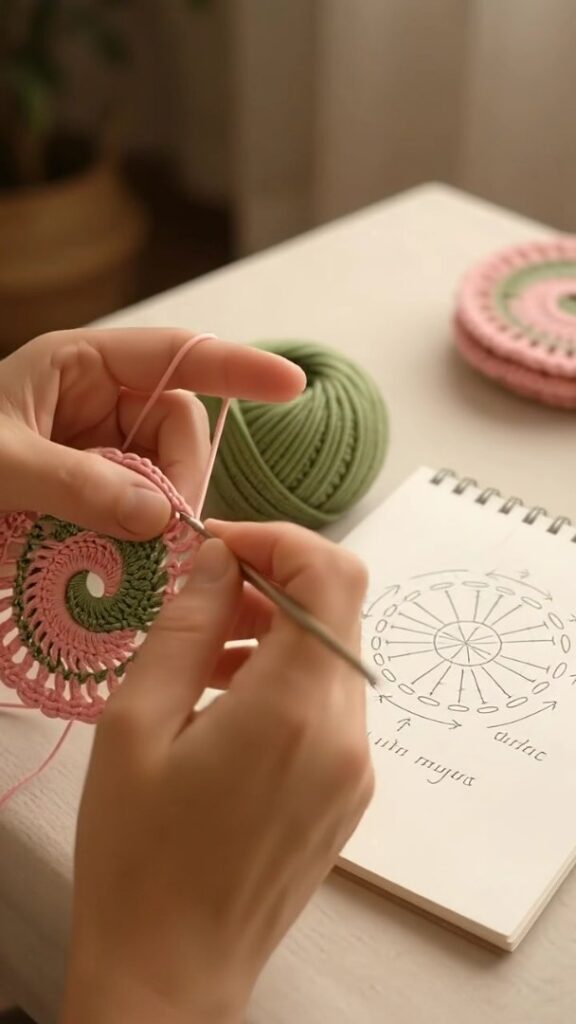
A round, flat medallion is built in a spiral of pink and green rounds, with a green inner swirl standing out against the pink outer rings. The edge looks lacy, and a second finished coaster in the same colours sits beside it.
Construction and Pattern Direction
Start with the concentric ring coaster practice pattern and sample the first round in green, then switch to pink for the outer rounds. Keep the colour-change rounds where the practice pattern places them and check the ring after each round.
Layout and Finishing
Work one coaster and use the second piece as a size check against your sample. Block it flat, and measure your sample because the photo does not state a finished diameter.
Complete Practice Pattern: Concentric Ring Coaster with Colour-Change Rounds
Materials: A smooth cotton or cotton-blend yarn in fingering or sport weight with a 2.5 to 3.5 mm hook, as one option and not a photographed specification.
Scope: Counted original practice component, physically untested; see the adaptation notes before scaling up.
- Round 1: Magic ring, 8 sc in ring, join. [8 sc]
- Round 2: Ch 1, 2 sc in each st around, join. [16 sc]
- Round 3: (sc in next st, 2 sc in next st) eight times, join. [24 sc]
- Round 4: (sc in next 2 sts, 2 sc in next st) eight times, join. [32 sc]
- Round 5: (sc in next 3 sts, 2 sc in next st) eight times, join. [40 sc]
- Round 6: Ch 1, sc in each st around, join. [40 sc]
- Round 7: (sc in next 4 sts, 2 sc in next st) eight times, join. [48 sc]
- Round 8: Ch 1, sc in each st around, join. [48 sc]
- Round 9: Ch 1, sc in back loop only of each st around, join. [48 sc]. Fasten off and weave in ends.
Assembly and Adaptation
Measure the finished diameter after a light steam block. To enlarge the coaster, add plain sc rounds, and when you add increase rounds keep the stitch count a multiple of 8 so the eight equal groups stay even. Change colour at the start of any round to recreate the banded look, and note that the photo does not show the exact colour order, the hook size or the matching basket.
7. Red, White and Green Flower Table Runner Set
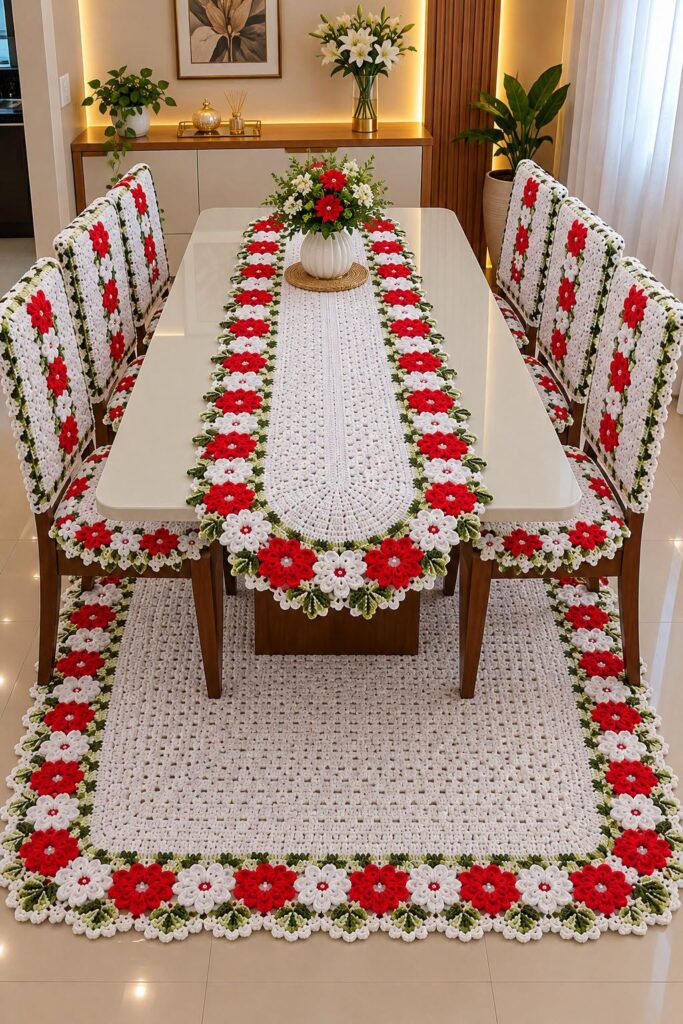
A runner of five-petal red and white flowers with small white centres forms a continuous border strip, separated by green leaf clusters. The centre field is open white mesh, and the runner ends in a rounded oval shape.
Construction and Pattern Direction
Sample one five-petal flower square in red with a white centre, then add the green leaf clusters between the motifs. Work the open white mesh as a separate field and join it to the flower border.
Layout and Finishing
Join the flowers into one continuous strip and fill the centre with mesh joined to that border. Measure your table for the oval shape, since the photo gives no exact dimensions.
Practice pattern: Layered Five-Petal Flower Square Practice Motif (full counted steps with photo 1).
8. Orange and White Flower Table Runner
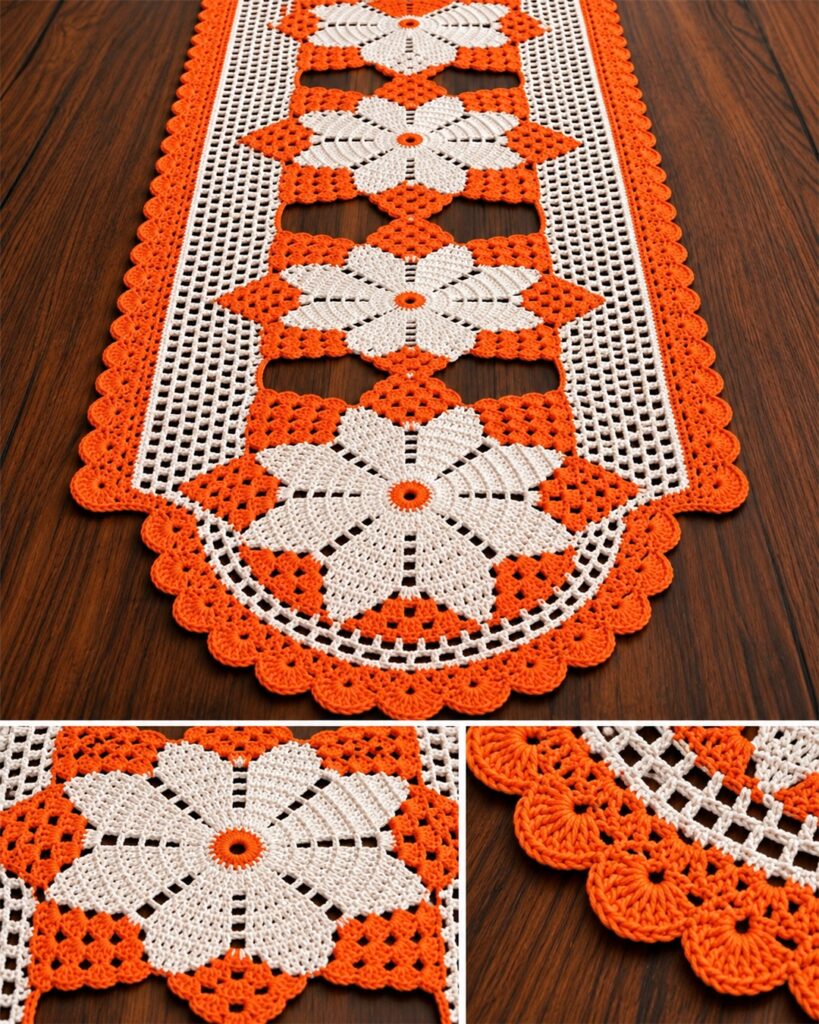
A central row of white radiating flower medallions, each with eight petal-like lobes around a small orange ring, sits between orange granny-style blocks. A scalloped fan-and-shell edge in orange frames the runner.
Construction and Pattern Direction
Start with the fan-and-shell lace panel to set the scalloped edge, then sample one eight-lobe medallion for the central row. Add the orange granny-style blocks between the flowers and work white open mesh panels along each side.
Layout and Finishing
Arrange the medallions along the centre and fill the sides with mesh panels, joining them by measurement. The photo does not show the medallion count or the finished size.
Complete Practice Pattern: Fan-and-Shell Lace Panel with Scalloped Edge
Materials: A DK-weight cotton-look yarn with a 3.5 to 4.5 mm hook as one option, not a photographed specification.
Scope: Counted original practice component, physically untested; see the adaptation notes before scaling up.
- Foundation: Ch 37. Sc in second ch from hook and each chain across [36 sc].
- Row 2 (shells): Ch 1, turn, *sk 2 sc, 5 dc in next sc, sk 2 sc, sc in next sc; rep from * across [six 5-dc shells and six sc, 36 stitches].
- Row 3 (lace): Ch 1, turn, *sc in next st, ch 3, sk 2 sts; rep from * across [12 sc and 12 ch-3 spaces, using all 36 stitches].
- Row 4 (fan): Ch 1, turn, sc in first sc, (3 sc in next ch-3 space, sc in next sc) eleven times, 3 sc in last ch-3 space [48 sc].
- Row 5: Ch 1, turn, sc in each sc across [48 sc].
- Finish: Fasten off, weave in ends and block the panel into a rectangle.
- Resize: for n shells, chain 6n + 1 for the foundation; rows 4 and 5 then give 8n sc. For n = 6, use ch 37 for 36 sc in row 1 and 48 sc in rows 4 and 5.
Assembly and Adaptation
Measure the finished sample’s width and length, then compare it with the piece it will cover. Join several strips with a flat seam through the back loops, or add a scalloped edge round for a finished border. The photo does not show the sample’s stitch count, yarn or size, so check your gauge before scaling.
9. Blue and Cream Flower Square Round Tablecloth Set
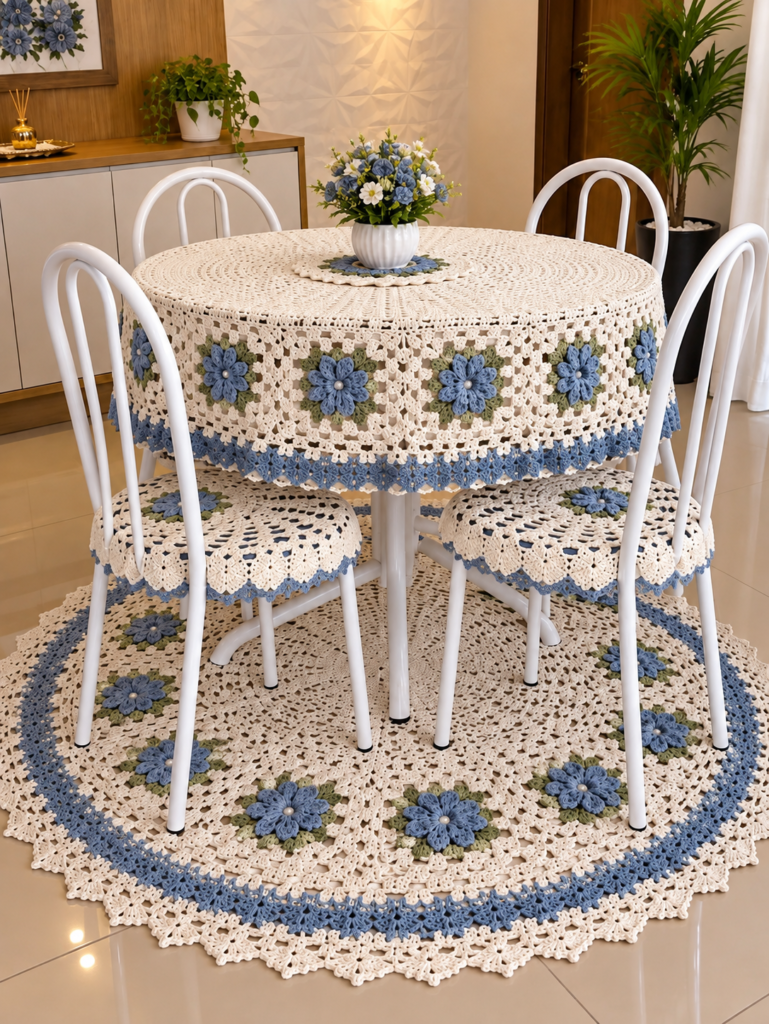
A round tablecloth with a lacy cream open-mesh body carries a ring of square motifs, each with a raised eight-petal denim-blue flower on a sage star base. A denim scalloped border band frames the piece.
Construction and Pattern Direction
Sample one layered flower square and adapt it to eight denim-blue petals on a sage star base. Keep the pearl-bead centre as an optional finish.
Layout and Finishing
Place the square motifs in a ring, join them into the cream mesh ground, and then add the scalloped band. The photo does not state the diameter, so size the round by measuring your table.
Practice pattern: Layered Five-Petal Flower Square Practice Motif (full counted steps with photo 1).
Looking for more? You may also like 14 Crochet Table Decor and Coasters: Runners, Lace Doilies and Christmas Panels, 20 Crochet Table Decor Ideas: Coasters, Doilies and Lace Runners and 8 Crochet Table Runners and Coasters: Christmas, Lace and Rose Motifs.